
The complete succession planning process: From first step to full rollout
| Tempo di lettura:


Leadership gaps cost organizations far more than vacant positions. They erode institutional knowledge, disrupt operations, and shake stakeholder confidence. Yet 34% of U.S. public company directors now identify CEO and C-suite succession planning as a top priority for 2026, a significant jump that signals a shift in how boards approach leadership continuity.
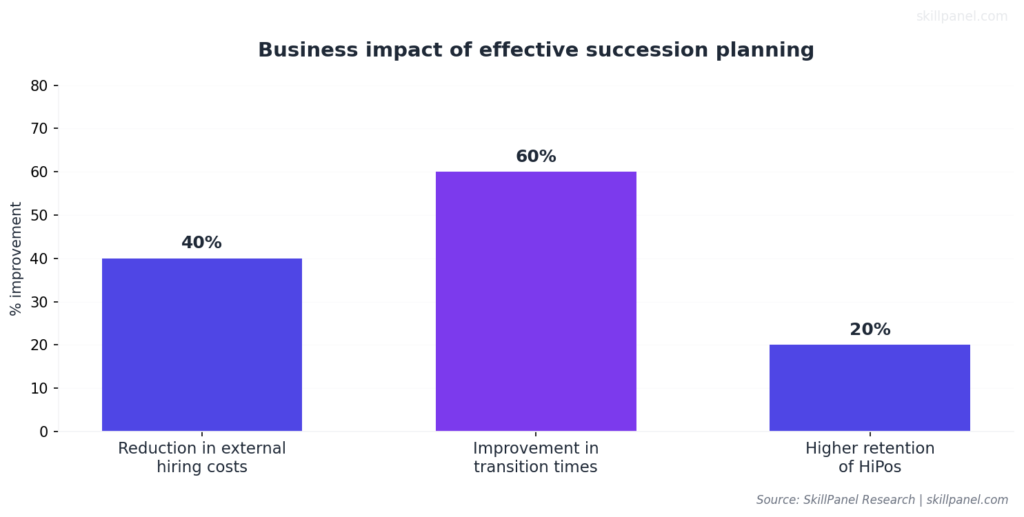
The succession planning process has evolved beyond simply naming heirs apparent. Modern succession strategies demand data-driven assessments, deliberate talent development, and continuous adaptation to workforce dynamics. Organizations that master this process reduce external hiring costs by up to 40%, improve leadership transition times by 60%, and achieve 20% higher retention rates among high-potential employees.
This guide delivers a practical framework for building succession plans that protect business continuity while developing your internal talent pipeline. You’ll discover actionable steps, proven methodologies, and real-world applications that help you identify critical roles, assess candidates objectively, and prepare your organization for seamless leadership transitions.
Transparency note
This article is published by SkillPanel, an AI-powered skills intelligence platform. While we reference our own solution where relevant to succession planning tools, we also present alternative approaches and competing platforms to provide balanced guidance. Our goal is to help you understand succession planning fundamentals and choose the right tools for your needs, whether that includes our platform or not.
What makes succession planning effective in 2026
Successful succession planning requires more than good intentions. Organizations must approach it as a strategic discipline that integrates with business objectives, leverages technology, and adapts to rapid market changes. The most effective succession strategies share specific characteristics that distinguish them from superficial planning exercises.
Core definition and evolution
Succession planning is the systematic process of identifying, evaluating, and developing employees to fill critical leadership and key positions when they become vacant. The succession planning meaning has expanded significantly from its traditional focus on executive roles. Today’s succession planning definition encompasses a strategic, data-driven approach that addresses leadership needs across organizational levels while building talent pipelines that support long-term business growth.
The evolution reflects fundamental shifts in workforce dynamics. Remote work, accelerating retirements, and skills-based hiring have transformed what succession planning means in practice. Organizations now face the challenge of preparing for roles that may not yet exist while managing knowledge transfer from departing leaders. This reality demands succession planning systems that remain flexible enough to accommodate emerging business needs while maintaining the structure necessary for consistent execution.
Modern succession planning integrates workforce analytics, skills intelligence, and predictive modeling. Technology platforms now enable organizations to visualize workforce capabilities through dynamic skills maps, identify competency gaps with precision, and track development progress in real-time. This technological foundation transforms succession planning from a periodic exercise into a continuous strategic process.
Why succession planning is critical for business continuity
Leadership transitions represent inflection points where organizations either maintain momentum or stumble. Effective succession planning serves as your insurance policy against disruption, ensuring critical roles remain filled by qualified individuals who can drive performance forward.
The succession planning importance extends across multiple dimensions. Organizations with structured succession planning processes experience faster leadership transitions, with some reporting 60% improvement in transition times. This speed matters because vacant leadership positions create uncertainty that ripples through teams, affects decision-making velocity, and can strain client relationships.
Institutional knowledge preservation stands as another compelling argument. When experienced leaders depart without adequate succession preparation, they take years of industry insights, relationship networks, and operational expertise with them. Knowledge transfer gaps hit sectors particularly hard— 67% of legal professionals report issues when departing leaders take unwritten expertise with them. This knowledge drain creates learning curves for new leaders that can last months or years, during which organizational effectiveness suffers.
Despite widespread recognition—86% of over 2,500 global business leaders say succession planning is critical to organizational success—many companies struggle with execution. The gap between acknowledging importance and implementing effective succession strategies reveals the complexity of translating good intentions into concrete action plans.
The cost of poor succession planning
The price of inadequate succession planning manifests in both immediate expenses and long-term organizational damage. Organizations without robust succession plans face predictable challenges that compound over time, affecting everything from recruitment budgets to competitive positioning.
Nearly two-thirds of U.S. family businesses lack a documented and communicated succession plan, contributing to a survival crisis where only 30% reach a second generation. While family business dynamics present unique challenges, the underlying lesson applies universally: succession planning failures threaten organizational continuity at its most fundamental level.
External hiring costs escalate rapidly when organizations must search outside for leadership talent. Companies with strong succession planning processes report 40% reduction in external hiring costs by developing internal candidates who require less onboarding time and possess existing organizational knowledge. Beyond direct recruitment expenses, external hires carry higher risk of cultural misalignment and longer performance ramp-up periods.
Employee morale suffers when high-potential talent sees no clear advancement path, leading to retention problems among the very individuals you need for future leadership. 62% of small-business owners find succession planning overwhelming, which explains why many delay until crisis forces reactive decision-making rather than strategic preparation.
Types of succession planning approaches
Different organizational contexts demand different succession strategies. Understanding the types of succession planning allows you to design approaches that match your specific needs, resources, and risk profile.
Strategic long-term succession planning
Strategic long-term succession planning takes a proactive, deliberate approach to leadership development. This methodology focuses on identifying high-potential employees early in their careers and grooming them through sustained development program that span multiple years.
Organizations implementing strategic succession planning create structured pathways that include job rotations, mentoring relationships, stretch assignments, and formal training. The timeline extends three to five years or more, allowing candidates to progressively take on challenging responsibilities, learn from mistakes in lower-stakes situations, and demonstrate sustained performance before formal transitions occur.
This approach aligns succession planning with business strategy by considering future organizational needs rather than simply filling current roles. Companies anticipate market evolution, technological shifts, and strategic pivots that will reshape leadership requirements. Development plans incorporate emerging competencies like digital fluency, change management, and global business acumen that tomorrow’s leaders will need.
The strategic approach yields significant benefits beyond immediate vacancy coverage. Organizations build bench strength—targeting 80% of critical roles with at least one “ready now” successor—that provides resilience against multiple simultaneous departures. Clear career progression paths boost engagement by showing high-potential employees realistic growth opportunities, supporting 90%+ annual retention rates among succession candidates.
Emergency succession planning
Emergency succession planning addresses the reality that leadership departures don’t always follow predictable timelines. Unexpected resignations, health crises, and organizational restructurings require rapid response capabilities that strategic planning alone cannot provide.
This reactive strategy emphasizes readiness for immediate deployment. Organizations maintain regularly updated lists of candidates who could step into critical roles within days or weeks, even if they haven’t completed full development programs. Cross-training programs ensure multiple individuals possess foundational knowledge for key positions, reducing single-point dependencies.
Emergency plans typically designate interim leaders who can maintain stability while longer-term succession processes unfold. These interim arrangements prevent leadership vacuums that create uncertainty and allow organizations to evaluate permanent succession candidates without making rushed decisions under pressure.
The COVID-19 pandemic demonstrated the value of emergency preparedness. Organizations with documented contingency plans adapted more smoothly to sudden workforce disruptions than those attempting to improvise during crisis. Emergency succession planning functions as organizational insurance—ideally never needed, but invaluable when circumstances demand rapid response.
Executive vs. organization-wide succession planning
Executive succession planning targets C-suite and senior leadership roles through highly structured, board-involved processes. This approach reflects the disproportionate impact these positions have on organizational direction and the complexity of finding qualified replacements.
Executive-focused succession typically involves formal committees of board members, senior executives, and HR leaders who conduct comprehensive assessments, develop detailed competency frameworks, and maintain ongoing oversight. The process emphasizes external benchmarking, succession scenario planning, and sophisticated evaluation methodologies that account for strategic vision and stakeholder management capabilities.
However, limiting succession planning to executive positions creates dangerous gaps. Most organizations develop succession plans for only 25% of the workforce, typically senior positions, leaving middle management and specialized technical roles exposed. This narrow focus ignores the reality that leadership exists throughout organizational structures and that talent pipelines require development across multiple levels.
Organization-wide succession planning extends beyond the executive suite to encompass all key positions. This comprehensive approach recognizes that managers, technical specialists, and individual contributors in critical functions require succession consideration. Organizations implementing broad succession strategies build inclusive talent pools, track diversity metrics across succession candidates, and leverage technology platforms to manage pipeline complexity.
The 9-step succession planning process
Building effective succession plans requires systematic execution across interconnected phases. This nine-step succession planning process provides a structured framework for identifying needs, developing talent, and ensuring continuity.
Step 1: Identify critical positions and future organizational needs
Your succession planning journey begins by determining which roles warrant focused attention. Not all positions carry equal organizational risk, and spreading resources too thin dilutes effectiveness.
Start by convening leadership teams to evaluate roles based on specific criteria: impact on business continuity, difficulty of external replacement, specialized knowledge requirements, and strategic importance. Prioritize positions where vacancy would cause significant operational harm, revenue loss, or strategic setbacks. Initial focus on five to ten critical roles allows manageable scope while building succession planning capabilities.
Document not just current position requirements but anticipated future needs. Business evolution means tomorrow’s leaders will face different challenges than today’s. Consider emerging technologies, market expansions, regulatory changes, and strategic initiatives that will reshape role demands. This forward-looking perspective ensures development programs prepare candidates for roles as they will exist, not as they are now.
Hold structured review meetings where stakeholders present role nominations, debate priorities, and reach consensus. Data-driven insights into which competencies matter most for business objectives help teams move beyond subjective judgments toward evidence-based prioritization.
Step 2: Define role requirements and competency profiles
Once critical positions are identified, create detailed success profiles that serve as benchmarks for candidate assessment and development. These profiles articulate exactly what makes someone successful in each role.
Build comprehensive competency frameworks that capture technical skills, leadership capabilities, behavioral attributes, and cultural fit indicators. Technical skills might include financial acumen, industry expertise, or operational knowledge. Leadership competencies encompass strategic thinking, people development, change management, and decision-making under uncertainty. Behavioral attributes address communication styles, resilience, and collaboration approaches.
Establish key performance indicators that define success for each position. What outcomes must leaders achieve? What stakeholder relationships must they manage? What decisions will they make autonomously? Clear performance expectations guide both candidate evaluation and development planning.
Consider the three to five-year horizon when defining requirements. If digital transformation will reshape operations, include digital literacy in competency profiles even if current role holders lack it. This future-focused approach ensures succession candidates develop capabilities the organization will need, not just those it needed in the past.
Success profiles should be specific enough to guide assessment but flexible enough to accommodate diverse candidates who may achieve results through different approaches. Avoid over-specifying personal characteristics in ways that inadvertently narrow the candidate pool or introduce bias.
Step 3: Assess your current talent pool
Understanding existing talent capabilities reveals your succession readiness and identifies where development investments should concentrate. Comprehensive assessment combines multiple evaluation methods to build objective candidate profiles.
Common challenge: Teams often struggle here when relying on single evaluation sources that introduce bias. If assessments feel subjective or incomplete, incorporate multiple perspectives through 360-degree feedback and validated assessment tools.
Evaluation methods and tools
Robust talent assessment employs diverse evaluation approaches that capture different capability dimensions. Performance reviews provide historical track records but should be supplemented with forward-looking potential assessments.
The 9-Box Grid is widely used to simultaneously evaluate current performance and future potential. This matrix plots employees on two dimensions—performance through current job ratings and potential for succeeding in higher-level roles. Candidates are distributed across nine boxes, allowing HR leaders to visually identify high-potential performers ready for advancement versus those needing development. The effectiveness lies in its ability to standardize talent comparison across the organization and reveal bench strength at a glance.
360-degree feedback combined with performance reviews provides multifaceted evaluations. This approach gathers input from multiple sources—current incumbents, senior management, succession advisory teams, peers, and direct reports—to provide comprehensive insights into a candidate’s capabilities and readiness. The evaluation incorporates estimated timelines for when candidates may be ready, creating a more objective lens than single-source assessments.
Validated leadership assessments like the Leadership Skills Profile – Revised (LSP-R) evaluate candidates against role-specific competencies. The process begins by developing a “Success Profile” documenting key competencies required for a critical role. Assessors then rate each candidate on these defined criteria, identifying notable gaps between current skills and those needed for the target position. This approach replaces subjective judgment with objective data on candidates’ strengths and development needs.
Psychometric assessments like the Hogan Personality Assessment reveal personality traits that predict leadership success. The Watson-Glaser critical thinking test measures analytical capabilities essential for complex decision-making. Leadership self-assessments help candidates reflect on their own strengths and development needs.
SkillPanel (our platform) integrates multi-source assessment capabilities—combining self-evaluations, peer reviews, manager input, and technical assessments into unifiedskill profiles. The platform’s real-time analytics reveal competency gaps by comparing individual capabilities against critical role requirements, enabling data-driven succession decisions.
Identifying high-potential employees
High-potential employees represent your succession pipeline’s foundation. These individuals demonstrate not just strong current performance but capacity for advancement into positions of greater scope and complexity.
Look for indicators beyond performance metrics: learning agility, adaptability to change, strategic perspective, and commitment to organizational success. High-potentials seek development opportunities, respond positively to feedback, and demonstrate resilience when facing setbacks.
Evaluate candidates’ growth trajectories rather than current state alone. Have they expanded their capabilities over time? Do they seek challenging assignments? How quickly do they master new skills or knowledge domains?
Avoid the common trap of assuming high performance in current roles automatically signals potential for leadership positions. Individual contributor excellence requires different competencies than people management, and promotion based solely on technical excellence can create mediocre leaders while losing exceptional individual contributors.
Communicate openly with identified high-potentials about succession opportunities. Transparency about career paths increases retention among these critical employees, with companies showing 20% increased retention among those with structured succession planning.
Step 4: Identify succession candidates and skills gaps
With thorough talent assessments complete, match candidates to critical roles based on competency alignment and readiness timelines. This step reveals both your succession bench strength and development priorities.
Build a “bench” of multiple candidates for each critical position rather than designating single heirs apparent. Target at least two to three qualified successors per role to reduce vulnerability if candidates leave, underperform, or prove unsuitable. This redundancy proved essential during unexpected workforce disruptions and remains a succession planning best practice.
Categorize candidates by readiness levels: Level A (ready within 3 years), Level B (ready in 3-5 years), and Level C (ready after 5 years). This tiered framework allows organizations to track candidate progress over time and assess overall pipeline strength while maintaining transparency about development trajectories. Scoring incorporates demographics, education, experience, and assessment results, enabling organizations to prioritize development investments and identify talent gaps requiring external recruitment.
Compare candidate capabilities against success profiles to identify skills gaps. Where do potential successors fall short of role requirements? Which competencies require development? Gap analysis should be specific—”needs experience managing P&L of $50M+” rather than vague “needs leadership development.”
Use bench strength matrices to visualize succession readiness across the organization. These tools highlight which critical roles lack adequate coverage, where readiness timelines align with expected vacancies, and which candidates appear in multiple succession plans (potentially creating conflicts if simultaneous vacancies occur).
Common challenge: If you discover inadequate bench strength across multiple critical roles, don’t panic. Prioritize the highest-risk positions first (those with nearest expected vacancies or highest business impact), and accelerate development for near-term ready candidates while building longer-term pipelines.
Step 5: Create individual development plans
Individual development plans (IDPs) translate gap analysis into concrete action. These personalized roadmaps guide candidates’ growth toward succession readiness through targeted activities and clear milestones.
Effective IDPs address priority skill gaps identified in assessments. If strategic thinking needs strengthening, the plan might include strategy workshops, exposure to executive decision-making, and practice developing business cases. Leadership gaps might be addressed through management training, coaching, and supervised people management opportunities.
Specify learning activities, timelines, accountability owners, and success measures. Vague development intentions (“improve communication skills”) fail where specific commitments (“complete executive presentation course by Q2, deliver three presentations to senior leadership by Q4”) succeed. Clear milestones enable progress tracking and ensure development remains on schedule.
Balance formal training with experiential learning. Classroom instruction builds knowledge foundations, but leadership capabilities develop primarily through practice. Include stretch assignments that expose candidates to situations beyond their comfort zones, mentoring relationships with experienced leaders, and job rotations that broaden perspective.
SkillPanel’s platform (our solution) enables creation of personalized development plans tied directly to critical role requirements. The system’s predictive gap analysis identifies priority development areas, while integration with learning management systems connects candidates to relevant training resources. Dynamic skills maps track progress as candidates complete development activities and acquire new capabilities.
Development plans should feel motivating rather than punitive. Frame them as investments in candidates’ careers that benefit both individual growth and organizational needs. Regular check-ins maintain momentum and allow adjustments as circumstances change.
Common challenge: Development plans often stall when candidates get overwhelmed by competing priorities. If progress lags, break large development goals into smaller monthly milestones and schedule dedicated development time on candidates’ calendars. Treat development activities as non-negotiable commitments, not optional extras.
Step 6: Implement training and mentorship programs
Development plans require organizational infrastructure that delivers learning experiences and supports candidate growth. Training and mentorship programs provide the mechanisms through which potential successors build capabilities.
Establish formal mentorship pairings that connect succession candidates with experienced leaders who can share insights, provide guidance, and offer perspective on leadership challenges. Effective mentoring relationships involve regular meetings, open dialogue, and mutual commitment. Mentors should represent diverse leadership styles and backgrounds to expose candidates to multiple approaches.
Deploy targeted training programs that address common development needs across succession candidates. Executive education programs, leadership workshops, and industry-specific training build foundational knowledge. Supplement group training with individualized coaching for personalized development support.
Create stretch assignment opportunities that push candidates beyond current capabilities. These might include leading cross-functional projects, managing temporary teams, representing the organization in external forums, or taking temporary assignments in different business units. Controlled exposure to higher-level responsibilities allows candidates to demonstrate readiness while developing confidence.
Facilitate knowledge transfer from current role holders to potential successors. Structured job shadowing, collaborative work on strategic initiatives, and documented procedures ensure institutional knowledge transfers before departures occur. This gradual transition reduces disruption and accelerates new leader onboarding.
Allocate sufficient budget and executive time for the development program success. 48% of organizations cite budget constraints as a key barrier to effective succession planning. Treating development as discretionary spending rather than strategic investment undermines succession program effectiveness.
Step 7: Document your succession plan
Documentation transforms succession planning from informal understanding into actionable strategy. Written plans create accountability, enable communication, and provide reference points for monitoring progress.
Comprehensive succession documentation includes identified critical roles, defined competency requirements, assessed candidate profiles, skills gap analyses, individual development plans, and transition timelines. Record the rationale behind candidate selection and readiness assessments to ensure transparency and support decision-making.
Establish clear governance structures that define responsibilities. Who reviews succession plans? How frequently? What triggers updates? Who approves succession decisions? Well-defined roles prevent confusion and ensure consistent plan maintenance.
Consider documentation sensitivity carefully. Full succession plans contain confidential information about candidate assessments and organizational vulnerabilities. Maintain appropriate access controls while ensuring relevant stakeholders can access information they need.
Use succession planning templates to standardize documentation across the organization. Consistent formats simplify reviews, enable comparison across business units, and reduce administrative burden. Many succession planning tools provide built-in templates that integrate with broader talent management processes.
Documentation should be dynamic rather than static. Plans gathering dust on shelves serve no purpose. Build documentation systems that facilitate regular updates and enable real-time access during decision-making.
Step 8: Establish a transition timeline
Effective succession execution requires thoughtful timing that balances development readiness with organizational needs. Transition timelines provide structure for moving candidates into new roles while managing risk.
Realistic timeline expectations: Organizations typically take 6-9 months for initial succession planning implementation, with specific milestones at 30 days (critical roles identified and committees formed), 60 days (competency profiles completed and initial assessments conducted), and 90 days (development plans finalized and training programs launched). Don’t expect immediate succession readiness—do expect gradual pipeline strengthening over 18-36 months as candidates complete development programs.
Map expected vacancy timelines based on retirement eligibility, contract terms, and announced departures. Cross-reference these dates with candidate readiness assessments to identify alignment or gaps. If a critical role holder plans retirement in 18 months but your strongest successor needs 24 months of development, you face a timing challenge requiring accelerated development or interim arrangements.
Build gradual transition approaches where feasible. Rather than abrupt changeovers, phase successors into increasing responsibility while current leaders remain available for guidance. This shadowing period allows knowledge transfer, relationship building, and on-the-job learning that smooths transitions.
Plan for emergency scenarios despite strategic timelines. Unexpected departures happen regardless of preparation, requiring contingency plans with interim leaders who can step in immediately. Emergency succession plans should complement rather than replace strategic development timelines.
Consider broader workforce implications when scheduling transitions. Multiple simultaneous leadership changes can strain organizational stability. Stagger transitions where possible to maintain continuity and prevent overwhelming remaining leaders with mentoring and onboarding demands.
Communicate timelines appropriately to stakeholders. Candidates deserve clarity about realistic advancement timeframes. Current role holders may need extended notice for comprehensive knowledge transfer. Board members and investors require confidence that leadership transitions follow deliberate plans.
Step 9: Monitor, review, and update regularly
Succession planning demands ongoing attention rather than periodic updates. Regular monitoring ensures plans remain relevant as circumstances change and development progresses on schedule.
Conduct formal succession plan reviews at least annually, ideally during Q1 or Q2 to align with performance review cycles and budget planning. These reviews should reassess critical role priorities, update candidate readiness levels, evaluate development progress, and adjust plans based on business strategy changes.
Track concrete succession planning metrics that indicate program health: percentage of critical roles with identified successors, bench strength ratios, candidate retention rates (targeting 90%+ retention of high-potentials), time to fill critical vacancies, and performance of promoted internal candidates in their new roles.
Establish triggers that necessitate off-cycle plan updates. Strategic shifts, organizational restructurings, unexpected departures, and changes in business priorities may invalidate existing succession plans. Responsive updating prevents plans from becoming obsolete between scheduled reviews.
Form dedicated succession committees with clear meeting cadences and responsibilities. These cross-functional teams including HR leaders, business unit executives, and senior managers provide ongoing governance and ensure succession planning receives consistent executive attention.
Gather feedback from succession candidates about development program effectiveness. Are they receiving meaningful growth opportunities? Do development activities align with stated career goals? Continuous improvement based on participant input strengthens program quality and engagement.
SkillPanel’s platform (our solution) supports continuous succession monitoring through automated tracking of development activities, real-time competency assessments, and custom dashboards visualizing pipeline health across the organization. Integration with HR systems ensures succession data stays current as employees complete training, change roles, or leave the organization.
What to do when plans don’t go as expected
Even well-designed succession plans face implementation challenges. Here’s how to address common scenarios that disrupt succession planning:
High-potential candidate leaves mid-development: Activate your bench strength by accelerating development for your next-tier candidate. Conduct exit interviews to understand why the candidate left—if succession timeline clarity was an issue, communicate more transparently with remaining candidates. Review compensation and recognition practices to ensure high-potentials feel valued. This scenario reinforces why maintaining 2-3 candidates per critical role is essential.
Business pivot changes role requirements: Convene an emergency succession committee meeting to reassess competency profiles. Identify which existing candidate skills remain relevant and which new capabilities are now required. Adjust development plans to incorporate emerging competency needs. Consider whether external hiring now makes sense given the changed requirements, but first evaluate whether existing candidates can develop new capabilities within acceptable timeframes.
Multiple critical departures happen simultaneously: Prioritize interim coverage for the highest-impact roles first. Deploy your emergency succession plans to establish temporary stability. Stagger permanent successor announcements to avoid overwhelming the organization with simultaneous transitions. Consider bringing back recently retired leaders as temporary consultants to bridge knowledge gaps while permanent successors onboard. This crisis situation often reveals weaknesses in bench depth that should drive future succession planning investment.
Identified successor proves unsuitable: Act quickly once unsuitability becomes clear—prolonging a poor fit damages both the individual and the organization. Provide honest feedback to the candidate and transition them back to a role matching their capabilities. Activate alternative candidates from your succession bench. Conduct a post-mortem on your assessment process: Did you miss red flags? Were development activities insufficient? Use these insights to strengthen future candidate evaluation.
Resistance to change often blocks implementation, especially when employees fear job insecurity or next-generation leaders lack interest. Address this by implementing formal mentorship and coaching programs that build skills and interest gradually, making succession feel like development rather than displacement.
Plans becoming outdated represents another common pitfall. Counter this with annual formal updates, quarterly informal check-ins, and clear written documentation that prevents verbal agreements from creating lost accountability.
Succession planning frameworks and models
Structured frameworks provide foundations for succession planning systems that scale across organizations. Understanding different succession planning models helps you choose or build approaches suited to your specific context.
Choosing the right framework for your organization
Multiple succession planning frameworks address different organizational priorities and constraints. Strategic models emphasize long-term leadership pipeline development aligned with business goals. Competency-based frameworks focus on specific skills and capabilities required for role success. Risk-based approaches prioritize roles by business continuity impact. Cultural frameworks emphasize values alignment and leadership style fit.
The strategic model suits organizations undergoing transformation or rapid growth where future leadership needs differ substantially from current requirements. This approach demands significant forward-looking analysis but ensures succession candidates develop capabilities the organization will need.
Competency-based frameworks work well for organizations with clearly defined role requirements and established capability models. This approach enables objective assessment and development planning tied directly to success factors. Skills intelligence platforms exemplify competency-based succession planning through precise skill mapping and gap analysis.
Risk-based models address organizations facing succession vulnerability in specific areas. By prioritizing high-impact, hard-to-replace positions, this approach allocates limited resources where they matter most. Smaller organizations often start with risk-based frameworks before expanding scope.
Cultural frameworks suit organizations where leadership style and values alignment significantly affect success. Family businesses, mission-driven nonprofits, and companies with distinctive cultures often emphasize cultural fit alongside capabilities when evaluating succession candidates.
McKinsey advocates structured approaches that include forming succession committees early, mapping successor criteria against business needs, conducting regular candidate reviews with developmental feedback, and providing experiences like job rotations and stretch assignments. This methodology emphasizes depersonalizing succession decisions through board-level governance and systematic candidate development.
Most organizations benefit from hybrid approaches that combine elements from multiple frameworks. A competency-based foundation with risk-based prioritization and strategic forward-looking perspective provides balanced coverage. The succession planning framework you choose should reflect your organizational maturity, resources, and most pressing succession challenges.
Building your custom succession planning model
While established frameworks provide starting points, many organizations benefit from customized succession planning models tailored to specific needs and contexts. Custom models allow flexibility while maintaining systematic rigor.
Begin by identifying your organization’s unique succession challenges. Do you face near-term retirement waves? Rapid growth requiring leadership capacity expansion? High turnover in specific functional areas? Understanding your particular pain points shapes model design.
Incorporate stakeholder input from executives, HR leaders, and potential succession candidates. What barriers do they see in current approaches? What capabilities do they believe future leaders need? Participatory design builds buy-in while surfacing insights that improve model effectiveness.
Define clear phases for your custom model—typically covering assessment, planning, development, transition, and evaluation stages. Within each phase, specify activities, decision points, accountability, and outputs that create logical progression.
Establish governance structures appropriate for your organizational size and complexity. A committee-driven approach works for larger enterprises needing cross-functional coordination. Smaller organizations might designate individual accountability with board oversight.
Balance standardization with flexibility. Consistent processes enable comparison and ensure fairness, but rigid approaches fail to accommodate contextual differences across departments, role types, and individual circumstances.
Essential succession planning tools and technology
Technology transforms succession planning from administrative burden into strategic capability. The right succession planning tools enable data-driven decisions, efficient processes, and scalable programs that grow with your organization.
Talent management software
Comprehensive talent management platforms provide integrated environments for managing succession planning alongside broader HR functions. These systems centralize employee data, track development activities, and support workforce planning that incorporates succession needs.
Cornerstone OnDemand delivers enterprise-scale talent management with robust succession capabilities. The platform integrates talent pools, readiness tracking, learning paths, and analytics for workforce continuity. Organizations can build comprehensive leadership pipelines while maintaining visibility into development progress across the workforce.
PageUp excels at leadership pipeline development through features including successor identification, bench strength dashboards, customizable development plans, and visual workflow management. The platform’s intuitive interface makes complex succession planning processes accessible to stakeholders beyond HR specialists.
SumTotal approaches succession through competency-based frameworks that link skill assessments, personalized learning, and performance tracking. This skills-centered methodology aligns naturally with organizations adopting capabilities-based talent strategies.
These platforms enable organization-wide succession planning that previously required infeasible administrative effort. Automated reminders, workflow approvals, and progress tracking reduce manual overhead while improving plan compliance.
Assessment and analytics tools
Specialized assessment and analytics tools provide deeper insights into candidate capabilities and organizational readiness for succession challenges. These succession planning tools complement broader talent systems with focused evaluation and predictive analytics.
Plum leverages AI-driven predictive analytics and behavioral assessments to identify potential leaders while emphasizing bias reduction and diversity goals. The platform’s talent matching capabilities help organizations discover succession candidates they might otherwise overlook.
TalentGuard supports competency frameworks, career pathing, real-time dashboards for pipeline depth, and targeted development for high-potentials. Organizations can visualize succession coverage across the enterprise and drill into specific development needs.
PeopleFluent delivers enterprise-grade tools including 9-box grids, sophisticated talent pools, deep analytics, and customizable succession workflows suited for complex or regulated industries requiring comprehensive documentation and compliance.
SkillPanel (our platform) differentiates through its focus on skills intelligence that powers succession planning. The platform’s dynamic skills maps visualize workforce capabilities across roles and departments, providing unprecedented visibility into organizational competencies. Multi-source assessments combine self-evaluation, peer reviews, manager input, and technical evaluations for objective candidate profiles. Predictive gap analysis identifies where capabilities fall short of critical role requirements, while personalized development plans address specific skill gaps. Integration with existing HR systems and learning platforms ensures succession planning data stays current as employees develop new capabilities.
The succession planning software] market valued at USD 1.43 billion in 2024 is projected to reach USD 3.06 billion by 2033, driven by AI integration for talent assessment and strategic workforce planning. This growth reflects increasing recognition that technology enables succession planning effectiveness previously unattainable through manual processes.
Succession planning templates and resources
Templates and frameworks provide practical starting points that accelerate succession planning implementation. While not as dynamic as software platforms, well-designed succession planning templates standardize processes and reduce documentation burden.
Succession planning templates typically include role requirement worksheets that capture competency profiles, candidate assessment forms for consistent evaluation, development plan templates outlining learning activities and timelines, transition checklists ensuring comprehensive handoffs, and review schedules maintaining ongoing plan currency.
Professional associations like SHRM offer succession planning resources including sample policies, implementation guides, and best practice frameworks. These resources benefit organizations building succession planning capabilities for the first time or enhancing existing programs.
Industry-specific templates address unique sectoral considerations. Healthcare succession planning deals with clinical credentialing and patient continuity. Government succession templates incorporate civil service requirements and political transitions. Financial services templates emphasize regulatory compliance and fiduciary responsibilities.
Customize templates to reflect your organizational context rather than using them verbatim. Generic templates provide structure but require adaptation to match your culture, vocabulary, and specific succession challenges.
Succession planning best practices
Decades of research and real-world implementation reveal recurring patterns that distinguish effective succession planning from superficial exercises. These best practices for succession planning apply across industries and organizational types.
Align succession planning with business strategy
Succession planning effectiveness depends fundamentally on alignment with broader organizational strategy. Leadership requirements flow from business objectives, making strategic integration essential for identifying relevant competencies and development priorities.
Begin strategic alignment by understanding where your organization is heading. What markets will you enter? What capabilities will you need? How will technology transform operations? These strategic questions shape what future leaders must deliver.
Map critical role requirements to strategic imperatives. If digital transformation represents a strategic priority, leadership competency profiles should emphasize digital literacy, technology adoption capabilities, and comfort with data-driven decision-making. This linkage ensures succession candidates develop capabilities the organization will need.
Involve C-suite executives in succession planning governance. When only 26% of CEOs and board members report that CEO succession planning is treated as a top priority despite its recognized importance, the gap signals insufficient executive engagement. Senior leadership participation demonstrates commitment and provides strategic perspective that improves succession plan relevance.
Review succession plans whenever business strategy evolves. Acquisitions, market pivots, and product portfolio changes may alter leadership requirements or critical role priorities. Succession plans that don’t adapt to strategic shifts become increasingly disconnected from organizational needs.
Prioritize transparency and communication
Succession planning secrecy undermines program effectiveness while transparency builds trust, engagement, and candidate motivation. Open communication about succession processes represents a best practice that strengthens organizational culture.
Be transparent with identified succession candidates about their status and development expectations. When employees understand they’re being prepared for advancement, retention improves by 20% among high-potential employees. Clear communication prevents talented individuals from seeking external opportunities when they’re already in line for internal advancement.
Explain succession criteria and selection processes broadly to demystify how advancement decisions occur. Perception of fairness matters as much as actual fairness for maintaining morale and trust. When promotion processes seem opaque or arbitrary, employees disengage and question leadership integrity.
Communicate succession planning importance to the broader organization without breaching individual confidentiality. Employees should understand that the organization invests in leadership development and creates advancement pathways. This messaging reinforces commitment to talent development as an organizational value.
Balance transparency with appropriate discretion. Publicizing detailed succession plans could create awkwardness with current role holders, raise false expectations among candidates whose circumstances change, or telegraph competitive information externally. Navigate this balance by focusing communication on process and principles rather than specific individuals or timelines.
Focus on diversity and inclusion
Succession planning provides powerful leverage for advancing diversity and inclusion goals. Intentional attention to diverse candidate pools ensures leadership representation matches workforce demographics and brings varied perspectives into decision-making roles.
Examine succession pools for diversity gaps across dimensions including gender, race, ethnicity, age, background, and experience. Homogeneous succession pools often reflect unconscious bias in talent identification rather than actual capability distribution. When succession pipelines lack diversity, investigation into assessment and selection processes can reveal where bias enters.
Use objective criteria and structured assessments to reduce bias in candidate evaluation. Skills-based assessments, competency frameworks, and data-driven tools minimize subjective judgments that often perpetuate existing leadership demographics. Multi-source assessment approaches counter individual bias by incorporating diverse evaluator perspectives into composite candidate profiles.
Actively develop high-potential employees from underrepresented groups through targeted mentorship, sponsorship, and stretch assignment opportunities. Research shows diverse candidates often lack the informal networks and visibility that benefit majority group members in advancement. Proactive development equalizes access to career-building experiences.
Set diversity goals for succession pools and track progress transparently. What gets measured gets managed, and public commitment to diversity in succession pipelines creates accountability for results. Monitor not just pool composition but advancement rates and development opportunity distribution.
Challenge assumptions about what leadership “looks like” that may inadvertently narrow candidate pools. Effective leaders come from diverse backgrounds and employ varied leadership styles. Focus assessment on demonstrated capabilities and potential rather than superficial characteristics or unstated assumptions about leadership attributes.
Integrate with broader talent management
Succession planning operates most effectively as an integrated component of comprehensive talent management rather than a standalone program. Integration ensures consistent data, aligned processes, and efficient resource utilization.
Connect succession planning with performance management by incorporating succession potential into regular performance reviews. This integration provides current data for candidate assessment while signaling to employees that development and advancement opportunities connect to performance excellence.
Align succession planning with learning and development initiatives by ensuring training programs address competencies relevant to critical roles. Development plans for succession candidates should leverage existing learning infrastructure rather than requiring separate program creation.
Incorporate succession considerations into recruitment and hiring decisions. External hiring for roles with internal succession candidates may signal that development programs aren’t effective. Conversely, external perspectives sometimes benefit organizations more than internal promotion. Balance these factors explicitly rather than defaulting to unstated preferences.
Link succession planning with compensation and retention strategies. Succession candidates represent high-value employees whose departure damages organizational preparedness. Ensure compensation, recognition, and retention initiatives prioritize these individuals appropriately.
Start early and plan long-term
Succession planning delivers greatest value when organizations plan years in advance rather than reacting to imminent departures. Early initiation and long-term perspective represent fundamental best practices.
Begin succession planning well before anticipated vacancies. Leaders require three to five years of development for complex roles, making last-minute preparation ineffective. Organizations should ideally form succession committees and initiate candidate assessment at the beginning of a CEO’s tenure, not near the end.
Identify high-potential employees early in their careers to maximize development time. Talent often becomes apparent years before individuals reach positions immediately below target roles. Early identification enables comprehensive development that builds readiness gradually.
Build continuous development cultures rather than episodic training programs. Leadership capabilities develop primarily through experience, reflection, and ongoing learning rather than discrete training events. Organizations that embed development into daily work create stronger succession pipelines than those relying on occasional development initiatives.
Maintain rolling succession plans that extend multiple years forward. Three-year planning horizons are common, with annual updates that add another year while refreshing nearer-term assessments. This rolling approach ensures sufficient lead time for development while incorporating current information.
Avoid the trap of waiting until it’s too late. Organizations often fall into reactive succession planning, addressing vacancies only as they arise. This pattern leads to rushed decisions, inadequately prepared successors, missed talent development opportunities, higher emergency hiring costs, and potential business disruption. Starting early prevents these predictable challenges.
Common succession planning mistakes to avoid
Even well-intentioned succession planning efforts can fail through common mistakes that undermine effectiveness. Understanding these pitfalls helps organizations avoid predictable problems.
Waiting until it’s too late
Procrastination ranks among the most damaging succession planning mistakes. Organizations frequently delay formal succession planning until a leader announces departure, leaving insufficient time for proper candidate development and evaluation.
The consequences of delayed planning compound quickly. Rushed assessments lack thoroughness, limiting confidence in candidate selection. Compressed development timelines force shortcuts that leave successors underprepared. External searches become necessary despite internal talent, incurring costs and risks that early planning would have avoided.
Only 51% of board directors reported their organization has a written CEO succession plan in recent surveys, highlighting the prevalence of inadequate preparation. Nearly half of organizations operate without formal documentation despite universal acknowledgment that leadership transitions represent critical risk points.
Start succession planning immediately upon appointing leaders rather than waiting for retirement eligibility. McKinsey recommends forming succession committees at CEO hiring, not years later when departure looms. This early initiation provides adequate development time while signaling that succession represents ongoing strategic priority rather than episodic concern.
Limiting your focus to executive positions only
Executive succession certainly matters, but exclusive focus on C-suite transitions leaves organizations vulnerable across middle management and specialized roles. Most organizations develop succession plans for only 25% of the workforce, typically senior positions, creating dangerous gaps in leadership bench strength.
Critical positions exist throughout organizational structures. Technical experts whose departure would disrupt operations, experienced managers who lead key business units, and specialized professionals with rare skills all warrant succession consideration. When these roles turn over unexpectedly, organizations scramble to fill vacancies with external hires who require extensive onboarding.
Extend succession planning beyond the executive suite to encompass all key positions. Identify critical roles at multiple organizational levels using the same criteria: business impact, replacement difficulty, and knowledge specialization. This comprehensive approach builds resilient organizations prepared for turnover wherever it occurs.
Failing to develop internal candidates
Identifying succession candidates without providing development opportunities represents another common failure. 70% of organizations report long-term leadership pipeline challenges persist despite widespread acknowledgment of succession planning’s importance. This gap often reflects inadequate investment in candidate development.
Succession plans that merely name potential successors without development programs serve a limited purpose. Candidates rarely possess full readiness without targeted capability building through training, mentoring, stretch assignments, and progressive responsibility increases.
Allocate sufficient budget and leadership time for the development program execution. 48% of organizations cite budget constraints as a key barrier to effective succession planning. Treating development as optional rather than essential to succession planning success guarantees inadequate candidate preparation.
Create individual development plans for each succession candidate with specific activities, timelines, and accountability. Monitor progress regularly to ensure development occurs rather than getting deferred indefinitely. Development plans that languish without execution fail to build candidate readiness.
Neglecting to document and communicate the plan
Informal succession planning that exists only in leaders’ heads fails to provide organizational continuity. Documentation ensures succession knowledge survives leadership transitions and enables consistent execution across the organization.
Only 23% of private business owners have fully documented and implemented succession plans, while 30% lack formal plans entirely. This documentation gap means succession knowledge remains trapped in individual minds rather than becoming organizational capability.
Document succession plans comprehensively including role requirements, candidate assessments, development plans, transition timelines, and decision rationale. Written documentation enables review, updates, and consistent execution by multiple stakeholders over time.
Communicate appropriate succession information to stakeholders while respecting confidentiality. Current role holders, succession candidates, executives, and boards require different information levels, but all benefit from clear communication about succession processes and timelines.
Real-world succession planning examples
Examining how organizations succeed or fail at succession planning provides valuable lessons that inform your own approach. These succession planning examples illustrate principles in practice.
Successful corporate succession: Lessons from industry leaders
Procter & Gamble exemplifies succession planning excellence through systematic, transparent processes that develop internal leadership pipelines. When A.G. Lafley began his second CEO tenure, P&G immediately prioritized succession planning, implementing rigorous candidate assessments, transparent board communication, and broad internal talent pool development. The company achieves 99% internal promotion for senior leaders through career-building role rotations that expose candidates to diverse business challenges over extended periods. Candidates rotate through multiple assignments spanning different functions, geographies, and P&L responsibilities, building comprehensive leadership capabilities before assuming top roles.
Toyota New Zealand demonstrates the power of long-term internal development. Over two decades, the company made only two external management hires, grooming leaders like former CEO Alistair Davis internally over decades. This consistent internal-first mentality ensures operational knowledge preservation and smooth leadership transitions that maintain business performance. The approach involves systematic mentorship where senior leaders personally develop their successors through shadowing, co-leadership arrangements, and gradual responsibility transfer.
Unilever’s Future Leaders Program illustrates structured talent development at scale. The company’s long-term development initiative propelled graduates like Jade Wright-Komal to management in 3.5 years, creating a reliable pipeline of future leaders. By investing early in high-potential employees and providing accelerated development experiences including international assignments, cross-functional projects, and executive coaching, Unilever builds succession bench strength across global operations.
Common success factors emerge across these examples: early succession initiation, systematic candidate assessment, substantial development investment, transparent processes, and strong internal-first cultures that retain and promote talent from within.
What happens when succession planning fails
Failure examples provide cautionary lessons about succession planning’s importance. Starbucks’ 2022 CEO succession faced criticism when the company bypassed internal candidates after Kevin Johnson’s retirement, bringing back founder Howard Schultz as interim CEO during an external search. Despite prior internal development efforts, no internal candidate proved ready, leading to prolonged interim leadership and questions about succession planning effectiveness. The situation revealed gaps in development program execution and assessment accuracy.
A global online advertising and search company’s succession planning was rated poorly, with successors rarely “ready now” and becoming less prepared over time as business growth outpaced talent development. Prior failures forced external hires and botched transitions, resulting in delays filling critical roles that missed growth opportunities. The company eventually shifted to more strategic succession discussions focused on business evolution and role changes, acknowledging their previous approach failed to anticipate future leadership requirements.
70% of small businesses fail to successfully sell or transition, with median close rates of just 6.46% for businesses listed for sale. This succession crisis in small business sectors reflects inadequate planning that threatens business survival and local economies. Many small business owners delay planning until they’re ready to exit, leaving insufficient time to develop successors or structure viable transitions.
These failures share common patterns: delayed succession planning until crisis forces action, over-reliance on single successors without backup candidates, inadequate development investment leaving internal candidates unprepared, and lack of systematic processes that create consistency and accountability.
Building your succession plan: Implementation guide
Moving from succession planning theory to operational reality requires practical implementation steps that translate best practices into your organizational context.
Getting executive buy-in
Executive commitment represents the foundation for succession planning success. Without senior leadership engagement, succession planning becomes an HR exercise that lacks strategic integration and resource support.
Articulate succession planning’s business case in terms executives prioritize: risk mitigation, cost avoidance, talent retention, and strategic execution. Frame succession planning as essential business continuity rather than nice-to-have HR program. Highlight that companies with structured succession planning achieve 40% reduction in external hiring costs while improving transition speed and retention.
Present data on succession risks specific to your organization. How many critical role holders are retirement-eligible within five years? What’s the current bench strength for key positions? Where do leadership pipeline gaps create vulnerability? Concrete risk assessment often motivates executive action more effectively than general arguments.
Request specific executive commitments: participation in succession committees, time allocation for candidate mentoring, budget approval for development programs, and personal involvement in succession candidate assessment. Define what executive sponsorship means practically rather than accepting vague support statements.
Leverage board pressure where appropriate. With 34% of U.S. public company directors identifying succession planning as a top 2025 priority, boards increasingly demand succession planning updates and accountability. This external pressure can motivate executives who might otherwise deprioritize succession planning.
Determining budget and resources
Succession planning requires investment in assessment tools, development programs, technology platforms, and administrative support. Adequate budget allocation determines whether succession planning can execute effectively or remains aspirational.
Quantify succession planning costs across key categories: succession planning software and assessment tools, training programs and leadership development workshops, coaching and mentoring program support, administrative time for plan coordination and updates, and temporary coverage costs during developmental rotations or assignments.
While specific budgeting research remains limited, organizations serious about succession planning typically dedicate 1-2% of overall HR budgets to succession-specific initiatives, though this varies by company size and succession challenges.
Consider phased implementation if budget constraints limit the initial scope. Start with executive succession planning for five to ten critical roles before expanding to broader organizational coverage. This staged approach builds capability while demonstrating value that justifies increased investment.
Explore technology ROI carefully. The succession planning software market is growing to USD 3.06 billion by 2033 reflects increasing adoption, but platforms vary dramatically in cost and capability. Match technology investment to your succession planning maturity and organizational scale.
Setting success metrics and KPIs
Measuring succession planning effectiveness enables continuous improvement and demonstrates program value to executive stakeholders. Establish clear metrics that track both process execution and business outcomes.
Key succession planning metrics include percentage of critical roles with identified successors (target 80-100% coverage), bench strength ratio showing average number of qualified successors per role (aim for 2-3 candidates per position), readiness distribution across “ready now,” “1-2 years,” and “3+ years” categories, and succession candidate retention rates (targeting 90%+ annual retention).
Track development program completion rates for individual development plans, average time to fill critical positions when vacancies occur (shorter times indicate better succession readiness), internal promotion rates for critical positions versus external hires, and performance ratings for promoted internal candidates in their new roles during first 12-18 months.
Monitor diversity metrics across succession pools including gender representation, racial and ethnic diversity, and age distribution compared to overall workforce demographics. Track how diverse candidates progress through succession pipelines to identify advancement barriers.
Measure business impact through leadership transition disruption levels, knowledge transfer effectiveness during succession events, and stakeholder confidence scores in succession preparedness. These qualitative indicators complement quantitative metrics for comprehensive program assessment.
Analytics capabilities provide real-time succession metrics dashboards that visualize pipeline health, track development progress, and highlight gaps requiring attention. Custom reporting enables stakeholders to monitor metrics most relevant to their needs.
Creating your action plan
Comprehensive action planning translates succession planning strategy into executable tasks with clear timelines, owners, and deliverables. Detailed action plans ensure implementation momentum and accountability.
Outline implementation phases with specific milestones: Phase 1 might focus on critical role identification and competency profile development over 1-2 months, Phase 2 on talent assessment and candidate selection over 2-3 months, Phase 3 on development plan creation and program launch over 1-2 months, with ongoing phases covering execution, monitoring, and refinement.
Assign clear ownership for each action plan component. Designate who conducts role analyses, performs talent assessments, develops training curricula, coordinates mentorship programs, maintains documentation, and produces progress reports. Ambiguous accountability ensures tasks fall through cracks.
Set realistic timelines that account for stakeholder availability and other organizational priorities. Aggressive schedules that ignore practical constraints create frustration and corner-cutting. Balance urgency with achievability to maintain quality and buy-in.
Build communication plans that inform stakeholders throughout implementation. Regular updates to executives, HR teams, managers, and succession candidates maintain visibility and engagement. Communication frequency should match implementation intensity.
Plan for iteration and learning. Initial succession planning implementations rarely achieve perfection immediately. Schedule review points where teams reflect on what’s working, what needs adjustment, and how processes can improve for subsequent cycles.
Frequently asked questions about succession planning
These common questions about succession planning address practical implementation challenges organizations frequently encounter.
Who should lead succession planning efforts?
HR professionals and senior leadership should collaborate on succession planning leadership, ensuring alignment between talent management expertise and strategic business perspective. HR brings process knowledge, assessment capabilities, and talent management integration. Senior executives contribute strategic insight, candidate evaluation perspectives, and organizational credibility.
Form dedicated succession committees with representatives from HR, business unit leadership, and senior management. This cross-functional approach fosters buy-in and ensures diverse perspectives inform succession decisions. Rotate committee membership periodically to incorporate fresh viewpoints while maintaining continuity.
While HR often coordinates succession planning logistics and documentation, leadership ownership by C-suite executives signals strategic importance. When succession planning becomes solely an HR responsibility without senior leadership engagement, it loses strategic integration and resource priority.
How often should succession plans be updated?
Succession plans should be reviewed annually as business needs evolve, with additional updates triggered by significant organizational changes. Annual reviews typically occur during Q1 or Q2, aligning with performance review cycles and budget planning periods.
Regular updates incorporate ongoing talent assessments, performance data updates, candidate readiness progression, retirements or departures, business strategy shifts, and organizational structure changes. These factors can quickly render succession plans outdated if reviews occur too infrequently.
Establish triggers that necessitate off-cycle updates: unexpected executive departures, major acquisitions or divestitures, significant strategic pivots, and critical role holder performance changes. Responsive updating maintains succession plan relevance between scheduled annual reviews.
Build continuous monitoring into succession planning systems rather than treating it as purely periodic exercise. Real-time skills tracking and automated development activity monitoring enable ongoing succession readiness assessment that supplements formal review cycles.
What’s the difference between succession planning and replacement planning?
Succession planning is proactive and strategic, focusing on developing internal talent pipelines for long-term continuity. It emphasizes identifying high-potential employees early, providing extensive development opportunities, and building bench strength across critical roles. Succession planning assumes years of preparation time and views leadership development as ongoing organizational investment.
Replacement planning is reactive, addressing immediate vacancies without emphasis on development or future readiness. It identifies who could step into roles if vacancies occurred tomorrow, functioning primarily as risk mitigation for sudden departures. Replacement planning serves emergency continuity but doesn’t build long-term leadership capability.
Effective programs incorporate both approaches: strategic succession planning for anticipated transitions and replacement planning for emergency scenarios. The succession planning process prepares candidates over multiple years while replacement planning ensures interim coverage if unexpected departures occur before development completes.
Organizations mature in succession planning often start with replacement planning’s immediate risk mitigation before expanding into comprehensive succession planning that develops talent systematically. This evolution reflects growing organizational capability and longer-term perspective.
How do you balance internal development with external hiring?
Prioritize internal high-potential employees for cultural fit, cost savings, institutional knowledge retention, and employee motivation, but remain open to external hiring when internal gaps persist, fresh perspective would benefit the organization, or diversity goals require broader candidate pools.
Internal development should be the default approach given its benefits: 20% higher retention rates,40% reduction in hiring costs, faster onboarding and productivity ramps, and positive cultural signals about advancement opportunities. Companies like P&G and Toyota New Zealand achieve exceptional results through internal-first approaches that develop 99% of senior leaders internally.
Consider external hiring when internal candidate assessment reveals significant capability gaps that development can’t address in available timeframes, the organization needs perspectives or expertise that don’t exist internally, succession pools lack diversity and external hiring addresses representation goals, or business transformation requires leadership experience with specific industry or functional backgrounds.
Conduct regular buy-versus-build analyses that evaluate whether internal development or external hiring better serves specific succession needs. Avoid defaulting to either approach without deliberate consideration of tradeoffs.
Use trial runs where internal candidates assume increased responsibilities temporarily before permanent promotions. This approach surfaces readiness gaps while development can still address them and validates fit before irreversible commitments. External hiring becomes appropriate when trials reveal fundamental misalignment.
Succession planning stands as one of the most consequential yet often neglected strategic imperatives facing organizations today. The succession planning process outlined here provides a comprehensive framework for building leadership pipelines that ensure continuity, preserve institutional knowledge, and position organizations for sustained success.
Organizations that excel at succession planning share common characteristics: they start early, invest in development, maintain transparency, integrate succession with business strategy, and commit resources commensurate with succession planning’s importance. These succession planning best practices apply across industries and organizational types, though implementation details vary based on context.
The future belongs to organizations that view succession planning as continuous strategic discipline rather than episodic crisis response. With technology platforms enabling data-driven talent decisions at scale, succession planning tools now support systematic approaches that were previously impractical. The succession planning framework you build today determines your organization’s leadership readiness for tomorrow’s challenges.
Begin your succession planning journey by identifying your five to ten most critical roles, assessing current talent against future needs, and creating development plans that prepare internal candidates for advancement. This focused start builds momentum and capability that supports broader succession planning expansion over time. The succession planning process may seem daunting initially, but systematic execution of proven practices delivers results that justify the investment many times over through reduced risk, lower costs, and stronger organizational performance.