

The rules of career advancement have changed. In 2026, the best career growth opportunities to advance in include vertical moves like promotions and leadership roles, horizontal moves that expand your skills into adjacent or AI-influenced work, internal opportunities such as cross-functional projects and higher-visibility assignments, and external moves like certifications and building your industry presence. Promotions no longer follow a predictable timeline, job titles no longer tell the full story, and the skills that made you competitive three years ago may already need updating. According to the World Economic Forum, skill gaps now outweigh other obstacles to organizational transformation, which means career growth in 2026 is fundamentally a skills challenge, not just an ambition one.
What makes this moment different is the pace of change. Around 44% of workers’ skills are expected to be disrupted within five years, driven by AI, automation, and shifting business models. For professionals at any career stage, that shift changes how advancement works: you need to know which growth path fits your role, how to evaluate opportunities, and how to build a plan that keeps you competitive. This guide breaks down what career growth means now, examples of vertical, horizontal, internal, and external opportunities, stage-specific strategies, ways to maximize each move, common barriers, and the key questions professionals ask when they want to advance.
What career growth opportunities actually look like in 2026
Career growth has always involved ambition, but the shape of that ambition has fundamentally shifted. Traditional career ladders, where you worked your way up a single vertical track within one function, are being replaced by what researchers now call career lattices. These are multidirectional frameworks that account for lateral moves, project-based roles, specialist tracks, and skill pivots, not just upward promotions.
The data reflects this shift clearly. LinkedIn’s Top Companies 2026 analysis finds that career paths are becoming less linear and more driven by skills, with internal mobility emerging as a primary route to advancement. Companies like Bank of America are now filling thousands of roles from within, using skills as the primary filter rather than seniority or tenure. Meanwhile, organizations implementing integrated career hubs see 22% higher internal mobility and 20% longer employee tenure compared to those without such systems.
Understanding what career growth means in this context requires separating two related but distinct concepts. Career growth is the upward trajectory of your career, encompassing greater responsibility, broader scope, or higher seniority. Career development is the ongoing, structured process of building the skills and experiences that enable that growth. Both are necessary, and neither happens automatically.
What does career growth mean in practice today? It means that advancing increasingly depends on what you can demonstrably do rather than how long you have been doing it. 81% of business executives believe a skills-based approach increases economic growth potential, and 55% of business leaders have already begun transitioning to skills-based talent models. The professionals who understand this shift and position themselves accordingly will have a significant advantage heading into 2026 and beyond.
Types of career growth opportunities worth pursuing
Not all career growth opportunities are created equal. Before diving into specific examples, it helps to understand the four primary categories of growth available to professionals today. Each serves a different purpose, and the most effective career growth plans typically draw from more than one. In fact, 76% of employees are more likely to stay with companies that offer continuous training, and organizations with strong learning cultures see 92% higher innovation rates and 57% retention rates. Strong plans also support professional growth and job satisfaction by combining these opportunity types with continuous learning.
Vertical growth: Promotions and leadership advancement
Vertical growth is what most people picture when they think about career advancement opportunities. It involves moving up the hierarchy, taking on greater formal authority, and increasing your scope of responsibility. Promotions, management tracks, and leadership development programs all fall into this category.
In 2026, what “leadership” means is itself changing. AI is reshaping management responsibilities: leaders are increasingly expected to oversee AI outputs and automated workflows alongside human teams, not just manage people in the traditional sense. The ability to evaluate AI-generated recommendations, set guardrails, and maintain accountability for AI-assisted decisions is becoming a baseline leadership competency, alongside strong communication skills, emotional intelligence, and strategic communication. Leadership skills have surged in employer priority rankings by roughly 22 percentage points, and leadership training programs are deployed by 71% of companies as their primary development strategy.
That said, vertical growth requires deliberate preparation. Based on SkillPanel platform data, roughly 62% of critical roles have at least one ready internal successor, meaning a meaningful number of key positions lack clear successors. That creates real openings for professionals who deliberately build their leadership capabilities, set visible professional development goals, and show readiness for roles such as team lead to make themselves promotion-ready candidates.
Horizontal growth: Lateral moves and skill expansion
Lateral moves are gaining significant traction as a career growth strategy, and the most compelling reason in 2026 is AI disruption itself. For example, job rotations can strengthen skill development across functions before automation reshapes a role. When automation reshapes a function, the professionals who move laterally into AI-adjacent or cross-functional roles before that disruption peaks tend to advance rather than stall. According to the PwC AI Jobs Barometer, AI exposure in functions like marketing and operations is associated with higher pay and seniority band transitions, with horizontal mobility into AI-enhanced roles emerging as a documented career accelerator.
Deloitte’s skills-based organization research consistently shows that organizations giving employees lateral, skills-based movement across projects and teams, including shadowing colleagues in other departments, are nearly twice as likely to place talent effectively and retain high performers while helping people build industry knowledge through broader exposure. For the individual, horizontal growth is one of the fastest ways to close the skill gaps actually limiting advancement. Based on SkillPanel platform data, employees hold on average 3.2 additional skills outside their formal role. A strategic lateral move can surface and leverage those hidden capabilities through better learning and development opportunities in ways that a vertical promotion track might never reveal.
Internal growth: Visibility, influence, and cross-functional projects
Internal growth is less about formal titles and more about expanding your influence, relationships, and reputation within the organization. It includes leading cross-functional major projects, volunteering as an internal subject matter expert, joining task forces, and having regular development conversations with leaders or managers across departments.
This type of career growth opportunity is often underestimated, yet it is one of the most powerful. Mentorship programs are used by 55% of companies and cross-functional projects by 45% as core development strategies. Mentors also benefit directly: 28% receive promotions, compared with 5% of non-mentors. For professionals who engage proactively, these channels create visibility with senior leadership and build the kind of organizational capital that pays off when leadership roles open up.
External growth: Certifications, networks, and industry presence
External career development opportunities extend your professional presence beyond your current employer by building credentials, expanding your professional network, and increasing your visibility in the market. In 2026, the most strategically valuable credentials are those that signal AI literacy and platform competency to current and future employers. Based on hiring trend data from vendor certification roundups and employer surveys, cloud-vendor AI credentials dominate for technical mid-senior roles while governance and strategy credentials matter most for leadership and policy-facing roles.
The five most employer-recognized AI credentials for 2025-2026 are worth knowing by name. The Microsoft Azure AI Engineer Associate (AI-102) signals readiness for enterprise AI implementation in Microsoft-heavy environments, especially where Azure OpenAI and Copilot workflows are in use. The Google Professional Machine Learning Engineer credential is recognized for senior ML, data, and cloud roles in large-scale environments. AWS Certified Machine Learning Engineer carries strong employer recognition for building and scaling ML systems in cloud-native teams. The Databricks Machine Learning and Generative AI certification is increasingly valued as enterprise data stacks standardize on that platform. And the IAPP Certified AI Governance Professional (AIGP) is particularly relevant for managers, legal and risk professionals, and transformation leaders as companies build out AI compliance functions. Memberships in professional organizations can expand job opportunities and strengthen your professional network.
AI literacy topped LinkedIn’s 2025 Skills on the Rise list, while soft skills such as conflict resolution, adaptability, and innovation comprised about half of the list. Organizations using LinkedIn Learning see 3.4 times faster growth in AI skills, illustrating how structured external learning translates into measurable capability gains.
Career growth in action: Stage-by-stage scenarios
Career progression looks different depending on where you are in your professional journey. Rather than a checklist of activities, the examples below show what growth actually produces when professionals pursue the right opportunities at the right stage.
Early career (0–3 years): Building foundations and momentum
The first three years are about learning broadly and creating momentum. The goal is not to climb quickly but to establish habits, relationships, and personal development practices that compound over time.
SHRM research recommends structured onboarding with regular feedback touchpoints specifically because they reduce early-career turnover and accelerate momentum. Actively seeking a mentor within the first year is one of the highest-return investments a new professional can make: employees in mentoring programs are promoted five to six times more often than non-participants, with substantially higher retention rates.
Beyond mentorship, early-career opportunities worth pursuing include attending industry conferences, earning domain certifications, joining employee resource groups, and volunteering for cross-functional projects that expand your exposure beyond your immediate team, helping you set career development goals early and build a stronger professional knowledge base. Since 2022, the rate at which LinkedIn members add new skills to their profiles has increased by 140%, signaling that skills visibility is becoming a core career tool, not just a nice-to-have. Stay interviews and continuous feedback conversations with your manager are also powerful tools that most new professionals overlook: surfacing growth needs early protects and accelerates your trajectory before disengagement sets in.
Mid career (3–10 years): Pivoting toward AI-adjacent opportunity
Mid-career professionals face a different challenge. The foundational work is done, but the path forward is less obvious. This is where many people plateau, not because of lack of talent, but because they have stopped investing in their own development, stopped seeking deliberate development, and are relying on performance alone to drive advancement.
The most valuable mid-career opportunities often involve moving horizontally before moving up. Three well-documented patterns from the PwC AI Jobs Barometer and the WEF Future of Jobs 2025 report illustrate what this looks like in practice.
A senior marketing manager at a large e-commerce retailer led internal adoption of generative AI tools for campaign copy and A/B testing, building prompt playbooks and automations as a cross-functional “AI lead” responsibility added to her existing role. Within about a year, she moved laterally into a newly created Marketing AI Product Lead role with formal responsibility for AI tooling across campaigns and customer journeys. The PwC AI Jobs Barometer cites this type of move as a horizontal mobility pattern into AI-enhanced product work from a non-technical base, associated with higher pay and seniority band transitions.
In financial services, an operations manager responsible for manual reconciliation took on a cross-functional role leading RPA and AI-assisted workflow pilots with IT and vendors. After proving ROI on those automation pilots, he was promoted into a newly created Intelligent Automation Lead role at one seniority band higher with broader span of control. This lateral-plus move, where responsibility shifted horizontally across operations, IT, and vendor management before yielding a title and grade increase, reflects a pattern documented across large institutions pushing to automate up to 60% of administrative tasks with AI and RPA.
In technology, a backend software engineer began acting as an internal AI integrations specialist, moving laterally to embed with product and customer success teams to integrate LLM APIs into existing workflows. According to case material cited by Nodes and aggregated examples from the PwC AI Jobs Barometer, engineers who moved into AI platform and tooling responsibilities were subsequently re-leveled into staff or lead engineer titles after demonstrating measurable impact. These moves are characterized as lateral, cross-functional pivots across engineering, product, and data that lead to higher level, broader scope, and higher pay bands in AI-exposed roles relative to baseline software positions.
For mid-career professionals not yet in AI-adjacent work, the most direct strategies remain checking internal job postings, discussing lateral moves with your manager, tracking industry trends, and using formal development plans to guide the pivot while pursuing advanced certifications that add credential weight to technical expertise. Career development leaders are four times more likely to have a formal internal mobility process, so seeking out organizations with these structures, or advocating for them within your current one, directly improves advancement odds.
Senior level (10+ years): Leading through AI transformation
At the senior level, career goals in 2026 shift from building competence to building legacy, influence, and succession readiness by helping cultivate future leaders. The opportunities that matter most expand strategic impact and position you as someone who develops others, but increasingly that means leading AI transformation, not just observing it.
Senior professionals who are visibly engaged in AI governance, adoption strategy, and workforce reskilling aligned with business objectives are positioning themselves for executive roles that simply did not exist five years ago. Serving on AI steering committees, sponsoring internal automation pilots, and building AI literacy across your team are forms of strategic contribution that translate directly into promotion readiness at the C-suite level. Pursuing credentials like the IAPP AIGP or executive AI programs signals that you are fluent in the governance dimensions of AI adoption, which matters as boards and regulators increase scrutiny.
Beyond AI, the classic senior-level accelerators remain: leading high-stakes or transformational projects, speaking at industry events, contributing to thought leadership publications, and building the external reputation that complements internal performance. 84% of CEOs say mentors helped them avoid costly mistakes, which underscores why senior professionals who both seek and provide mentorship tend to advance further and faster. Succession planning participation, formal mentoring of junior colleagues to help develop leadership capabilities in others, and cross-functional advisory roles are also high-value investments. Projections suggest that 70% of the skills used in most jobs will change by 2030, which means no career stage is exempt from the need for continuous reskilling.
A concrete example of senior-level stretch impact comes from Evive, where a project manager with strong technical curiosity was given an independent stretch assignment to lead a single sign-on integration between a client and vendor. With no existing playbook to follow, he had to schedule and own stakeholder calls, gather technical requirements, and coordinate across engineering. The assignment expanded him from coordination work into owning a complex, cross-functional initiative, raising his internal credibility significantly. 71% of executives say stretch assignments were pivotal in unlocking their potential and enabling significant career jumps, and waiting until you feel fully ready typically means waiting too long.
How to evaluate which opportunities fit your career goals
Identifying career growth opportunities is one challenge. Choosing the right ones is another. The professionals who advance most consistently are not necessarily the ones who pursue every opportunity, but the ones who pursue the right ones with real intention.
Align opportunities with your long-term career direction
A useful framework from Harvard Business Review involves evaluating each opportunity against three questions: Does it align with your core purpose and values? Does it build or showcase the skills you need for your long-term direction? Does it add meaningfully to your career portfolio of experiences? That broader lens supports career success by weighing advancement alongside work life balance and long-term personal priorities. Opportunities that score well on all three are worth pursuing aggressively. Opportunities that score well on only one may be worth considering as tactical steps but should not consume disproportionate time and energy.
Career pathing frameworks used by forward-thinking organizations, including SkillPanel, map roles, verified skills, and AI adoption signals into a unified view, giving employees clear visibility into what skills are needed to reach their next step. When that kind of transparency exists, aligning opportunities with long-term career direction becomes data-driven rather than intuitive, with clearer job descriptions for target next steps rather than vague assumptions.
Identify skill gaps that are holding you back
Before pursuing external opportunities, it is worth conducting an honest internal audit. Most professionals overestimate their readiness for the next level. Based on SkillPanel platform data across its customer base, there is a 32% job-position fit gap and a 33% skill mastery gap versus full proficiency benchmarks, which means that for most people, closing specific skill gaps—such as weak time management skills or limited conflict resolution skills—is the single most direct lever for improving performance and promotion readiness.
The World Economic Forum estimates that four out of five workers will need to acquire new or updated skills, yet a significant portion of professionals underestimate how quickly their competencies become outdated. Conducting a structured skills gap analysis, comparing your current capabilities against the requirements of target roles, is the diagnostic step that builds stronger self awareness about your current strengths and weaknesses and makes all subsequent development activity more precise and effective.
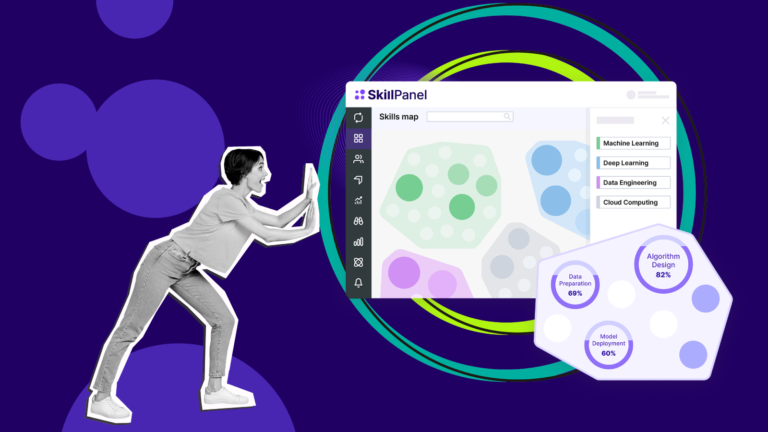
Tools like SkillPanel’s skills mapping platform support this process by providing both self-assessment data and evaluator input through full-circle feedback. The 20-percentage-point perception gap between self-assessments and supervisor ratings, documented in SkillPanel platform data, shows why objective skills data is so valuable for fair and effective advancement planning.
Weigh short-term cost against long-term return
Not every career growth opportunity is free. Pursuing a certification costs time and potentially money. Accepting a lateral move might mean a temporary step back in seniority. Volunteering for a stretch project could mean additional hours during an already full schedule. These are real costs that deserve honest evaluation.
The framework that tends to work best is straightforward: evaluate whether the opportunity builds foundational expertise you can credibly leverage, whether it holds genuine meaning for your career direction, and whether the stretch it offers is sufficient to drive growth without being so far beyond your current readiness that failure becomes likely. Organizations offering career advancement and skills development save approximately $8,053 per employee annually through higher productivity and lower turnover, based on SkillPanel customer data. The same logic applies at the individual level: strategic development investments support personal growth and measurable business outcomes over time.
How to build a career growth plan around real opportunities
Identifying the right opportunities means little without a structured plan to pursue them. A career development plan is not a vague aspiration document or a one-time exercise. It is a living roadmap built as an ongoing process that connects where you are today to where you intend to be, with specific milestones, development milestones, learning actions, and review checkpoints along the way.
Set SMART goals tied to specific opportunities
Effective career growth planning starts with translating aspirations into SMART goals: Specific, Measurable, Achievable, Relevant, and Time-bound. SMART goals are 42% more likely to be achieved. SMART goals that float in isolation from real opportunities tend to drift. SMART goals anchored to a specific certification program, a particular internal role, or a defined leadership project stay actionable.
For example, “becoming more visible as a leader” becomes a SMART goal when rephrased as “lead one cross-functional project within Q3 and present outcomes to department heads by September 30” to improve leadership skills. Only 39% of HR professionals say their organizations have effective career development processes, which means most employees are largely responsible for building their own structured plans. Career goals at this level of specificity might include completing a data analysis certification in 90 days, requesting a performance review discussion about promotion criteria within the next 30 days, or set career development goals tied to a target role, project, or certification.
Create a 30-60-90 day action roadmap
A 30-60-90 day action roadmap gives your career growth plan a practical, near-term structure that prevents the trap of vague long-term intentions without near-term action. The first 30 days should focus on foundation: self-assessment, goal clarification, identifying the specific opportunities you are pursuing, and identifying relevant learning and development opportunities. The next 30 days shift toward execution: beginning a certification, requesting a project assignment, scheduling conversations with mentors or managers, or plugging into career development programs as a structured option. The final 30 days focus on evaluation: reviewing what you have learned, adjusting based on feedback, and setting the next 90-day cycle.
Organizations with mature career development functions are seven times more likely to identify and address skills gaps to a high degree, and that maturity almost always includes structured timelines and accountability mechanisms. Building your own 30-60-90 day rhythm is a practice that directly separates professionals who grow consistently from those who grow only when pushed.
Track progress and adjust as you go
A career growth plan is not static. Professionals who advance most effectively build regular review habits, ideally quarterly, where they assess progress, incorporate new information, include regular development conversations, and recalibrate goals as needed. A career journal is a particularly underrated tool here. Documenting achievements, lessons learned, developmental milestones, and progress against professional development goals creates a running record that is directly useful during performance reviews, compensation discussions, and internal mobility conversations. It also helps counteract the perception gap problem: having concrete evidence of growth and contribution strengthens your ability to advocate for your own advancement with accuracy and confidence.
Career advancement tips to make opportunities work for you
Identifying and planning around career growth opportunities is necessary but not sufficient. How you engage with those opportunities ultimately determines how much value they deliver.
Build relationships that open doors (mentors, sponsors, peers)
Mentorship is valuable, but sponsorship is transformative. A mentor gives advice; a sponsor uses their influence to advocate for you when you are not in the room. 73% of women with sponsors experience faster career advancement, yet only 45% of women have ever had a sponsor. Cultivating sponsors, not just mentors, is one of the highest-leverage career improvement strategies available, especially when you are building a professional network across levels and functions.
Gallup’s research shows that employees with formal mentors are 58% more likely, and those with formal sponsors 48% more likely, to strongly agree that their organization gives all employees equal opportunities to advance. Actively building a network that includes both advisors and advocates, across levels and functions, can also surface unadvertised job opportunities and gives you access to the kinds of opportunities that never appear on job boards.
Make your contributions visible without overselling
One of the most common career growth barriers is the assumption that strong performance speaks for itself. It often does not. SHRM specifically recommends seeking visibility for your accomplishments as an explicit growth strategy, particularly for professionals aiming for broader impact and senior roles.
The key is making visibility feel natural rather than calculated. Sharing insights in team meetings after a challenging project, contributing meaningfully to cross-functional conversations, and ensuring your manager has an accurate picture of your contributions through regular updates are all effective ways to build presence without coming across as self-promotional. The 20-percentage-point perception gap between employee self-assessments and supervisor ratings, documented in SkillPanel platform data, shows that visibility gaps have real consequences for promotion decisions.
Use performance reviews as a career advancement tool
Most professionals treat performance reviews as evaluations. High-growth professionals treat them as structured development conversations that align their growth with business objectives. Coming in with a prepared list of contributions, a clear articulation of your career objectives for the next 12 months, and specific questions about what promotion readiness looks like in your organization transforms the dynamic and can increase your visibility with senior leadership. 59% of organizations plan to increase spending on manager development programs over the next two years, and professionals who engage proactively benefit most from that investment.
Common barriers to career growth and how to overcome them
Knowing what career growth opportunities exist and understanding how to pursue them does not eliminate the real obstacles that slow advancement. Identifying those barriers clearly is the first step to overcoming them.
The most common barrier is a lack of clarity about what advancement actually requires. When employees do not know the specific skills, behaviors, and outcomes expected for promotion, they cannot pursue them effectively. The solution is making those criteria explicit, either by asking your manager directly, using tools like SkillPanel’s skills-based career pathways that show employees exactly what is needed for their next role, or by studying the profiles of people who have already made the transition you are targeting, since weak growth support can also hurt employee engagement and retention.
Insufficient development time is a close second. Gallup explicitly recommends embedding upskilling opportunities into paid working hours, and SHRM research confirms that employees need both financial support and adequate time to build new skills. 44% of employees aged 18 to 34 consider leaving their job due to insufficient training and development, and only 46% feel they have adequate opportunities to learn new skills. If your organization is not providing time and resources for professional development, the most direct solution is to ask explicitly, propose a development plan, and show how the investment supports reskilling, especially since 79% of learning and development professionals prefer it over hiring and because it benefits the team.
Limited networking and sponsorship access remains a significant barrier, particularly for women and underrepresented professionals. Attending company events, participating in ERGs, and requesting informational conversations with senior leaders are all practical starting points.
Finally, the perception gap between how employees see their own performance and how managers actually see it can silently derail advancement. Accurate, multi-source skills data, supported by platforms like SkillPanel that integrate self-assessments, peer reviews, manager input, and technical evaluations, is one of the most effective tools for closing that gap and ensuring promotion decisions are grounded in real capability data.
Frequently asked questions about career growth opportunities
What are career growth opportunities, and how do they differ from career development opportunities? Career growth opportunities are specific experiences, roles, projects, or credentials that advance your professional trajectory in terms of scope, seniority, or influence. Career development opportunities are the broader set of activities, including training, mentorship, talent development efforts, and formal career development programs that build the skills enabling that growth. Both are necessary, and effective career planning integrates them deliberately.
What are the most valuable career advancement opportunities in 2026? The most valuable opportunities right now are those that build AI literacy, analytical thinking, and leadership skills, all three of which are top employer priorities. Beyond specific competencies, opportunities that provide cross-functional exposure, visibility with senior stakeholders, and structured skills development tend to deliver the highest returns across career stages, especially when they also strengthen soft skills like communication and customer service skills.
How do I identify areas for growth in my current role? Start with a structured skills gap analysis that compares your current capabilities against the requirements of your target role. Combine self-assessment with external feedback from peers, mentors, and managers to reduce the perception gap that affects most self-evaluations. Tools like SkillPanel’s skills intelligence platform can provide objective, multi-source data that makes this process more accurate and actionable.
How many jobs do professionals hold today compared to previous generations? Workers today are expected to hold roughly twice as many jobs over a decade compared to workers a generation ago. This shift reflects both greater career mobility and the rising norm of lateral, skills-driven career paths rather than single-employer vertical progression.
What is the most important career advancement tip for professionals right now? The single most impactful tip is to stop waiting for your organization to hand you a career path and start building one yourself. Set SMART goals tied to real opportunities, identify your specific skill gaps, build relationships with both mentors and sponsors, and create a visible track record of contribution. 94% of employees say they would stay at a company longer if it invested in their career development, which tells you that when you take your own growth seriously, the best organizations will invest in it alongside you.How do I know if I am ready for a promotion or new role? Based on SkillPanel platform data, the average career path distance between an employee’s current role and their next one is just 23%, meaning most employees already possess the majority of the skills needed for their next step. Readiness is not about perfection. It is about closing the specific gaps that exist between where you are and where you want to go through an ongoing process of professional development, not a one-time promotion push. A structured skills assessment gives you the clarity to pursue that next step with confidence rather than guesswork.