Don’t wait for a crisis: How to build a bulletproof succession plan today
| Reading time:


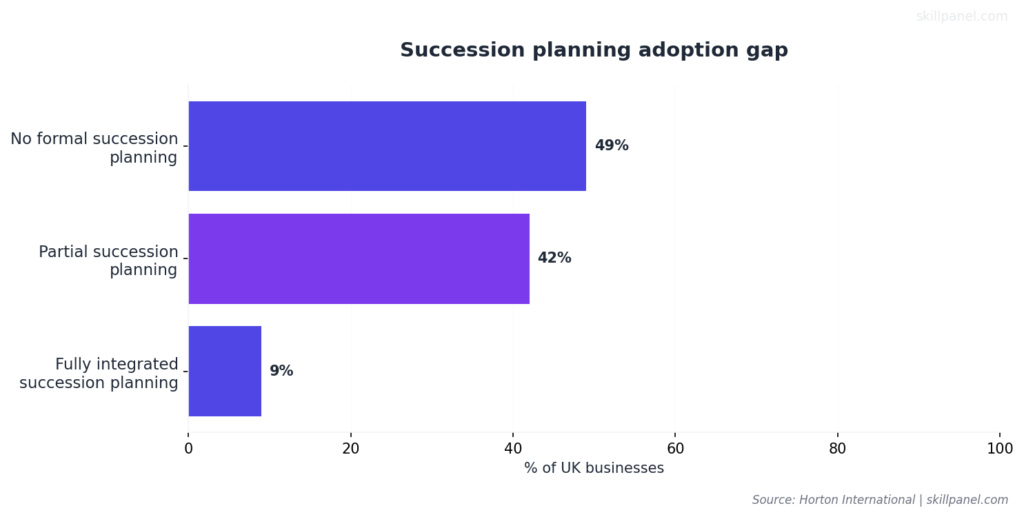
Building resilience into your organization starts with knowing which positions matter most. Critical roles succession planning protects your company from disruption by preparing leaders for pivotal positions before vacancies occur. Yet only 9% of UK businesses have fully integrated succession planning into their strategy, leaving most organizations vulnerable to costly leadership gaps.
Full disclosure: This guide references SkillPanel’s platform where relevant to succession planning technology. The frameworks and strategies apply regardless of tools used.
The succession plan meaning goes beyond replacing executives. It encompasses identifying positions where vacancy creates immediate operational risk, assessing your internal talent pipeline, and developing successors through targeted experiences. When done well, succession planning transforms talent management from reactive firefighting into strategic workforce architecture.
This guide walks you through the complete succession planning process for critical roles, from identification through implementation. You’ll learn systematic frameworks for pinpointing which positions require succession attention, building competency profiles that define success, and creating development pathways that prepare your next generation of leaders.
What makes a position critical to your organization
Critical positions share a defining characteristic: their vacancy creates disproportionate disruption to operations, revenue, or strategic execution. Unlike senior positions that derive importance from organizational hierarchy, critical roles earn their status through measurable business impact. A frontline technical specialist managing your core product architecture may be more critical than a vice president overseeing a support function.
The critical role definition extends beyond individual contributors to encompass pivotal teams and cross-functional interfaces. Your fraud monitoring team or supply chain coordination group might represent single points of failure despite having no executive titles. Approximately 80% of companies now prioritize roles affecting strategy when building succession frameworks, recognizing that competitive advantage often resides in specialized functions rather than corner offices.
Strategic context determines criticality. A role driving your three-year growth initiative carries more weight than one maintaining legacy systems, aligning succession planning with future value creation rather than preserving yesterday’s structure.
Critical roles vs. senior positions: Key distinctions
Confusing hierarchy with criticality represents the most common pitfall in company succession planning. Senior positions command authority and manage large teams, but their absence doesn’t always threaten business continuity. Critical roles concentrate unique knowledge or capabilities that take significant time to rebuild, often serving as organizational connectors linking customer needs with internal delivery or translating technical complexity into business strategy.
Replacement difficulty provides another distinction. Senior positions attract abundant external talent; critical technical roles often require twelve to eighteen months of domain-specific learning. According to Deloitte research, only 14% of organizations effectively execute succession planning despite 86% of executives viewing it as a priority, revealing the gap between recognition and action.
Core characteristics that define critical roles
Impact on business operations and revenue forms the foundation of criticality assessment. Gartner found that financial-services firms experienced a 15% drop in EBITDA within 90 days of losing a key relationship owner without succession plans. If the role’s vacancy would visibly affect quarterly financial results, it demands succession attention.
Specialized skills and institutional knowledge create the second dimension. Roles requiring deep technical expertise, proprietary system knowledge, or years of relationship building resist quick replacement. Your compliance director who navigated three regulatory audits carries context that new hires lack, while customer-facing roles accumulate relationship capital that transfers imperfectly to successors.
Strategic alignment with future growth completes the picture. Regular reassessment ensures your succession efforts focus on positions driving tomorrow’s objectives rather than preserving yesterday’s structure.
Strategic benefits of critical roles succession planning
Employee succession planning delivers measurable protection against value destruction. Inadequate succession practices among S&P 1500 companies destroy nearly £1 trillion in value annually through underperforming external hires and unprepared internal candidates. A McKinsey study revealed that companies with prolonged leadership vacancies suffer a 15% productivity drop, underscoring the urgency of succession preparation.
Institutional knowledge preservation represents the most immediate benefit. When critical role incumbents leave without successors, decades of customer insights, process expertise, and strategic context vanish overnight. Organizations reduce new hire time-to-productivity by 32% on average when comprehensive talent tracking systems guide succession preparation.
The succession plan purpose extends to talent retention and engagement. High-potential employees stay with organizations that invest in their development and provide visible career pathways. 83% of HR leaders state that business success depends more on upskilling existing employees than external hiring, reflecting this strategic pivot.
Succession planning in action: What works
While comprehensive case study data remains limited, several organizations demonstrate effective critical role succession approaches:
General electric’s systematic approach: GE operates an annual “Session C” talent review process combined with their Crotonville learning facility for leadership training. Their systematic framework emphasizes continuous talent assessment rather than crisis-driven planning, though this represents a multi-decade investment beyond most organizations’ immediate reach.
Adobe’s open discussion framework: Adobe implements an “open talent discussion” framework for succession planning that emphasizes transparency and regular calibration. Their approach normalizes succession conversations as part of ongoing talent management rather than sensitive, secretive processes.
Utility sector implementation: An electric utility partnered with ScottMadden to implement succession planning focused on critical roles and leadership development. The approach emphasized identifying roles essential for operational continuity and regulatory compliance, acknowledging that utility operators and system engineers represent critical positions despite lacking executive titles.
These examples share common elements: systematic processes, integration with broader talent management, and focus beyond executive positions. However, detailed metrics on time-to-fill improvements or retention gains remain proprietary or unpublished in most cases.
How to identify critical positions in your organization
Systematic identification prevents the bias and blind spots that plague intuitive approaches. ScottMadden research found that only 19% of organizations have formal succession plans, with 72% focusing narrowly on executive/senior roles while neglecting broader management layers essential for operational continuity.
The stages of succession planning begin with comprehensive identification. A structured process incorporating multiple perspectives and objective criteria produces more accurate results than gut-feel assessments, determining whether your entire succession program addresses real organizational vulnerabilities.
Step 1: Assemble a cross-functional evaluation team
Diverse perspectives prevent organizational blind spots when identifying critical positions. Your HR team understands talent availability, operations leaders know which roles drive daily execution, and strategy executives recognize future requirements. Finance adds perspective on revenue impact while IT clarifies technical dependencies.
Team composition should span hierarchical levels since mid-level managers often understand operational vulnerabilities better than executives who’ve moved away from day-to-day challenges. Include representatives who interact regularly with various functions to capture cross-functional dependencies that create criticality.
Rotating membership annually prevents groupthink while building broader organizational capability in succession thinking. Document your evaluation methodology so new team members can apply consistent standards across review cycles.
Step 2: Define evaluation criteria for your context
Weighted criteria scoring brings objectivity to role assessment. Rate each position on a one-to-five scale across dimensions like revenue impact, customer experience, replacement difficulty, operational continuity, and strategic alignment. Customize dimension weights to reflect your industry and growth stage.
Set numeric thresholds that designate criticality. Roles scoring 16 or above on a 25-point scale or meeting high criteria on two of three simplified questions qualify for succession focus. This quantitative approach reduces arguments about borderline positions and creates defensible decisions when explaining resource allocation to executives.
Urgency and risk of vacancy
Timeline to likely vacancy determines succession planning urgency. Roles held by employees nearing retirement or expressing departure interest require immediate attention. External labor market dynamics also create urgency; when similar positions show high turnover rates industry-wide, proactive succession planning prevents scrambling during unexpected exits.
Assess single points of failure carefully. If only one person understands a critical system or maintains a key client relationship, vulnerability multiplies. These situations demand accelerated successor development even when the incumbent shows no signs of leaving.
Impact on business operations and revenue
Revenue connection provides the clearest measure of business impact. Quantify this connection when possible by calculating the revenue or cost exposure each role manages. A national sales director overseeing $50 million in annual revenue clearly demands succession attention.
Operational continuity represents the second impact dimension. Roles that coordinate across functions, maintain critical infrastructure, or manage supplier relationships keep operations running smoothly. Ask whether daily operations would continue normally without the position for a month.
Specialized skills and institutional knowledge
Technical complexity creates replacement barriers that elevate role criticality. Positions requiring advanced degrees, industry certifications, or years of specialized training resist quick backfilling. Your enterprise architect who designed your core platform, accumulated knowledge that takes new hires eighteen months to develop.
Institutional knowledge compounds over tenure. Long-serving employees understand why decisions were made, how systems evolved, and where documentation fails to capture reality. They navigate informal networks that accelerate problem-solving and maintain relationships that grease organizational friction.
Internal bench strength vs. external talent availability
Internal pipeline depth determines whether you can build successors or must buy talent externally. Survey your organization for employees who could step into critical roles with twelve to twenty-four months of development. Strong internal bench strength reduces succession risk while weak pipelines demand earlier external recruitment or accelerated development programs.
External labor market conditions provide the other half of the equation. 90% of organizations report leadership capability gaps, making internal development through targeted programs more reliable than hoping the external market provides ready leaders. Multi-source assessments that combine self-reviews, manager evaluations, and peer feedback reveal which employees can grow into critical roles.
Strategic alignment with future growth
Future orientation prevents succession planning from cementing your current structure. Map roles against your three-to-five-year strategic priorities rather than today’s org chart. Positions driving new market entry, digital transformation, or competitive differentiation deserve succession investment even if they’re new to your organization.
Business model evolution changes which roles matter most. Your shift from product sales to subscription services elevates customer success management while diminishing transactional sales support. Anticipate these shifts when identifying critical positions so successor development aligns with future needs.
Step 3: Map current roles against strategic priorities
Enterprise-wide role inventory provides the foundation for strategic mapping. Compile every position from your HRIS, organizational charts, and department records to avoid missing pivotal non-executive roles. Plot roles against your top strategic objectives for the next three years: which positions directly enable revenue growth targets, drive operational improvements that reduce costs, or build capabilities that differentiate you from competitors?
Revenue stream analysis adds granularity. Break down your business by product line, customer segment, or geographic market, then identify which roles drive success in each area. A position critical to your fastest-growing segment deserves more succession attention than one supporting a mature, stable business.
Step 4: Create your critical role identification matrix
Visual matrices transform abstract evaluations into actionable insights. Plot roles on a two-dimensional grid with business impact on the X-axis and replacement difficulty on the Y-axis. High-impact roles that take months to replace occupy your urgent succession planning zone and demand immediate action.
Action zones guide resource allocation. High-impact positions with short replacement times need successor monitoring but less intensive development investment. Low-impact roles regardless of replacement difficulty receive minimal succession resources.
Document successors, readiness levels, and risk factors directly on your matrix. Color-coding by readiness provides at-a-glance pipeline health assessment, with red indicators for roles lacking any identified successor creating clear calls to action.
Common pitfalls when identifying critical roles
Equating seniority with criticality leads organizations to over-invest in executive succession while ignoring operational vulnerabilities. Your chief strategy officer holds an important role, but daily operations continue smoothly during their absence. Meanwhile, your lead cloud architect who maintains systems serving millions of customers represents a true single point of failure.
Confusing high-performing individuals with critical roles creates succession planning failures. Star performers often make their roles appear more important than they actually are through exceptional execution. When they leave, organizations discover the position itself didn’t require that level of talent. Evaluate the role independent of the incumbent.
Near-term thinking produces succession plans that prepare for yesterday’s organization. Companies focusing only on current roles miss emerging positions that will drive future growth. Balance immediate succession risks with strategic workforce planning.
Building success profiles for critical positions
Success profiles translate abstract role requirements into concrete competency frameworks that guide successor selection and development. These documents capture the technical skills, leadership behaviors, and contextual knowledge required for effective performance in critical positions, enabling objective assessments that reduce bias and provide clear development targets.
The profile of success balances aspirational standards with realistic attainability. Setting requirements too high eliminates all internal candidates and justifies only external searches. Standards set too low fail to drive meaningful development and produce unprepared successors. Calibrate each profile against what high performers in the role actually demonstrate.
Essential components of an effective success profile
Technical competencies form the foundation of every success profile. Document the specific knowledge, tools, and methods the role requires for effective performance. Rate proficiency levels for each competency on a consistent scale so you can measure gaps objectively.
Leadership and behavioral competencies complement technical skills for roles with people management or strategic influence. Effective critical role successors demonstrate capabilities like strategic thinking, stakeholder management, change leadership, and decision-making under uncertainty. Describe these competencies clearly with observable behaviors rather than vague personality traits.
Role-specific accountabilities clarify what success looks like beyond competency checklists. Document three to five key outcomes the role must deliver, such as maintaining 99.9% system uptime, achieving 15% annual revenue growth, or ensuring zero compliance violations.
Institutional knowledge requirements deserve explicit documentation. New hires bring general skills but lack your organization’s specific context around culture, processes, relationships, and history. Identify critical knowledge areas where successors need development regardless of their external experience.
Linking success profiles to competency requirements
Competency frameworks create consistency across multiple critical roles when you map individual success profiles to enterprise-wide standards. Your organization might define core competencies required of all leaders, functional competencies specific to departments, and role-specific competencies unique to individual positions.
Proficiency levels transform competencies from binary checklists into developmental pathways. Define three to five levels for each competency that describe progression from basic awareness through expert mastery. Your successor might enter a critical role at proficiency level three, then develop to level four through targeted experiences.
Skills-to-role mapping enables gap analysis that drives development priorities. Platforms that visualize how each potential successor’s current skills align with their target role’s success profile create objective discussions about readiness that replace subjective opinions with data.
Assessing your current talent pipeline
Talent pipeline assessment determines whether you can promote from within or must recruit externally for critical roles. This evaluation combines performance reviews, potential assessments, and skills gap analysis to identify which employees could succeed in pivotal positions with appropriate development.
Nine-box grids provide a standard framework for plotting employees based on current performance and future potential. High-performers with high potential occupy your ready-now or near-ready successor categories. Solid performers with growth potential need longer development timelines.
U.S. internal talent marketplace adoption rose from 25% in 2024 to 35% in 2025, reflecting increased reliance on skills-based mobility for succession planning. Organizations that map employee capabilities comprehensively identify hidden successors who might not appear on traditional high-potential lists.
Evaluating internal successor readiness
Multi-source assessments deliver credible readiness evaluations that guide promotion decisions. Combine self-assessments where employees rate their own capabilities with manager evaluations, peer feedback, and objective skills tests to create unifiedskill profiles that highlight both perceived and actual competencies.
Perception gaps between employees and supervisors reveal development needs. Employees might self-rate at 65% proficiency while supervisors assess them at 42% on critical skills. These discrepancies flag areas requiring coaching, training, or performance feedback before succession becomes viable.
Readiness levels should reflect realistic timelines for successor preparation. Ready-now successors can step into critical roles immediately with minimal transition support. Near-ready candidates need six to twelve months of targeted development. Longer-term successors require one to three years of preparation.
Determining build vs. buy strategies for each role
Internal development costs less and produces better cultural fit than external recruitment, but timeline constraints sometimes force external hiring. When critical roles lack any internal candidates within eighteen months of readiness, external recruitment becomes necessary. Balance your preference for promotion from within against business continuity requirements.
Labor market analysis informs build-versus-buy decisions. Research typical compensation, hiring timelines, and candidate availability before committing to internal development. McKinsey research indicates that effective development with aligned talent pipelines reduces external hiring costs by up to 50%.
Hybrid approaches often work best for highly specialized critical roles. Hire external leaders with immediate technical expertise while simultaneously developing internal candidates who bring cultural knowledge and relationship capital.
Identifying high-potential employees for development
High-potential identification extends beyond current performance to assess learning agility, leadership capability, and strategic thinking. Employees who excel in their current roles don’t automatically succeed at higher levels requiring different skills. Look for evidence of adaptability, complex problem-solving, and influence beyond direct authority.
Structured talent reviews prevent recency bias and availability heuristics that skew high-potential identification. Schedule quarterly or semi-annual calibration sessions where leaders discuss potential successors using consistent criteria. Document decisions and rationale to maintain institutional memory across leadership changes.
Diversity considerations should explicitly inform high-potential identification to prevent perpetuating homogeneous leadership pipelines. Actively seek candidates from underrepresented groups and examine your selection criteria for hidden biases.
Creating targeted successor development plans
Individual development plans transform succession planning from aspirational lists into concrete action. Each successor needs a customized roadmap that closes their skills gaps, builds leadership capabilities, and provides experiences that prepare them for critical roles.
Development plan components should balance formal learning, experiential assignments, and relationship building. Classroom training builds foundational knowledge efficiently, stretch assignments develop practical skills through application, and mentoring relationships transfer institutional wisdom. This multi-modal approach accelerates readiness more effectively than any single development method.
Maria Goldsholl, chief people officer at TechCXO, notes that “high-potential CHRO successors will start in a rotation program about five years before they are needed”, followed by approximately two years serving as the CHRO’s protégé. This extended timeline reflects the depth of development required for truly critical positions.
Designing individual development plans (IDPs)
Effective IDPs begin with clear gap analysis that compares the successor’s current competencies against their target role’s success profile. Prioritize gaps that represent readiness blockers versus nice-to-have skills. Your finance successor might need immediate development in strategic thinking and board presentations while less critical skills like advanced analytics can wait.
Timeline and milestone setting creates accountability for development progress. Specify what the successor should achieve each quarter, such as completing specific training, leading particular projects, or demonstrating new competencies in performance reviews. These concrete milestones enable tracking and create natural check-in points for coaching conversations.
Development activities should mix challenge and support to optimize learning without overwhelming successors. Assign stretch assignments that push beyond current capabilities while providing mentoring and feedback that helps successors process experiences.
Providing strategic job rotations and stretch assignments
Cross-functional rotations build the enterprise perspective critical roles require. Goldsholl recommends that organizations “design opportunities that give HR team members a taste of other parts of the organization, such as operations, sales and marketing, and finance”, building the cross-functional understanding senior roles demand.
Stretch assignments provide learning through controlled risk-taking. Assign successors to lead initiatives slightly beyond their current capability, then support them through coaching and resources. Managing a product launch, leading a system implementation, or turning around an underperforming team develops capabilities that training alone cannot build.
International assignments accelerate development for roles requiring global perspective. Three-year expatriate postings or shorter global project assignments expose successors to different markets, cultures, and operating models while testing whether successors can perform in ambiguous environments.
Implementing mentoring and knowledge transfer programs
Structured mentoring relationships between incumbents and successors facilitate crucial knowledge transfer. Schedule regular meetings focused on strategic decision-making, stakeholder management, and institutional history. Incumbents should share context behind current processes, explain political dynamics, and introduce successors to key relationships.
Knowledge documentation complements interpersonal mentoring by capturing information that will survive incumbent departures. Have successors shadow incumbents during critical activities while documenting processes, decisions, and rationale. Create decision frameworks and relationship maps that new role holders can reference.
Reverse mentoring programs where successors teach incumbents emerging skills like digital tools or data analytics build reciprocal relationships while keeping experienced leaders current. This mutual learning approach increases incumbent buy-in while acknowledging that successors bring valuable perspectives.
Measuring development progress and readiness
Regular skills assessments track whether development activities actually build required competencies. Quarterly or semi-annual competency measurements reveal progress objectively. Compare successive assessments to see whether technical training, stretch assignments, and mentoring are closing gaps as planned.
Performance in development assignments provides behavioral evidence of readiness growth. How effectively did the successor handle their cross-functional project? What feedback did they receive from stakeholders? Collect this qualitative input systematically rather than relying on anecdotal impressions.
Readiness reviews bring together assessment data, assignment performance, and manager observations into holistic succession conversations. Conduct these reviews quarterly for near-ready successors and semi-annually for longer-term candidates. Adjust development plans based on progress.
Implementing your critical roles succession plan
Implementation transforms succession planning documents into organizational reality. This phase requires clear communication with stakeholders, integration with existing talent systems, and sustained executive commitment. A What Directors Think report found that 34% of U.S. public company directors identified CEO and C-Suite succession planning as a top priority for 2025, ranking ahead of AI at 27%, yet only 21% rate their processes as ‘excellent’.
Phased rollout often works better than attempting comprehensive implementation immediately. Start with five to ten highest-priority critical roles, develop successors for these positions, document lessons learned, then expand to additional roles. This iterative approach builds organizational capability while delivering quick wins that maintain momentum.
Documenting your succession strategy and timelines
Formal succession planning documentation should specify critical roles, identified successors with readiness assessments, development plans with timelines, and contingency plans for unexpected vacancies. This comprehensive record becomes your organization’s talent continuity roadmap and supports consistent execution across leadership changes.
Succession timelines must balance ideal development periods with business realities. Your best candidate might need two years of preparation, but the incumbent plans to retire in twelve months. Document both optimal and accelerated development paths so you can adjust when circumstances change.
Governance structure clarifies who owns succession planning decisions and progress monitoring. Define whether HR leads with business leader input, or vice versa. Establish review frequency, decision-making authority, and escalation paths for disagreements.
Communicating with stakeholders and successors
Transparent communication builds trust and engagement with succession planning. Share the overall process, selection criteria, and timelines with your broader organization while keeping individual succession decisions confidential. Employees understand that succession planning happens and appreciate clarity about how the organization approaches leadership continuity.
Direct conversations with identified successors create motivation and commitment. Explain why you see them as future leaders, outline development expectations, and discuss their career aspirations. These conversations shouldn’t guarantee promotion but should clearly communicate opportunity contingent on successful development and business need.
Incumbent involvement in successor development prevents knowledge hoarding while creating legacy-building opportunities for departing leaders. Frame succession planning as leadership’s responsibility to build organizational capability rather than as replacement threats.
Integrating succession planning with talent management systems
Skills intelligence platforms create the foundation for integrated succession planning. When your system maintains comprehensive employee capability data, succession planning becomes an extension of existing talent management rather than a disconnected process. Identified successors automatically appear in relevant talent pools, their development plans link to learning systems, and progress tracking leverages existing performance management workflows.
Automated dashboards provide real-time succession pipeline visibility that manual tracking cannot match. See which critical roles have ready successors, where gaps exist, and how development plans are progressing without requesting status reports.
API integrations connect succession planning with applicant tracking systems, learning management platforms, and HRIS solutions. When a successor completes required training, that achievement updates their readiness status automatically. This automation reduces administrative burden while improving data accuracy.
Common implementation challenges and practical solutions
While succession planning frameworks appear straightforward, execution reveals predictable obstacles that derail even well-designed programs. Understanding these challenges before they emerge enables proactive mitigation rather than reactive crisis management.
Challenge 1: Competing priorities and resource constraints
According to Evanta research,40% of CHROs cited competing priorities as their greatest challenge in leadership development and succession planning, while 28% pointed to lack of resources. Succession planning competes with talent acquisition, performance management, compensation planning, and dozens of other HR initiatives for limited time and budget.
Soluções: Start with radical focus on three to five highest-risk critical roles rather than attempting comprehensive coverage. Demonstrate quick wins through targeted succession preparation that prevents costly external hires or leadership gaps, building the business case for expanded investment. Integrate succession planning into existing talent review meetings rather than creating separate processes that burden already-stretched calendars.
Challenge 2: Talent pool limitations and succession burnout
The post-pandemic environment has created severe talent shortages, particularly for senior roles. Maria Goldsholl reports that demand for interim CHROs soared 225% year-over-year between 2022-23, reflecting difficulty in finding ready successors. She notes that “a lot of that has to do with some apathy in the workforce” and that the hybrid, work-from-home environment has fundamentally changed talent availability.
Soluções: Extend development timelines to acknowledge that ready successors require longer preparation in talent-constrained markets. Consider interim leadership solutions and external advisors to bridge gaps while internal successors develop. Build deeper talent pools by identifying multiple potential successors per critical role rather than single candidates. Kirsty Dougan, MD at Warren Partners, emphasizes that “organisations must invest in long-term [development program](https://skillpanel.com/blog/development-program/#defining-development-programs)s to prepare future leaders from within their ranks” given external talent scarcity.
Challenge 3: Rapidly changing business landscape
29% of CHROs identified the quickly changing landscape as a challenge to succession planning. The modern CHRO role now demands strategic vision, operational expertise, and people management skills to drive initiatives around DEI, employee experience, and organizational culture, representing a significant expansion from traditional HR operations management.
Soluções: Build adaptability into success profiles rather than narrowly defining competencies for today’s role requirements. Emphasize learning agility and change leadership in successor selection criteria. Review and update critical role definitions annually to ensure succession planning keeps pace with evolving business needs. Focus successor development on building strategic thinking and business acumen that transfers across changing contexts.
Challenge 4: Skills gaps and leadership development deficiency
Two-thirds of CHROs cited developing talent and skills as their top goal for succession planning, indicating widespread recognition of capability gaps. Research notes that “a pretty significant skill gap is leadership” and that organizations are “rethinking the whole structure” around what skills to deploy.
Soluções: Create robust individual development plans that combine formal training, stretch assignments, and mentoring rather than relying solely on classroom learning. Accelerate development through concentrated experiences like 12-month rotations rather than waiting for organic progression. Partner with external leadership development providers to supplement internal capability when your organization lacks specific expertise. Track development metrics rigorously to ensure investment produces actual competency gains.
Challenge 5: Weak process integration and trust issues
While succession planning ranks as a top priority, it frequently remains “a weak process.” For CHROs specifically, trust is vital: they can lead successful CEO succession planning only when trusted by the board, CEO, and executive team. Without it, “succession planning can become vulnerable to missteps, misalignment or reputational damage”.
Soluções: Establish clear governance structures with defined roles for the board, CEO, CHRO, and business leaders in succession decisions. Create transparent selection criteria and communicate them widely to build trust in the process. Involve multiple stakeholders in succession assessments to prevent perception of favoritism. Document decisions thoroughly to demonstrate objectivity. Conduct regular calibration sessions where leaders debate succession readiness using evidence rather than opinions.
Diagnostic questions for troubleshooting:
- Are identified successors progressing through development milestones on schedule?
- Do you have at least one ready-now successor for each critical role, or are gaps emerging?
- Are high-potential successors staying with your organization, or are retention issues depleting your pipeline?
- Do business leaders actively engage in succession planning, or does it remain purely an HR exercise?
- Can you demonstrate tangible succession planning outcomes like reduced time-to-fill or improved leadership quality?
Negative answers signal implementation problems requiring immediate attention before succession failures create crises.
Maintaining and updating your succession plan
Succession planning requires ongoing maintenance to remain effective. Organizations that treat succession planning as an annual exercise rather than a continuous process fail to keep plans current as business conditions and talent dynamics shift.
Regular review cycles ensure succession plans evolve with your organization. Quarterly reviews for critical roles with imminent transitions and annual comprehensive reviews for all critical positions maintain plan relevance. These structured touchpoints prevent succession planning from becoming stale documents that sit unused until sudden vacancies create crisis.
Establishing regular review cycles
Structured review meetings should follow consistent agendas that combine data analysis with strategic discussion. Spend the first portion reviewing quantitative succession metrics like bench strength percentages, readiness distributions, and development plan completion rates. Then debate qualitative factors like changing business priorities, emerging talent, and revised role criticality assessments.
Cross-functional participation in reviews prevents functional silos from distorting succession decisions. Include representatives from HR, finance, operations, and strategy so succession planning incorporates multiple business perspectives. Rotate participants annually to build a broad organizational understanding.
Document review decisions and rationale to create institutional memory. When you add or remove roles from critical designation, capture why. When you promote successors or add new candidates, record the justification.
Adapting to organizational changes and market shifts
Business strategy evolution should trigger succession plan updates. Your acquisition of a competitor, entry into new markets, or shift to different business models changes which roles matter most. Schedule succession plan reviews within 90 days of significant strategic announcements to realign critical role identification with new priorities.
Technology disruption and automation alter role requirements and create new critical positions. When artificial intelligence transforms your customer service model, your succession needs shift from managing large call centers to leading AI implementation and optimization.
Market talent dynamics influence whether your build-versus-buy strategies remain viable. When specialized technical roles become even more difficult to recruit externally, internal development gains urgency. Monitor labor market trends quarterly to keep succession strategies realistic.
Tracking key succession planning metrics
Bench strength metrics quantify how many ready successors exist for critical roles. Track the percentage of critical positions with at least one ready-now successor, the average number of successors per critical role, and the distribution of readiness levels across your pipeline. Target 90%+ retention rates for high-potential successors to maintain pipeline health.
Successor development progress metrics ensure IDPs drive actual capability building. Monitor the percentage of planned development activities completed on schedule, competency score improvements over time, and successor progression through readiness levels.
Internal hire rates for critical roles measure succession planning effectiveness. Organizations should target filling 70% of critical roles internally when succession planning functions well. Lower rates suggest your succession preparation fails to produce ready candidates.
Diversity representation in successor pools requires explicit tracking to prevent homogeneous pipelines. Monitor how successor demographics compare to your overall workforce and to external labor market availability. Set specific diversity targets and measure progress quarterly.
Succession planning for small vs. large organizations
Company succession plans vary significantly based on organizational size and complexity. Large organizations with 1,000+ employees are more likely to have succession planning in place at 89% compared to small organizations under 100 employees at 76%. Yet each leadership departure creates proportionally greater impact in smaller organizations where individual leaders often fill multiple roles.
Resource constraints push small organizations toward simpler succession approaches. While enterprises establish cross-functional committees, deploy sophisticated software, and track comprehensive metrics, small businesses succeed with owner-led identification of three to five critical roles and straightforward development through on-the-job training and mentoring. Only 33% of small organizations have comprehensive, documented succession plans versus 56% of large ones.
Small organizations should prioritize narrow, deep succession preparation over broad, shallow coverage. Identify your highest-impact roles where a vacancy creates an immediate crisis, then focus all succession resources on preparing one to two successors for each. Owner-led discussions replace formal committees effectively, directly assessing career goals with potential successors and creating simple development plans.
Large organizations benefit from an enterprise-wide skills platform that provide visibility across thousands of employees and dozens of critical roles, scaling succession planning complexity that manual approaches cannot handle.
Putting your critical roles succession plan into action
Begin your succession planning journey by identifying five to ten highest-priority critical roles using the frameworks outlined in this guide. Assemble a small evaluation team, apply systematic criteria, and create your initial critical role matrix. This focused start delivers quick wins while building organizational capability.
Conduct success profile workshops for your priority roles over the next 30 days. Involve current incumbents, their managers, and HR partners to document the technical competencies, leadership skills, and institutional knowledge each role requires.
Assess your current talent pipeline against success profiles within 60 days. Use multi-source assessments to evaluate potential successors objectively, identify readiness gaps, and categorize candidates into ready-now, near-ready, and longer-term development groups.
Launch individual development plans for near-ready successors immediately. Assign mentors, schedule rotations, and begin tracking progress. Review progress quarterly and expand gradually, adding five to ten more critical positions to your succession planning scope after six months of learning.
The succession planning process requires commitment, but organizations that invest consistently reap substantial returns through reduced disruption, improved leadership quality, and stronger talent retention. Start small, measure results, and expand systematically to build succession planning that truly protects your organization’s future.