How to build a talent acquisition strategy that wins the people everyone else is chasing
| Reading time:


Hiring the right people has never been harder, or more consequential. Skills shortages are deepening, candidate expectations are shifting, and the gap between organizations that hire well and those that struggle is widening every quarter. Yet despite 56% of HR professionals rating their recruiting as effective or very effective, most talent acquisition strategies still fall short of what the business actually needs. The difference between companies that consistently win top talent and those perpetually scrambling to fill seats comes down to one thing: strategy. Not tactics, not tools, but a coherent, forward-looking talent acquisition strategy that treats hiring as a core business function.
This guide covers what a talent acquisition strategy really means, how to build one from the ground up, and what separates high-performing teams from everyone else.
Why most talent acquisition strategies fall short
Despite record investment in recruiting technology and growing HR budgets, 69% of organizations still struggle to fill full-time positions. That number is improving from a peak of 91% in 2022, but the underlying causes remain largely unresolved. The problem is rarely a lack of effort. It is a lack of alignment.
Most organizations approach hiring reactively, opening roles when someone leaves and scrambling to fill seats quickly. That urgency creates a cascade of bad decisions: vague job descriptions, rushed interviews, poor candidate experiences, and ultimately, hires that don’t stick. A bad hire can cost up to 30% of an employee’s first-year salary, and 60% of business leaders admit they’ve hired the wrong person at some point, with consequences including slower growth, damaged reputation, and weakened service quality.
Several structural failure points compound the issue. Decentralized talent philosophies create inconsistent hiring goals across departments. Leadership teams cut pipeline investments at the first sign of budget pressure, undermining long-term sourcing work. AI tools get deployed without governance, generating biased results and poor candidate experiences. And platforms purchased to modernize recruiting sit underutilized because no one trained the team to use them. The result is a talent acquisition lifecycle that looks active but produces weak outcomes. Skills gaps from inadequate talent strategies cost a median S&P 500 company an estimated $480 million annually in lost productivity. That is not a recruiting problem. That is a strategy problem.
What is a talent acquisition strategy (and how it differs from recruiting)
A talent acquisition strategy is a long-term, business-aligned plan for attracting, assessing, and hiring the people an organization needs to achieve its goals, both now and in the future. Talent acquisition means thinking ahead, building relationships before roles open, and treating every hiring decision as an investment in the company’s capability.
Recruiting, by contrast, is tactical. It focuses on filling a specific open role within a specific timeframe. Recruiting is a component of talent acquisition, but the two are not interchangeable. Talent acquisition encompasses the entire talent acquisition lifecycle, from workforce planning and employer branding to candidate pipeline management, selection frameworks, onboarding integration, and continuous measurement. Where recruiting operates in weeks, talent acquisition planning operates in quarters and years.
What talent acquisition really represents is the intersection of HR, business strategy, and workforce intelligence. It asks: What capabilities will this organization need 12, 24, or 36 months from now? Where are the gaps? How do we position ourselves to attract the people who can fill them? Those questions require a fundamentally different operating model than traditional reactive hiring, and they demand collaboration between HR leaders, finance, and the C-suite.
Core components of an effective talent acquisition strategy framework
A talent acquisition strategy framework does not exist in isolation. Each component connects to the others, and gaps in one area will undermine even the strongest elements elsewhere. Here is what an effective, integrated framework includes.
Workforce planning and talent needs assessment
Workforce planning is the foundation of any serious talent acquisition program. It means analyzing where the business is heading, what capabilities it will need to get there, and how current talent stacks up against those future demands. This is not a once-a-year exercise. It requires regular assessment of internal skills data, market trends, and business objectives to stay calibrated.
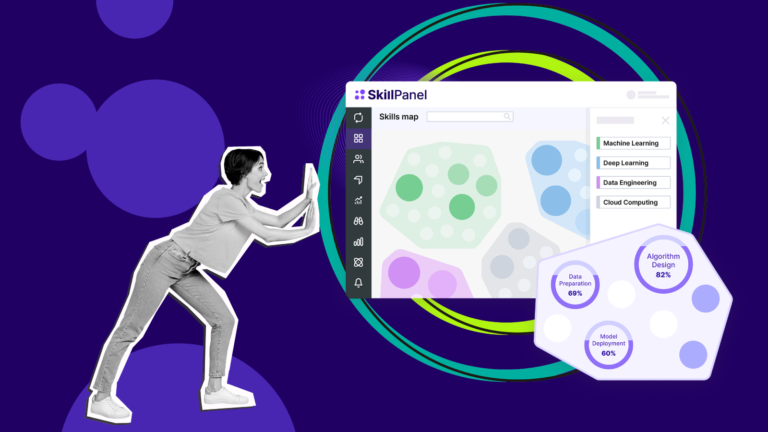
Effective planning starts with a structured skills audit. Organizations need a clear picture of what competencies exist across roles and departments before they can make smart sourcing decisions. Platforms like SkillPanel are built for exactly this purpose, offering predictive gap analysis and real-time visibility into workforce capabilities. With that data in hand, talent acquisition teams can prioritize hiring based on strategic importance rather than whoever made the loudest request.
Employer brand and employee value proposition (EVP)
A compelling employer brand is one of the most cost-effective tools in talent acquisition. Companies with strong employer brands consistently win in increasingly competitive hiring environments, and with 52% of recruiters reporting that hiring is becoming more competitive, differentiation is no longer optional.
The EVP articulates why talented people should choose your organization over competitors. It goes beyond perks and pay to communicate purpose, growth opportunity, culture, and flexibility. That message must be consistent across every touchpoint, from job descriptions and career pages to social media and interview experiences. A dissonant brand, where the public narrative does not match the actual candidate experience, erodes trust and drives qualified candidates to competitors.
Sourcing strategy and candidate pipeline
A strong sourcing strategy uses multiple channels simultaneously rather than relying on a single job board or sourcing method. It combines active outreach with passive pipelining, blending referral programs, social recruiting, talent communities, and direct sourcing to reach candidates who are not actively looking.
Proactive pipeline-building is especially important for critical or hard-to-fill roles. Building those relationships before urgency strikes gives recruiting teams significantly more leverage. Data quality matters here, too. Candidate information becomes outdated quickly, and talent tools that miss industry-specific context produce poor matches. Regular pipeline hygiene and skills-based data enrich candidate records and prevent the decay that kills pipeline effectiveness.
Candidate experience and engagement
The candidate experience shapes how people perceive your organization, and perception directly affects whether they accept offers, refer others, or warn their networks to stay away. According to a Criteria report cited by Fortune, 38% of job seekers experienced employer ghosting in 2024, leaving candidates with a “silent treatment” that damages brand reputation far beyond the individual interaction.
Excellent candidate experience means clear communication at every stage, fast and transparent feedback, and application processes that respect people’s time. It also means recognizing that candidates are evaluating you just as actively as you are evaluating them. Personalization, responsiveness, and honesty signal the kind of workplace you are.
Selection process and decision-making protocols
The selection process is where bias, inconsistency, and poor structure create the most damage. Organizations without a standardized interview process are five times more likely to make a bad hire. Structured decision-making protocols, including defined competency criteria, consistent interview questions, and diverse evaluation panels, significantly reduce that risk.
Skills assessments should be implemented early in the funnel rather than as a late-stage formality. Testing candidates before investing significant interview time filters out mismatches and protects everyone’s time. Relying on resumes alone is particularly risky in technical roles, where candidates frequently oversell capabilities and superficial questions fail to expose real skill gaps.
Technology stack and data infrastructure
Recruiting technology has evolved rapidly, but adoption has not kept pace. 22% of organizations face significant recruiting process inefficiencies, often because their tools are either poorly configured or not used at all. An ATS without proper adoption is not an asset. It is a liability.
An effective technology stack integrates applicant tracking, skills assessment, analytics, and communication tools into a cohesive system that supports rather than complicates the recruiter’s work. SkillPanel’s integration with existing HR technology, including payroll and learning systems, ensures that skills data flows seamlessly across the talent lifecycle rather than sitting in isolated silos.
Diversity, equity, inclusion, and belonging (DEIB)
DEIB is not a standalone initiative. It is woven into how organizations source, screen, assess, and evaluate talent. 42% of recruiters acknowledge that economic pressures are deprioritizing DEI efforts, but candidates have not lowered their expectations. They still evaluate organizations on diversity data, inclusion practices, and mobility opportunities.
Reducing structural bias requires structured hiring, anonymized screening where appropriate, and diverse interview panels. It also requires honesty about where the organization currently stands and what it is actively doing to improve. Performative commitments without substance damage employer brand and accelerate attrition among the very people organizations are trying to attract.
Measurement, feedback, and continuous improvement
A talent acquisition strategy without measurement is just a plan with good intentions. Defining KPIs from the outset and regularly reviewing them against outcomes is what separates a strategy from a to-do list. Metrics should include process efficiency indicators, quality signals, and candidate experience feedback, giving teams a holistic view of what is working and what needs adjustment. That feedback loop is what enables continuous improvement over time.
How to build a talent acquisition strategy step by step
Building an effective talent acquisition strategy requires sequencing the right actions in the right order. Here is a practical step-by-step guide.
Step 1: Align talent goals with business objectives
Start with the business, not the hiring plan. Meet with executive and functional leaders to understand where the organization is headed and what capabilities will drive success over the next one to three years. Translate those priorities into specific talent acquisition goals that tie directly to business outcomes. This alignment is what transforms HR from an administrative function into a genuine strategic partner.
Step 2: Analyze your workforce gaps and future needs
Map your current workforce against the capabilities your strategy requires. Identify not just what roles are open, but what skills are scarce, which competencies are at risk through attrition, and where internal mobility could address gaps before external hiring becomes necessary. The value of this analysis is concrete. In one documented case, a mid-sized financial services firm used a skills assessment to identify internal employees with latent data science potential, combined it with a targeted training program, and built the required capability at 40% of external hiring costs, with 100% retention after two years. SkillPanel’s predictive gap analysis and dynamic skills map are purpose-built for this kind of workforce intelligence, surfacing patterns that are invisible without structured data.
Step 3: Audit your current hiring process and TA team capabilities
Before building forward, understand where you stand. Review your current talent acquisition process end-to-end: how long each stage takes, where candidates drop off, what your recruiter-to-requisition ratio looks like, and how your team’s skills compare to what the strategy demands. This audit reveals bottlenecks and capability gaps that would otherwise undermine your next steps.
Step 4: Define your target candidate profiles
Strong candidate profiles go beyond job descriptions. They capture the skills, behaviors, motivations, and backgrounds that correlate with success in each role. Develop these in collaboration with hiring managers, and anchor them to real performance data where possible rather than guesswork. Specific, behavior-based profiles enable better sourcing, more relevant outreach, and sharper evaluation criteria, all of which reduce time-to-hire and improve quality-of-hire.
Step 5: Assess and strengthen your employer brand
Gather data on how your employer brand is actually perceived. Review platforms like LinkedIn, Glassdoor, and Indeed. Survey current employees. Assess whether your career site and job postings authentically reflect your culture and value proposition. Identify gaps between the brand you intend to project and the experience candidates actually receive, and address them systematically before scaling sourcing.
Step 6: Build a multi-channel sourcing plan
A single-channel sourcing strategy is a single point of failure. Develop a plan that combines job boards, social platforms, employee referrals, talent communities, direct sourcing outreach, and partnership channels such as universities, bootcamps, and professional associations. Assign ownership to each channel, set realistic pipeline targets, and monitor which channels produce the highest-quality candidates, not just the highest volume.
Step 7: Standardize your screening and selection process
Create consistent evaluation criteria for each role family and document them. Standardize interview questions to ensure candidates are assessed on the same dimensions across every panel. Integrate skills assessments early in the funnel rather than waiting until final stages. Involve a diverse group of evaluators and ensure every participant understands the criteria before the process begins. Consistency is the antidote to bias and the foundation of fair, defensible hiring decisions.
Step 8: Implement the right talent acquisition technology
Evaluate your current tools against the needs your strategy has identified. Look for platforms that integrate across your existing HR tech stack, offer strong analytics, and are actually usable by your team without extensive technical support. AI adoption in hiring reduced time-to-hire by 35% in 2024, and organizations planning AI investments expect cost-per-hire reductions of up to 35% in 2025. Technology should amplify recruiter performance, not replace human judgment in high-stakes decisions.
Step 9: Establish key metrics and feedback loops
Define the KPIs that will tell you whether the strategy is working. Set baseline measurements before making changes so you can track genuine progress. Build feedback loops that capture input from candidates at each stage, gather hiring manager satisfaction data, and monitor post-hire performance against initial assessments. These signals drive the iterative improvements that keep the strategy effective over time.
Step 10: Review, iterate, and scale
Talent acquisition planning is not a one-time deliverable. The labor market shifts, business priorities evolve, and what worked six months ago may no longer be the right approach. Schedule formal strategy reviews quarterly and annual deep dives to recalibrate your approach. As the organization grows, the talent acquisition strategy should scale with it, maintaining quality and consistency even as volume increases.
Talent acquisition best practices that separate high-performing teams
The gap between average and exceptional talent acquisition teams is not just about budget or headcount. It comes down to a handful of practices that fundamentally change outcomes.
Proactive talent pipelining vs. reactive hiring
Reactive hiring creates a predictable cycle of rushed decisions, inflated salaries, and elevated attrition. Proactive pipelining breaks that cycle by building relationships with qualified candidates before urgency creates pressure. This approach requires investment that does not show immediate ROI, which is why leadership buy-in is so often a challenge. However, the payoff is measurable. Using LinkedIn Talent Insights for pipeline analysis, Siemens’ recruiters reduced profile reviews by up to 62%, demonstrating the efficiency gains that structured pipelining enables.
Maintaining talent pipelines requires consistent engagement. Candidates expect timely communication, and without it, pipeline interest evaporates quickly. Small teams must prioritize personal outreach and use automation intelligently to scale without sacrificing authenticity.
Using data and predictive analytics to guide decisions
Data-driven hiring decisions consistently outperform gut-based ones. In one case study, a national manufacturing company partnered with Dame Leadership to identify top performer traits through data analysis. The result: turnover dropped by 63% alongside significant productivity and cost improvements. A US technology enterprise using the RecruitAI platform saw its full-cycle hiring cut from 24 to 10 to 12 days, with the interview-to-offer ratio rising from 12% to 38%.
Predictive analytics also improves sourcing quality. AI-assisted search tools have been shown to improve InMail acceptance rates by 18% compared to manual filters, by surfacing contextually relevant profiles that keyword-only searches miss. The key is pairing analytical capability with human judgment, rather than outsourcing the decision entirely to the algorithm.
Reducing bias through structured hiring
Unstructured hiring processes are not just inefficient. They are expensive. The five-times-higher bad-hire risk associated with non-standardized interviews represents an entirely avoidable cost. Structured hiring means using the same interview format, questions, and scoring criteria for every candidate in a given role, evaluated by trained interviewers who understand what good answers look like.
Structured hiring also means separating observable skills from inferred potential. Where possible, blind screening, skills-first assessments, and diverse panels counteract the cognitive shortcuts that lead to homogeneous and underperforming teams. 74% of recruiters believe AI makes hiring more efficient, and 67% say it reduces bias when paired with human oversight and proper governance.
Keeping candidates engaged throughout the process
60% of companies reported an increase in time-to-hire in 2024, and with longer timelines come higher dropout rates. Candidates accept other offers, lose interest, or simply go silent when communication breaks down. Engagement is not a nice-to-have. It is a direct driver of offer acceptance rates and hiring success.
Regular, personalized communication at each stage keeps candidates invested. Using LinkedIn’s Recommended Matches, for example, candidates are 35% more likely to respond to InMails, and candidates marked “Open to Work” show the same uplift. Combined with personalized outreach and prompt feedback, these tactics dramatically reduce the 41% ghosting rate that frustrates so many recruiting teams.
Talent acquisition strategy template: What to include
A practical talent acquisition strategy template gives your team a shared document to align around and revisit as conditions change. At its core, the template should capture your organization’s business objectives and how they translate into specific talent acquisition goals. From there, it should define the candidate profiles you are targeting for priority roles, specifying the skills, competencies, and behavioral attributes that predict success.
The sourcing section outlines which channels your team will use, how pipeline targets are set by channel, and what your outreach approach looks like for passive candidates. The selection section documents your screening criteria, assessment methods, and interview structure for each role family. The technology section identifies the tools supporting each stage of the process, from ATS and skills assessment platforms to analytics dashboards.
Rounding out the template is a metrics section defining your KPIs, establishing baselines, and setting review cadences. The final piece is a DEIB commitment that describes specific practices, not aspirations, embedded throughout the entire process. SkillPanel’s organizational skills matrix template and talent pipeline management checklist provide a strong structural starting point for teams building these components for the first time or auditing existing documentation.
Key talent acquisition metrics to track progress
Choosing the right metrics depends on what questions your strategy needs to answer. Time-to-fill and time-to-hire measure process speed and signal where bottlenecks exist. Quality-of-hire, typically measured through post-hire performance ratings and retention at 90 days and one year, tells you whether your selection process is working. Cost-per-hire reflects the efficiency of your sourcing and assessment investments.
Offer acceptance rate reveals how your employer brand and candidate experience land in the final stages. Candidate satisfaction scores, collected via brief post-interview surveys, identify friction points before they become reputational issues. Source-of-hire data shows which channels produce your best performers, enabling smarter budget allocation. Diversity metrics across each funnel stage make DEIB commitments measurable rather than aspirational. Tracking these metrics consistently and reviewing them at regular intervals is what turns a talent acquisition plan into a learning system.
Common talent acquisition mistakes to avoid
Even well-resourced talent acquisition programs make predictable errors. Vague or absent job descriptions are among the most common, preventing candidates from self-selecting accurately and flooding pipelines with poor-fit applicants. Relying on resumes alone, without structured skills verification, allows candidates to oversell capabilities and moves unsuitable people deep into the funnel before the mismatch becomes apparent.
Deploying skills tests too late in the process wastes everyone’s time. Moving assessments earlier, even as a brief initial screen, filters low-fit candidates before significant recruiter hours are invested. Prioritizing quantity over quality in sourcing outreach damages both brand perception and recruiter reputation when generic messages flood inboxes. Failing to communicate with candidates post-application is one of the fastest ways to lose top talent and generate negative employer brand reviews — a pattern the Criteria research captured in its finding that 38% of job seekers experienced employer ghosting in 2024 alone.
Using AI in high-judgment areas without proper governance generates another layer of risk. Without oversight, AI-driven screening can perpetuate bias, produce inaccurate assessments, and create poor candidate experiences. The technology should augment well-designed processes, not substitute for them.
How to improve an underperforming talent acquisition process
When hiring outcomes consistently miss the mark, the instinct is often to add more activity: more job postings, more sourcing channels, more recruiter hours. Rarely is volume the real problem. The more productive approach is a structured audit of where the process actually breaks down.
Start by working through a short diagnostic before making any changes:
- Where is your drop-off rate highest — pre-screen, post-screen, or at offer stage?
- Are hiring managers aligned on role criteria before interviews begin, or is consensus happening in debrief?
- Are you measuring time-to-move-forward at each funnel stage, or only tracking overall time-to-hire?
- Is candidate feedback being collected and reviewed, or does it go unread?
- Are your highest-effort recruiting resources allocated to your most strategically critical roles?
Those five questions will locate the specific breakdown faster than any dashboard. Once the failure point is identified, examine it from multiple angles: drop-off rate data, time-to-move-forward metrics at each funnel stage, and honest qualitative feedback from both candidates who declined offers and hiring managers who expressed dissatisfaction.
McKinsey recommends creating dedicated “talent win rooms” — cross-functional groups that bring HR together with business unit leaders on a recurring cadence to review candidate experience, revisit job criteria, and address pipeline drop-offs in real time. Unlike standard hiring reviews, these sessions are designed to surface organizational misalignments that HR alone cannot see: roles with unrealistic requirements, compensation bands disconnected from market reality, or interview processes that create bottlenecks at the manager level. The output is a concrete action log, not a discussion summary. Complement that approach with a structured skills audit that clarifies which roles are truly critical to business strategy, and direct your highest-quality recruiting effort to those roles first. A global technology corporation that took this approach — using structured skills-based workforce planning to map internal capabilities and prioritize hiring — reduced time-to-fill by 63% and achieved a 340% ROI within two years. SkillPanel’s workforce intelligence capabilities support this kind of prioritization directly, giving HR leaders real-time visibility into workforce gaps and the skills data needed to make defensible decisions about where external hiring is truly necessary versus where internal upskilling is the faster and cheaper path.
Building a talent acquisition strategy that scales with your business
A talent acquisition strategy that works for a 200-person company will not automatically scale to 2,000. The processes, tools, and team structures that enable quality hiring at one size often become bottlenecks at another. Building for scale requires deliberately separating what should be standardized, the criteria, frameworks, and assessment methodologies, from what should adapt, the sourcing channels, outreach messaging, and technology configuration.
Companies with effective are 2.2 times more likely to outperform their peers, and that advantage compounds as organizations grow. 81% of organizations adopted skills-based hiring programs in 2024, up from 74% in 2023, reflecting a broad recognition that degree-based filtering limits access to the talent market unnecessarily. Skills-first approaches, supported by robust assessment infrastructure and integrated workforce intelligence, create broader, more accurate pipelines and support internal mobility alongside external hiring.
Scaling talent acquisition also requires technology that grows with the organization without demanding constant re-implementation. SkillPanel’s integration with existing HR systems, including payroll, learning platforms, and performance management tools, ensures that workforce skills data remains current and actionable as the organization evolves. That continuity of data is what enables the kind of predictive talent planning that turns hiring from a reactive cost center into a proactive growth engine.
The organizations that will win top talent in the years ahead are not the ones with the largest recruiting budgets. They are the ones that treat talent acquisition as a strategic capability, invest in the infrastructure to do it well, and build the institutional knowledge to keep improving. That starts with a strategy worth executing.