Talent management strategy: The models and moves that actually work
| Tempo di lettura:


Hiring is getting harder, not easier. 75% of employers globally reported difficulty filling roles in 2024 due to skills mismatch, and the gap is widening. By 2030, the world could face more than 85 million unfilled jobs across financial services, technology, and manufacturing. These aren’t abstract projections. They represent real pressure on real organizations trying to compete, grow, and adapt.
The companies navigating this landscape most effectively share one thing: a deliberate, forward-looking talent management strategy. Not a collection of scattered HR programs, but a connected system that links people decisions directly to business outcomes. This guide breaks down what that looks like in practice, how to build one, and which models and tools are driving the most impact heading into 2026.
Why talent management strategy is a business priority in 2026
The pressure on talent leaders has changed in character. It’s no longer primarily about finding enough people. It’s about finding the right capabilities, keeping them, and continuously developing them as the work itself evolves.
69% of organizations are still struggling to fill roles in 2025, reflecting 2016 difficulty levels despite years of investment in recruiting. That stagnation signals something deeper than a pipeline problem. It points to structural misalignment between how organizations manage talent and what the modern workforce actually needs. Around 37% of workers globally report holding jobs that don’t align with their skills and experience, while only 55% of workers express satisfaction with opportunities to fully use their abilities.
Poor management is quietly draining organizational performance on top of all that. According to the Perceptyx 2026 Special Report, ineffective management costs U.S. businesses $408 billion annually in turnover and up to $211 billion more in lost productivity. Employees with poor managers are four to five times more likely to leave, and 85% of employees with ineffective managers are actively job seeking. These aren’t HR metrics. They’re business risk indicators.
Strategic talent management is the antidote. When organizations connect talent decisions to business goals, align learning with capability needs, and build cultures where people can grow, performance follows. The organizations treating talent as a strategic asset rather than an operational function are the ones building durable competitive advantage.
What is a talent management strategy?
At its core, a talent management strategy is the integrated approach an organization uses to attract, develop, engage, and retain the people it needs to achieve its goals. It’s not a hiring plan or an annual performance review cycle. It spans the full employee journey and connects every major workforce decision to organizational direction.
SHRM defines it plainly: “Talent management integrates every stage of the employee lifecycle into one strategy that fuels business performance.” That integration is what separates strategic talent management from a loose collection of HR activities. When recruitment, onboarding, learning, performance management, and succession planning operate in silos, the organization loses coherence. When they operate as a unified system, they multiply each other’s impact.
In practical terms: knowing what capabilities your business needs now and in the future, understanding what you currently have, and building a deliberate path from one to the other. That’s the strategic talent management definition that drives real workforce transformation.
Core components of an effective talent management strategy
An effective talent management strategy is built on interconnected components, each reinforcing the others. Talent acquisition anchors the front end, focusing not just on filling open roles but on sourcing people whose capabilities align with long-term business needs. Onboarding extends that investment, ensuring new hires integrate effectively and reach productivity faster. From there, ongoing development programs drive skill enhancement and career growth, while performance management systems provide the feedback loops employees need to stay aligned and motivated. Succession planning closes the cycle, identifying and preparing the next generation of leaders before gaps appear. Underpinning all of these is a data infrastructure that makes it possible to see, measure, and continuously improve how talent is being managed across the organization.
How talent management strategy differs from general HR practice
General HR practice covers a wide range of essential but largely administrative functions: compliance, payroll, benefits administration, and workforce policy. These functions are necessary, but they’re fundamentally reactive. A talent management strategy operates on a different axis entirely.
Where HR administration asks “Are we in compliance?” strategic talent management asks “Are we building the workforce we’ll need in three years?” Talent management is proactive, future-focused, and directly tied to business outcomes. It doesn’t replace core HR functions. It elevates them by giving every HR decision a strategic context and a measurable purpose.
Proven talent management models and frameworks
No single talent management model works for every organization, but several frameworks have proven consistently useful across industries and workforce sizes. Understanding the mechanics of each helps organizations choose an approach that fits their specific context and scale.
The integrated talent management model
The integrated talent management model is built on a simple but powerful premise: talent functions should not operate independently. Recruitment, development, performance management, and succession planning create their greatest value when they’re connected. A hire made without considering development pathways creates a retention problem. A performance management process disconnected from learning investment creates a feedback loop without resolution.
This model maps how information and decisions flow across talent functions, ensuring that insights from one area inform decisions in another. When an organization identifies a skills gap through performance data, the integrated model routes that insight directly into learning investment and hiring criteria. The result is a talent management process that compounds its own effectiveness over time.
The employee lifecycle framework
The employee lifecycle framework organizes talent management around the stages every employee moves through: attraction, recruitment, onboarding, development, retention, and eventually offboarding. Each stage presents specific opportunities to strengthen the employment relationship and address emerging risks.
What makes this framework valuable is its emphasis on continuity. Too many organizations invest heavily in attraction and onboarding, then go quiet on development and engagement until attrition becomes a problem. The lifecycle framework keeps every stage visible, prompting organizations to ask “What does this person need from us right now?” at each point in their journey. That orientation dramatically improves retention and engagement outcomes.
The skills-based talent framework
The skills-based talent framework shifts the organizing logic of workforce management from roles to capabilities. Rather than defining people by their job title, this framework treats skills as the fundamental unit of workforce planning. The central questions become: what capabilities does the organization need, who has them, who is building them, and where are the critical gaps?
This approach is gaining significant momentum. By 2027, 75% of hiring processes will include certifications and testing for workplace AI proficiency during recruiting, signaling a structural shift toward skills-based evaluation. Meanwhile, by 2026, 50% of global organizations will require AI-free skills assessments, reflecting broader concerns about critical-thinking skill development. The evidence on outcomes is compelling: hiring for skills is five times more predictive of job performance than hiring based on education credentials, and 82% of employers using skills-based hiring reduced their total time-to-hire, while 74% reduced their total hiring costs.
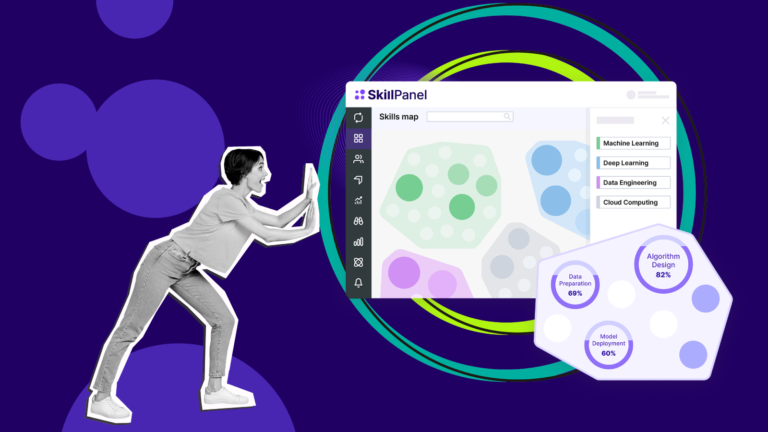
Operationalizing this framework begins with designing a skills ontology: a structured taxonomy that classifies the capabilities relevant to your organization into categories, levels, and relationships. A well-designed ontology distinguishes between, for example, “data analysis” as a broad family and “SQL querying,” “statistical modeling,” and “dashboard visualization” as distinct, measurable skills within it. Taxonomy design matters because it determines what you can see, measure, and act on. Vague or inconsistent skill definitions produce unreliable data; a precise ontology makes skills audits, gap analysis, and development planning actually workable.
The practical difference between a role-based and a skills-based organization shows up in everyday workforce decisions:
| Dimension | Role-Based Approach | Skills-Based Approach |
| Workforce planning | Headcount by job title | Capability inventory by skill domain |
| Hiring criteria | Degree and years of experience | Verified skill demonstrations and assessments |
| Development investment | Training tied to current role | Learning tied to skills gaps and career trajectory |
| Project staffing | Assign by job description | Match by relevant skill set |
| Succession logic | Identify next-in-line by seniority | Identify readiness by capability profile |
A mature skills-based organization doesn’t just have this taxonomy on paper. It actively uses skills data to staff projects, calibrate development investments, evaluate promotion readiness, and plan future hiring, making skills the connective tissue across every talent decision rather than a reference document that sits unused.
How to develop a talent management strategy: Step-by-step
Developing a talent management strategy that actually works requires more than a planning document. It requires a structured sequence of decisions that build on each other, starting with organizational direction and ending with a continuous improvement loop.
Step 1: Align talent goals with business strategy
Every talent management strategy starts at the same place: the business strategy. Before auditing skills or designing programs, organizations need clarity on where the business is going. What does growth look like over the next three to five years? What capabilities does that trajectory require? Which workforce gaps would most directly threaten execution?
The C-suite conversation happens first. Without that alignment, talent initiatives risk becoming well-intentioned but disconnected from what the business actually needs. Once organizational direction is clear, talent goals can be defined in terms that executives recognize as business-relevant, not just HR metrics.
Step 2: Audit your current workforce capabilities
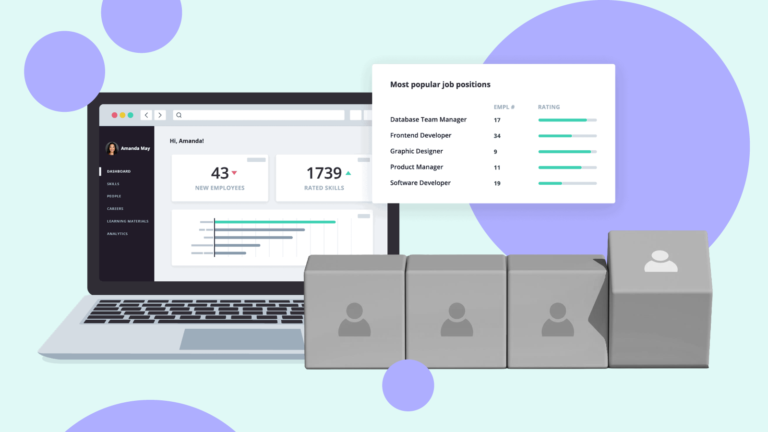
With strategic direction established, the next step is an honest assessment of where the workforce stands today. This means building a skills inventory that goes beyond job descriptions and performance reviews. Effective audits combine self-assessments, peer input, manager evaluations, and technical assessments to build a verified, multi-dimensional picture of current capabilities.
Platforms like SkillPanel are purpose-built for this work. Using a comprehensive skills library and multi-source assessments, SkillPanel creates a searchable, manager-verified database of employee skills, certifications, and experience across every role and department. That visibility is the foundation everything else is built on.
Making the audit actionable from day 1
Most organizations don’t start a talent transformation from zero. They’re transitioning from a fragmented HR model where skills data is scattered across performance reviews, LinkedIn profiles, and manager intuition. A skills audit, on Day 1, produces a gap between what people report and what managers can verify, and that gap itself is the first insight worth acting on.
When leadership alignment is shaky at the outset, the audit data becomes the business case. Showing executives a concrete picture of where critical capability gaps sit, quantified and mapped to strategic priorities, converts a conceptual conversation into a decision one. A realistic timeline from audit to actionable insights runs roughly 60 to 90 days: the first month for data collection and validation, the second for gap analysis and prioritization, and the third for translating findings into development and hiring plans. That window is where platforms like SkillPanel earn their value most visibly, accelerating the process from raw input to structured intelligence that leaders can act on.
Step 3: Identify critical roles and future skills gaps
An audit tells you what you have. The next step is comparing that inventory against what you’ll need. Start by identifying the roles most critical to delivering on business objectives, then map the skills those roles require against current workforce capabilities. The gaps that emerge define your talent development and acquisition priorities.
This is where predictive capability becomes a significant advantage. SkillPanel’s forecasting tools use a library of over 3,000 digital and IT skills to model future workforce requirements 12 to 18 months in advance, enabling scenario planning before shortages become operational crises. Organizations that invest in this kind of foresight avoid the reactive scramble that drives up hiring costs and strains teams.
Step 4: Design and streamline core talent processes
Once gaps are visible, the next priority is ensuring that core talent processes, from recruiting to onboarding to performance management, are designed to close them efficiently. Streamlined processes reduce friction, accelerate integration, and ensure that new capabilities are being deployed quickly once acquired. This step also involves reviewing where processes create unnecessary complexity or duplication, since clear workflows with defined handoffs between talent functions make the overall talent management plan easier to execute at scale.
Step 5: Define roles, ownership, and accountability
A talent management strategy without clear accountability is a strategy in name only. Each component of the strategy needs an owner. Recruitment goals need to sit with specific leaders. Development programs need champions who are responsible for outcomes, not just activities. Skills gap closure needs metrics attached to names and timelines.
This step extends beyond HR. Talent development must involve managers, team leads, and the C-suite as active participants, not passive observers. When leadership models engagement with talent development, it signals organizational seriousness and drives broader participation.
Step 6: Build learning, development, and mobility programs
With gaps identified and accountability defined, organizations can design the programs that close those gaps. Effective development ecosystems blend multiple modalities: microlearning for accessible skill building, on-the-job training for applied development, mentoring for knowledge transfer, and stretch assignments for high-potential acceleration.
The data on program effectiveness is instructive. Around 4 in 5 organizations offering mentorship programs say they’re somewhat or very effective in addressing talent shortages, with 45% planning to expand them over the next five years. Building individualized career paths within these programs, informed by skills data and personal career objectives, drives both engagement and retention by showing employees a visible future within the organization.
Step 7: Embed inclusion into every talent decision
Inclusion isn’t a standalone program. It’s a quality standard applied to every talent decision. That means reviewing sourcing practices for diversity of candidate pools, examining promotion and development decisions for equity in access and outcomes, and ensuring that performance management frameworks don’t inadvertently favor particular working styles or backgrounds.
SHRM notes that leading organizations are shifting from diversity, equity, and inclusion as a compliance posture to DEI focused on equitable outcomes. That shift connects inclusion to talent effectiveness rather than treating it as a separate obligation.
Step 8: Select the right talent management technology
Technology should serve the strategy, not define it. That said, the right platforms make an enormous difference in what’s practically achievable. Organizations need systems that can collect and integrate skills data from multiple sources, surface insights in real time, connect with existing HR infrastructure, and scale without creating administrative overhead.
SkillPanel integrates with HRIS, payroll, and learning systems to deliver a unified view of workforce capabilities without disrupting existing workflows. Its analytics tools track development ROI, flag attrition risk, and identify mobility opportunities across the organization, turning raw workforce data into decisions that HR and business leaders can act on immediately.
Step 9: Set metrics and continuously refine the strategy
A talent management strategy is a living system. The final step is building the measurement framework that keeps it honest. Establish baseline metrics before programs launch, define what success looks like at six, twelve, and twenty-four months, and build in regular review cycles that translate data into strategy adjustments.
Less than 50% of organizations currently trust the skills data they have. AI-based assessment tools significantly improve both reliability and timeliness. Organizations that invest in trustworthy data infrastructure will consistently make better talent decisions than those relying on incomplete or outdated information.
Talent management strategy examples from leading organizations
Named examples from organizations that have actually done this work are more instructive than sector-level patterns. Three cases from recent years illustrate what skills-based talent strategy looks like when it’s fully operational.
Walmart faced a persistent problem: limited internal talent pipelines for higher-level roles, driving heavy reliance on external hiring amid widespread talent shortages. The company addressed this by removing degree requirements from job postings and prioritizing demonstrated skills for promotions and internal mobility through programs including the Rework America Alliance and Business Roundtable’s Multiple Pathways initiative. The result was that Walmart filled 88% of roles above entry-level internally in 2023, expanding talent pools and significantly reducing external hiring dependency.
A global technology organization with 85,000 employees faced critical technical positions sitting vacant for an average of 127 days, well above the 60-day target, with costly external hires frequently missing on fit. After deploying a skills-based workforce planning tool for skills mapping and building an internal talent marketplace to match employees to open roles, the company reduced time-to-fill by 63% (from 127 to 47 days), achieved a 45% increase in internal mobility, and cut external hiring costs by $14.3 million annually.
A financial services firm struggling to build internal data science expertise used skills mapping to identify 34 analysts with latent quantitative capabilities rather than defaulting to external recruitment. A structured six-month upskilling program with mentorship and a new “quantitative analyst” career track followed. Of the 34, 27 transitioned successfully at 40% of what external hiring would have cost. More telling than the cost savings: 100% retention after two years compared to 68% historically, generating a 287% ROI over three years.
What these cases share is a deliberate investment in knowing what skills already exist inside the organization before looking externally, and building the infrastructure to act on that knowledge. Healthcare and manufacturing organizations, which face some of the most persistent shortages globally with gaps reported in up to 98% of job roles across Europe, are following a similar logic through deep succession planning and accelerated development pathways for high-potential talent.
Talent management best practices for 2026
The best practices shaping talent management in 2026 reflect a broader shift toward data-led, personalized, and structurally inclusive approaches. Organizations still relying on intuition and annual cycles are falling behind those that have built responsive, insight-driven talent systems.
Use AI and predictive analytics to inform talent decisions
AI is transforming what’s possible in talent decision-making, moving organizations from descriptive reporting to predictive intelligence. Tools that forecast attrition risk, model future skills requirements, and identify development trajectories are enabling HR leaders to act on problems before they become crises.
76% of HR leaders believe businesses without data-driven solutions will face significant competitive disadvantages within the next 12 to 24 months. SkillPanel’s predictive workforce analytics draw on machine learning and a 3,000-skill ontology to forecast workforce requirements well in advance, enabling scenario modeling that prevents both talent shortages and idle capacity.
Build internal talent marketplaces for skills mobility
Internal talent marketplaces give employees visibility into opportunities across the organization while giving talent leaders a mechanism for deploying capabilities where they’re most needed. The result is a more agile workforce and reduced reliance on external hiring for roles that existing employees are ready to fill. Skills-based hiring delivers up to a 25% increase in employee retention compared to traditional credential-based approaches, which is a direct case for prioritizing internal skills mobility over reflexive external recruitment.
SkillPanel supports this through integrated skills mapping and mobility analytics, making it easy to identify employees with adjacent capabilities who are ready for new challenges. Employees who see clear growth pathways within the organization have far less reason to look elsewhere.
Personalize employee development at scale
Generic training programs produce generic results. Personalized development, calibrated to individual skills profiles, career aspirations, and business needs, produces measurably better outcomes on both engagement and capability development. The challenge has always been executing personalization at scale without creating an administrative burden that HR teams can’t sustain.
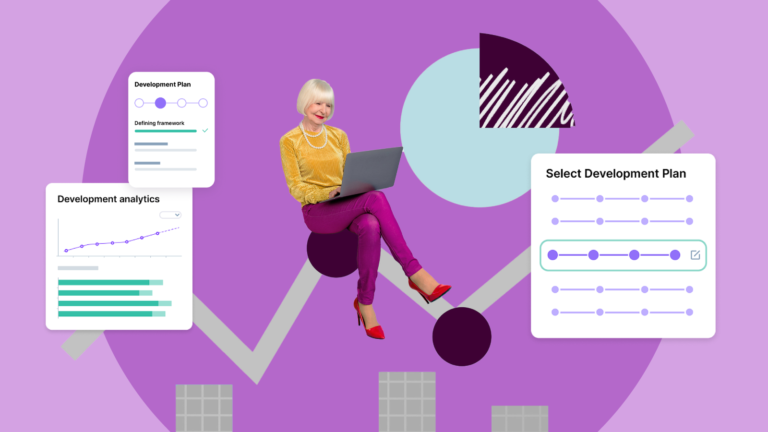
By analyzing skills data, learning history, and performance trajectories, platforms like SkillPanel generate individualized development recommendations automatically, enabling large organizations to deliver personalized paths to every employee without manual intervention.
Design for hybrid, remote, and contingent workforces
The workforce is no longer a homogeneous group reporting to the same location on the same schedule. Effective talent management strategies in 2026 explicitly design for hybrid and remote employees, contingent workers, and distributed teams. This means digital-first onboarding, asynchronous learning options, and talent management processes that don’t assume physical co-location. SHRM notes that leading organizations are increasingly creating unified “total talent” strategies that span both permanent and contingent workforces. Organizations that continue to treat contingent workers as outside the talent management strategy are leaving significant capability and insight on the table.
Measuring talent management effectiveness
Measurement is where talent management strategies prove their worth. Without a disciplined approach to tracking outcomes, even well-designed programs become difficult to defend and nearly impossible to improve.
Key metrics and KPIs to track
The most useful talent management metrics connect workforce outcomes directly to business performance. Time to hire measures recruitment efficiency and signals where process friction is creating unnecessary cost. Employee retention rate, calculated as employees at start minus leavers divided by employees at start, reveals whether the organization is successfully retaining the talent it works to attract and develop. High-performer retention is especially critical, since the loss of top talent carries disproportionate revenue risk.
Internal mobility rate tracks what percentage of roles are filled from within, which is a direct indicator of whether development programs are producing promotion-ready talent. Training ROI, evaluated through Kirkpatrick’s model across reaction, learning, behavior, and business results, connects learning investment to performance outcomes. Succession planning effectiveness, measured through bench strength and the percentage of critical roles filled internally, gauges organizational resilience.
Skills gap analysis quantifies the distance between current and required capabilities at any point in time, and is especially powerful when tracked longitudinally to show whether the organization is systematically closing gaps or allowing them to widen. Time to productivity measures how quickly new hires reach full effectiveness, a direct readout of onboarding quality and initial skills alignment.
Building a workforce insights dashboard
A centralized workforce insights dashboard transforms scattered metrics into a coherent management tool. Effective dashboards give executives an organization-wide view of talent health while allowing managers to drill into team-specific engagement and performance data.
SkillPanel’s performance dashboard architecture is built around this need, offering customizable views that balance breadth for leadership with granularity for frontline managers. Talent heatmap analytics visualize capability density and skills distribution across geographies, departments, and competency domains, combining internal performance data with external market intelligence to identify gaps and flag emerging risks. Configurable alerts and streaming analytics enable real-time anomaly detection, so issues surface before they become significant problems rather than after.
Common talent management strategy mistakes to avoid
The most costly talent management mistakes tend to follow predictable patterns.
Disconnecting talent strategy from business strategy is the foundational mistake. When talent management objectives aren’t explicitly linked to organizational direction, even well-executed programs fail to move the needle on what leadership actually cares about. Every talent initiative should be traceable back to a specific business outcome.
Neglecting the skills audit leaves organizations building development programs on assumptions rather than evidence. Organizations that haven’t established a verified, current inventory of workforce capabilities are essentially flying blind on their most important resource decisions.
Treating inclusion as an afterthought, rather than embedding it into every talent decision, creates both ethical and practical problems. Talent pools that exclude capable people from development and advancement are simply less effective.
Underinvesting in manager development is another common and costly gap. Given that only 1 in 5 employees with ineffective managers are fully engaged, and that 24% of employees report working for their worst manager ever, management quality is one of the highest-leverage variables in any talent strategy.
Finally, setting metrics but failing to act on them produces data without improvement. Measurement should drive decisions, not just documentation. Organizations that build review cycles with clear decision rights around talent metrics are far more likely to improve year over year.
Frequently asked questions about talent management strategy
What is a talent management strategy? A talent management strategy is an integrated, organization-wide plan for attracting, developing, engaging, and retaining the people needed to achieve business objectives. It connects every major workforce decision to organizational direction, ensuring that talent investments directly support business performance.
Why is talent management important? The importance of talent management comes down to business sustainability. Skills shortages are structural and growing. Organizations without a deliberate approach to building and retaining capabilities face rising hiring costs, productivity losses, and competitive disadvantage. Effective talent management converts workforce decisions from reactive costs into proactive investments.
What is the difference between talent management and HR? General HR practice covers administrative functions including compliance, payroll, and workforce policy. Talent management is a strategic layer on top of those functions, focused on aligning workforce capabilities with business goals, developing people proactively, and driving measurable business outcomes.
What are the core components of a talent management strategy? Core components include talent acquisition, onboarding, learning and development, performance management, succession planning, and the data infrastructure that connects them. Each component should be explicitly aligned with organizational objectives.
How do you measure talent management effectiveness? Key talent management metrics include employee retention rate, internal mobility rate, time to hire, time to productivity, high-performer retention, training ROI, and succession bench strength. A centralized workforce insights dashboard makes these metrics actionable for both executives and frontline managers.What tools support a strong talent management strategy? Skills intelligence platforms like SkillPanel provide the data foundation that strong talent strategies require. By integrating skills mapping, predictive analytics, development planning, and performance dashboards into a single system connected to existing HR infrastructure, SkillPanel enables organizations to make workforce decisions with clarity, speed, and confidence.