The talent development strategy that turns potential into performance (and performance into growth)
| Tempo di lettura:


Businesses that treat employee development as a cost center rather than a growth engine are falling behind. The evidence is clear: according to a 2023 Deloitte survey, organizations that effectively align their talent strategies with business goals are 2.5 times more likely to outperform their competitors, and every dollar invested in employee development returns approximately four dollars in productivity. With workforce dynamics shifting faster than most organizations can adapt, a deliberate talent development strategy isn’t just an HR priority. It’s the mechanism that determines whether a business grows or stagnates in 2026.
Why talent development strategy is a business growth driver in 2026
The urgency around talent development has never been sharper. According to Gallup, only 20% of employees worldwide were engaged in 2025, costing the global economy roughly $10 trillion in lost productivity. That’s roughly 9% of global GDP. When disengagement reaches those levels, no product roadmap or market expansion plan survives contact with the workforce.
At the same time, Deloitte’s 2026 human capital research shows that 7 in 10 business leaders now prioritize being “fast and nimble” as their primary competitive strategy. Speed, however, doesn’t come from technology alone. It comes from people who have the right skills, clear growth paths, and genuine motivation to perform. Organizations taking a human-centric approach to AI realize returns 1.6 times higher than those focusing purely on the technology itself.
Developing talent strategy isn’t a soft people initiative layered on top of real business strategy. It is business strategy. When workforce capabilities align with organizational objectives, growth and development in business become self-reinforcing rather than fragile.
What a talent development strategy actually involves
A talent development strategy is a structured, organization-wide approach to building employee capabilities in ways that directly support business goals. It moves well beyond scheduling training courses. A comprehensive talent development plan encompasses learning design, career architecture, skills visibility, performance support, and the organizational culture that makes all of it stick.
The talent development definition most widely cited comes from the Association for Talent Development (ATD), which describes it as the efforts that foster learning, employee engagement, talent management, and employee development to drive organizational performance, productivity, and results. In practical terms, that means connecting individual growth to measurable business outcomes rather than treating development as an isolated HR function.
How it differs from talent management
Talent development meaning and talent management are often conflated, but the distinction matters for how organizations structure their people initiatives. Talent management is the broader system that includes recruitment, performance management, succession planning, and workforce deployment. Talent development sits within that system with a specific focus: building capability in the people you already have.
Think of talent management as the operating framework for the entire employee lifecycle. Talent development is the engine within that framework responsible for making people more capable, more engaged, and more valuable to the organization over time. Getting this distinction right prevents organizations from mistaking activity, such as running annual reviews or posting job openings internally, for genuine development.
Core components: Training, career pathing, and retention
Effective talent development plans rest on three interconnected pillars. Training programs provide the foundational skill-building, but they work best when designed around verified capability gaps rather than generic curricula. Career pathing ensures employees have transparent visibility into where their development leads, connecting effort to advancement in a way that sustains motivation. Retention strategy sits at the intersection of both: when people see clear pathways and feel genuinely supported in growing, they stay.
These components don’t function in isolation. The most effective talent development programmes build pathways that connect a specific training experience to a defined career step, anchored in the actual skills the business needs next. Without that connection, training becomes a checkbox and career conversations become vague.
How to build a talent development strategy that works
Building a talent development strategy that produces real results requires sequencing. Organizations that jump straight to selecting learning platforms or designing programs, without first aligning on objectives and capability data, routinely find that their investment fails to move the metrics that matter. The following steps provide a structured talent roadmap for getting it right.
Step 1: Align development goals with business objectives
Every talent development plan needs a business anchor. Start by identifying the three to five strategic objectives your organization must achieve over the next one to three years, then work backward to determine which workforce capabilities those objectives require. If the business is expanding into new markets, which roles are most critical, and what skills do those roles demand? If the priority is operational efficiency through AI integration, what human capabilities need to grow alongside the technology?
This alignment process transforms development from a cost to a strategic investment. It also makes it far easier to secure executive sponsorship and budget, since every initiative can be traced directly to a business outcome.
Step 2: Identify critical roles and skill gaps
Not all roles carry equal weight in a transformation. Bain’s 2024 Transformation and Change Survey of more than 400 executives found that 90% of transformation value comes from fewer than 5% of roles. Yet only 76% of successful transformers had a clear understanding of mission-critical roles, compared to 58% of poor performers.
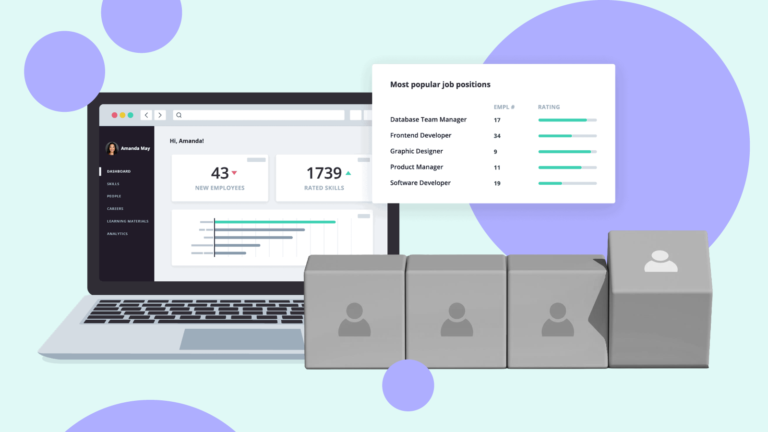
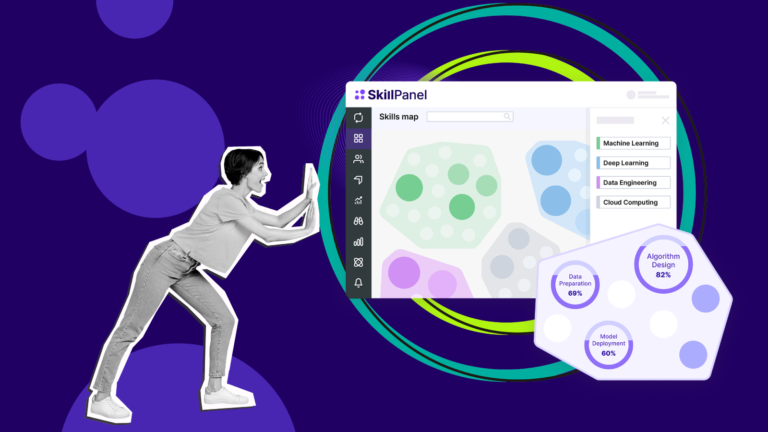
Identifying those roles starts with skills visibility. Platforms like SkillPanel provide a searchable, real-time database of employee skills, certifications, and experience across the entire organization. This data, verified by managers and continuously updated, lets HR and L&D leaders see exactly where gaps exist and which employees are closest to filling critical positions internally. SkillCheck Assessments go further, delivering real-world technical evaluations across more than 3,000 digital and IT skills to pinpoint gaps with precision rather than assumption.
Step 3: Design a blended learning and development programme
Once capability gaps are mapped, the design of the development programme should reflect how people actually learn best. The 70-20-10 model, developed by Charles Jennings and widely documented by ATD, remains a practical reference point: roughly 70% of development comes from on-the-job experience, 20% from coaching and mentorship, and 10% from formal training. Blended programmes combining online courses, workshops, peer learning, and coaching tend to outperform single-format approaches because they accommodate diverse learning styles and reinforce skills across multiple contexts.
Career rotations, apprenticeships, and cross-functional assignments are especially effective for building the adaptive, curiosity-driven workforce that competitive environments require. The key is connecting each learning experience to verified skill data so progress is measurable, not just assumed.
Step 4: Integrate development into the employee lifecycle
Talent development and retention are most durable when development isn’t treated as a periodic event but woven into every stage of employment. Onboarding is an underused development opportunity, as it sets the tone for how seriously the organization takes growth. Mid-career employees need visibility into what advancement looks like. Longer-tenured employees benefit from reskilling pathways that acknowledge their institutional knowledge while helping them adapt to new demands.
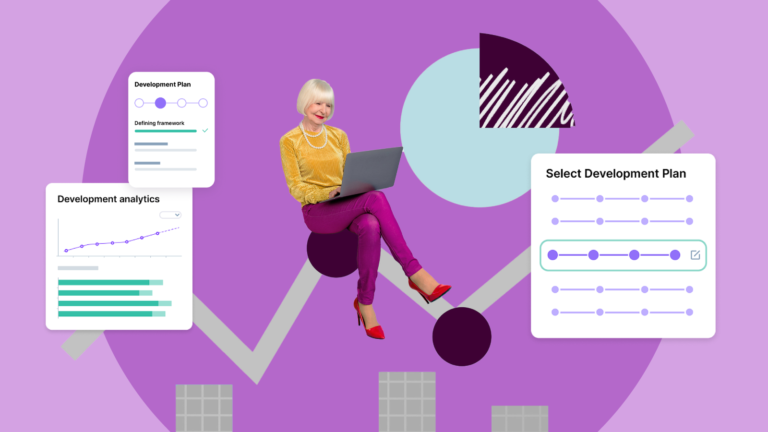
SkillPanel’s personalized development paths automatically generate career trajectories based on verified skill data, individual interests, and organizational goals. Employees see clear next steps rather than ambiguous potential, which directly supports engagement and reduces voluntary turnover.
Step 5: Equip managers to champion development
Managers are the most direct influence on whether an employee’s development actually progresses. According to SHRM research, 46% of CHROs identified leadership and manager development as a top priority for 2026, marking the second consecutive year it topped the list. That signal reflects a broader recognition that middle management is often where talent development plans either gain traction or stall.
Equipping managers means more than sending them through a leadership course. It means redefining their role to include active development accountability, providing them with real skill data on their team members, and reducing the administrative burden that crowds out coaching time. When managers are genuinely empowered to develop talent, the returns scale across the entire organization.
Step 6: Build a culture of continuous learning
Culture is what happens when no one is watching. Organizations that build genuine learning cultures don’t rely solely on formal programmes; they make curiosity and skill growth the default way people work. SHRM research also notes that 31% of CHROs are prioritizing workplace culture in 2026, up from just 15% in 2025, indicating that leaders are connecting culture directly to organizational performance.
Practically, this means integrating learning into the flow of work rather than treating it as something people do alongside their job. Cross-generational mentorship, knowledge-sharing sessions, internal mobility encouragement, and recognition of skill growth all contribute to a culture where development feels normal rather than exceptional.
Step 7: Measure impact and refine the plan
Without measurement, a talent development programme is simply an activity budget. Effective talent development management connects learning metrics to business outcomes, tracking not just course completions but skill gains, performance improvements, productivity shifts, and retention rates. According to the LinkedIn Workplace Learning Report, employee retention is used by 31% of organizations as a metric for tracking the business impact of L&D.
SkillPanel’s learning and development analytics provide dashboards connecting learner behavior, capability growth, and business performance in one place. That integration with existing HR systems means insights are actionable rather than isolated, enabling continuous refinement of the talent strategy framework over time.
The impact of structured development programmes, measured and properly resourced, can be significant. New Zealand Telecom’s learning sabbatical program, which gave employees one month of paid time to pursue any course of their choice, produced a 10% increase in engagement scores and a marked drop in turnover within a single year. The program worked because it treated learning as a genuine employee benefit, not a compliance exercise, and measured outcomes from the start.
Talent development framework: Structuring your approach
A talent development framework gives structure to what could otherwise become a scattered collection of initiatives. Rather than managing development as a series of disconnected programmes, a framework provides consistent logic that scales across roles, levels, and functions. It operates at three interconnected levels: individual capability, team capability, and organizational capability.
Individual capability: Upskilling and reskilling paths
At the individual level, a talent framework focuses on building the right skills in the right people at the right time. Upskilling deepens competence within a current role, while reskilling prepares employees for entirely different functions as business needs shift. Both require accurate starting-point data. Organizations that lack visibility into their workforce’s actual skills often waste development investment on gaps that don’t exist or miss critical ones that do.
Personalized development paths, grounded in verified skill assessments rather than self-reported information, dramatically improve the precision and impact of individual-level development. When an employee can see exactly which skills they need to reach the next stage of their career, learning motivation increases alongside business relevance.
Team capability: Leadership pipelines and succession planning
At the team level, the talent development framework focuses on ensuring a consistent flow of capable leaders into critical roles. DSG’s 2026 Workforce Power Index found that two-thirds of HR leaders in large organizations cite succession planning as a top pain point. That challenge is compounded by a sobering reality from Bain’s 2022 Talent Survey: more than half of high performers lack the capabilities they’ll need for critical roles in five to ten years.
The most effective response combines data-driven early-warning systems with the 70-20-10 model, embedding cross-functional rotations, mentoring, and structured coaching into succession planning rather than treating them as extras. Building leadership pipelines this way isn’t reactive planning; it’s a proactive investment that protects business continuity.
Organizational capability: Future-proofing through learning systems
At the organizational level, the framework shifts to the systems and infrastructure that make continuous development possible at scale. Schneider Electric’s Open [Talent Market](https://skillpanel.com/blog/talent-marketplace-platform/) offers a real-world illustration: an AI-powered platform for internal career opportunities that achieved broad adoption and facilitated thousands of mentoring and gig matches across the global workforce. The Senior Talent Program, launched globally in 2023, aimed to give more than 90% of employees access to career development opportunities, reflecting organizational-level ambition for learning infrastructure.
SkillPanel’s integration capabilities connect development data with HR systems, payroll, and learning platforms, creating a unified view of workforce capability that enables the organization to anticipate future skill needs rather than react to shortfalls. That predictive capacity is the foundation of true organizational resilience.
Talent development and retention: The direct link
The relationship between talent development and retention is direct and quantifiable. According to the LinkedIn Workplace Learning Report, companies with a strong learning culture show the highest retention rate at 57% and the highest internal mobility rate at 23%. Separately, 90% of organizations report concerns about employee retention, and providing learning opportunities ranks as the top strategy for addressing it.
Internal mobility plays a significant role in this dynamic. Organizations that actively encourage employees to explore different roles internally benefit from longer tenure, deeper institutional knowledge, and faster organizational adaptation. 46% of companies are already investing in career mentoring and coaching programs specifically to boost retention and internal mobility, and the trajectory is upward.
Beyond retention, there’s a cost efficiency argument that’s difficult to ignore. Filling skills gaps through internal upskilling, such as developing junior developers into senior roles, avoids the recruitment costs, onboarding time, and productivity losses associated with external hires. That efficiency frees HR capacity for higher-value strategic work rather than reactive hiring cycles.
Common mistakes that undermine talent development plans
Even well-resourced organizations undermine their talent development plans through predictable but avoidable mistakes. Understanding where strategies typically fail is as important as knowing how to build them well.
The most consequential error is misalignment. Bain’s research found that only 12% of business transformations achieve their original ambitions, with talent handling being the strongest predictor of success or failure. Organizations that fail to identify mission-critical roles, overload top performers with too many responsibilities, and neglect future capability planning consistently fall short. When 56% of successful transformers avoided overloading key leaders compared to just 44% of poor performers, the implication is clear: how you manage your best people’s time and development directly shapes transformation outcomes.
A second common failure is neglecting skills visibility. Without a transparent, accurate picture of workforce capabilities, organizations can’t create meaningful career paths, can’t identify internal candidates for open positions, and can’t allocate talent effectively. This “learning debt” accumulates quietly. When organizational change outpaces employee development, skills erode without anyone noticing until a capability gap becomes a business problem.
Many organizations also cling to pre-2020 talent frameworks that no longer reflect the current reality of workforce expectations, skills demands, and competitive pressures. Reverting to legacy approaches while the talent landscape has fundamentally shifted creates a credibility gap between what the organization says about development and what employees actually experience.
Finally, failing to empower employees in their own development is a consistent retention risk. When career growth feels like something that happens to employees rather than something they actively shape, engagement drops and turnover rises. Giving employees ownership through transparent career paths, self-service skills assessments, and clear visibility into development options fundamentally changes the dynamic.
Building your talent development strategy: Next steps
A talent development strategy only delivers value when it moves from concept to execution. The starting point is honest assessment: where does your organization currently stand in terms of skills visibility, development infrastructure, and cultural alignment around learning? What gaps exist between your current workforce capabilities and the capabilities your business will need in the next two to three years?
From that foundation, the work of developing talent strategy becomes concrete. Engage business leaders and HR stakeholders to align on priority objectives. Use skills intelligence tools to map your existing workforce and identify the highest-impact gaps. Design learning and development programmes that connect verified skill data to personalized career paths. Build manager capability to champion development as an ongoing responsibility rather than an annual review conversation.
Platforms like SkillPanel accelerate this process by providing the data infrastructure that makes skills-based talent decisions possible at scale, from gap analysis and internal mobility tools to SkillCheck Assessments and L&D analytics. For organizations looking to benchmark their current approach and stay ahead of emerging L&D trends, SkillPanel’s State of L&D in 2025 Ebook offers forward-looking insights and practical guidance for refining your talent roadmap.
The organizations that build strong talent development plans today are creating self-reinforcing advantages: longer tenure, deeper capability, faster market response, and cultures that attract people who want to grow. In a business environment where speed and adaptability determine competitive position, that kind of workforce is the most durable edge available.