
Is your company one resignation away from chaos? How to identify critical roles
| Reading time:


Identifying critical roles in succession planning
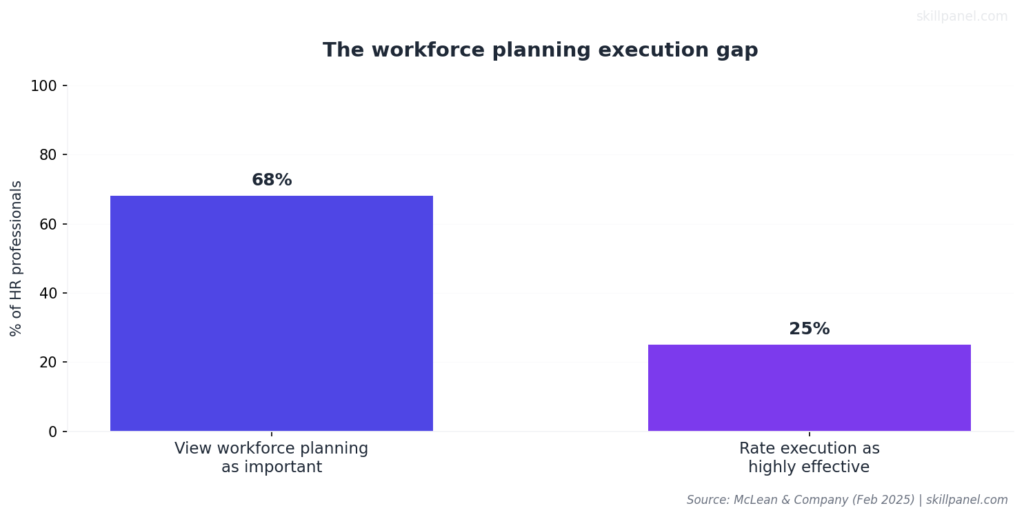
Succession planning fails at the first step when organizations can’t pinpoint which roles actually matter. 68% of HR professionals view workforce planning as highly important, yet only 25% rate their execution as highly effective, according to McLean & Company’s February 2025 research. This execution gap leaves companies vulnerable to operational disruptions they never saw coming. The difference between succession planning that works and one that merely exists on paper starts with identifying critical roles succession planning must protect.
Critical role definition goes beyond titles and hierarchy. It requires systematic evaluation of which positions, if left vacant, would genuinely threaten your strategic objectives, operational continuity, or competitive position. This foundation determines whether your succession planning process will safeguard business resilience or simply document organizational charts.
Why identifying critical roles determines succession planning success
The succession planning purpose hinges on protecting your organization’s most vulnerable pressure points. When you misidentify critical positions, you invest resources developing successors for replaceable roles while genuinely pivotal positions remain exposed.
Companies include critical roles in succession planning at a rate of 82%, yet only 57% ensure high performers occupy those positions. The gap reveals a fundamental problem: identifying roles without understanding their true strategic weight leads to weak execution. Your succession development plan becomes reactive rather than strategic, responding to departures instead of preventing disruption.
86% of business leaders consider succession planning critical to organizational success, yet 70% report significant shortcomings. The weakness almost always traces back to poor critical role identification. When you don’t know which positions truly drive business outcomes, you can’t allocate talent development resources effectively or build meaningful bench strength.
Strategic resource allocation demands precision. Organizations that nail critical role identification create focused succession planning frameworks that address actual vulnerabilities rather than perceived ones. They develop successors for positions that genuinely impact revenue generation, operational stability, and long-term strategic execution.
Real-world evidence: Companies getting critical role identification right
Consider how Procter & Gamble approached succession for their CEO transition. Rather than designating a single heir apparent, P&G implemented a transparent multi-candidate process with strict assessments and direct board-candidate interactions. The surprising element? Their emphasis on building a broad executive bench beyond one leader. This approach produced an exceptional CEO successor plus a high-performing senior team that sustained long-term achievements through leadership changes.
The American Society for Health Care Engineering faced a different challenge. ASHE addressed succession gaps for specialized facility roles often overlooked in planning. Their critical role identification revealed that facility managers, while not in leadership positions, were pivotal because they oversee fire protection, power failures, and sterilization systems where vacancies risk life-or-death hospital operations. Targeted development for these niche technical positions filled critical gaps in mission-critical functions.
A mid-sized tech company discovered this reality during an emergency. When their Head of Customer Success departed suddenly due to a family emergency, pre-identified high-potentials stepped in through shadowing, coaching, and gradual client handovers. The successor managed enterprise clients effectively during a 30-day transition, proving emergency readiness value. The lesson? Client-facing operations roles maintaining low churn through escalations and relationships often carry more criticality than their organizational chart position suggests.
These examples highlight a consistent pattern: effective critical role identification surfaces non-obvious positions based on business impact rather than hierarchy alone.
Core criteria for evaluating role criticality
Role analysis for succession planning in companies requires a multi-dimensional approach that goes beyond gut instinct or organizational politics. Effective critical positions evaluation uses consistent criteria applied systematically across your entire workforce.
Strategic impact and business value
Strategic importance and business impact form the foundation of any robust succession planning framework. Roles earn critical designation when their vacancy would disrupt operations, stall revenue generation, damage customer experience, or derail strategic initiatives.
Consider how each position influences company success beyond day-to-day operations. Does the role shape long-term growth trajectories, protect competitive advantages, or enable strategic pivots? A technical specialist who maintains proprietary systems critical to your product differentiation may carry more strategic weight than several mid-level management positions combined. The key is evaluating impact on organizational performance and continuity rather than assuming hierarchy equals importance.
Practical assessment involves rating direct effects on revenue or cost structures, capacity to influence customer retention or brand reputation, and contribution to core business processes like product development or supply chain management. Weight these factors based on your organization’s three to five year strategy. A scaling technology company might assign 30% weight to strategic revenue impact and 25% to operational continuity, while a regulated financial institution might prioritize compliance and risk mitigation more heavily.
Replacement difficulty and timeline urgency
Urgency and vacancy risk create another essential dimension for evaluating criticality. Roles become more critical when replacement timelines extend beyond acceptable business tolerance or when departure probability increases due to retirement windows, market demand for specialized skills, or burnout indicators.
Timeline pressures particularly matter for leadership positions. Organizations should monitor leaders approaching retirement age between 60 and 65, recognizing that by 2027 through 2030, these departures could create sudden vacancies in pivotal roles.
Assessment involves evaluating how quickly you could fill the vacancy with a qualified successor who can perform effectively. A role requiring six months to hire and an additional year for the new person to reach full productivity carries different risk than one you could fill internally within weeks.
Knowledge concentration and skill uniqueness
Roles housing specialized expertise or unique knowledge bases that genuinely resist external hiring deserve critical classification. This criterion examines whether the position requires proprietary system knowledge, institutional memory, relationship networks, or technical competencies available in only narrow talent pools.
Unique skillset or knowledge base evaluation separates truly hard-to-replace expertise from generally scarce but obtainable skills. A software engineer with common programming languages differs from one who built and maintains legacy systems integral to core operations. The latter’s departure could halt critical processes while the organization scrambles to reconstruct undocumented knowledge.
Geographic constraints compound skill scarcity. Assess whether your location limits access to required competencies or if roles draw from deep, accessible talent pools. Deloitte projects that 90% of companies will face skills shortages by 2027, emphasizing how roles requiring high-demand, evolving skills carry elevated strategic value.
Internal talent availability vs. external market conditions
Internal bench strength versus external market reality creates the final core criterion. Roles become more critical when organizations lack developed potential successors and external recruiting faces significant barriers.Only 50% of organizations report ready-now candidates for critical roles, amplifying replacement risk.
Evaluate whether your company has identified and developed successors who could step into the position within three years. This assessment requires honest appraisal through performance data, 360-degree feedback, and competency measurements. Roles lacking viable internal candidates while also facing challenging external markets deserve immediate succession focus.
External market conditions matter because they determine feasibility of outside hiring. Skills availability in the broader talent market, competitive compensation pressures, and industry-specific talent dynamics all influence replacement difficulty. The intersection of weak internal pipelines and constrained external options creates maximum vulnerability.
Proven frameworks for critical role identification
Systematic succession planning frameworks transform subjective opinions into objective, defensible decisions about which roles deserve focused succession investment. Several proven methodologies help organizations structure their critical role identification process.
The three-dimension assessment model (Strategic, business, role value)
This framework evaluates positions across three interconnected dimensions that together reveal true criticality. Strategic dimension examines long-term organizational objectives and how the role enables or threatens their achievement. Business dimension focuses on immediate operational impact including revenue generation, cost control, and customer satisfaction. Role value dimension assesses the position’s inherent characteristics like skill requirements, knowledge concentration, and replacement complexity.
Organizations using this model typically establish rating scales for each dimension, then combine scores to identify roles crossing predetermined thresholds. The advantage lies in forcing evaluators to consider multiple perspectives simultaneously rather than fixating on a single factor like seniority or current incumbent performance.
Implementation involves defining specific questions or metrics for each dimension relevant to your business context. Strategic assessment might ask how role vacancy would affect your ability to execute planned initiatives or respond to market shifts. Business assessment evaluates quantifiable impacts on key performance indicators. Role value assessment examines market scarcity and internal replacement capacity objectively.
Framework trade-off: The Three-Dimension Model provides comprehensive evaluation but requires mature HR data infrastructure that many mid-sized companies lack. Organizations under 200 employees often achieve better results with facilitated workshops than formal scoring matrices, which can create analysis paralysis.
Critical role identification matrix method
The succession plan matrix approach plots positions on a two-axis grid to visualize priorities and define appropriate action zones. The most common configuration uses business impact as the horizontal axis ranging from low to high, and replacement difficulty or time-to-fill as the vertical axis ranging from short to long timelines.
This visualization creates four distinct quadrants demanding different responses. Top right positions showing high impact combined with long replacement time require immediate succession planning focus, robust development programs, and potentially backup successors. Top left roles with low impact but long replacement time might benefit from work redesign, automation exploration, or process documentation rather than intensive succession investment.
Bottom right positions deliver high business impact but offer relatively quick replacement options, suggesting pipeline monitoring and broad talent development suffice rather than dedicated succession plans. Bottom left roles warrant standard talent management practices without specialized succession focus.
Framework trade-off: The Matrix Method provides clear visualization but may oversimplify roles that span multiple quadrants or have nuanced characteristics not captured by two axes alone.
Skills-based workforce segmentation approach
This framework segments your workforce by competency clusters and evaluates role criticality through the lens of skill availability, skill evolution velocity, and skill impact on business outcomes. Rather than treating each position individually, this method identifies capability families that drive organizational success.
Skills-based evaluation proves particularly valuable as organizations recognize that skills shortages by 2027 will affect 90% of companies. Roles requiring rapidly evolving technical skills or competencies with limited market supply automatically gain critical status because they represent bottlenecks to strategic execution.
Implementation begins by defining eight to twelve critical competencies per role, categorized into core competencies required across all positions, role-specific functional competencies, and leadership competencies. Assessment through self-evaluations, supervisor ratings, and 360-degree feedback creates baseline data highlighting where capability concentrations create dependencies and where gaps expose vulnerabilities.
Step-by-step process to identify your organization’s critical positions
How to start critical role identification requires a structured methodology that balances comprehensiveness with practical execution. The following process synthesizes best practices into an actionable sequence applicable across organization sizes.
Assemble a cross-functional evaluation team
Building a diverse evaluation team beyond HR ensures you capture operational reality rather than organizational chart assumptions. Your team should include HR leadership who understand talent dynamics, department heads with strategic context, finance representatives who grasp cost implications, and individual contributors who know where work actually gets done.
Cross-functional collaboration reduces bias that emerges when single departments or perspectives dominate decisions. Advisory teams that listed only top executives initially delayed succession for critical roles like data analysts vital to revenue forecasting, causing strategic missteps during unexpected turnover. Department heads might overstate their own roles’ importance while undervaluing adjacent functions.
The ideal team size ranges from six to ten members representing varied organizational levels and functions. Establish clear roles distinguishing decision-makers from advisors, and define your criteria and process before beginning evaluations.
Map current positions against future business strategy
Strategic alignment transforms company succession planning from reactive gap-filling to proactive capability building. Begin by gathering your strategic plan documents, growth projections, planned initiatives, and anticipated market shifts for the next three to five years.
Create a comprehensive role inventory spanning all organizational levels, geographies, and functions. Include position details like department, location, number of incumbents, current vacancy status, and retirement risk indicators. This enterprise-wide view prevents the common pitfall of starting too narrowly and missing hidden pivotal roles.
Evaluate how each position supports or enables strategic objectives. A role that’s moderately important today might become critical if your strategy involves geographic expansion requiring that expertise. A tech firm that ignored a cybersecurity role’s growing importance amid market changes faced talent shortages when threats escalated. This forward-looking perspective ensures your succession investments align with where your company is going rather than where it’s been.
Apply evaluation criteria to create initial candidate list
Systematic scoring brings objectivity to what otherwise becomes political or subjective territory. Rate each position using the criteria framework your organization adopted, typically on one-to-five scales across dimensions like direct revenue or cost impact, customer experience influence, operational continuity requirements, and replacement timeline.
For faster decision-making or smaller organizations, simplified criteria work effectively. Three straightforward questions capture essentials: What breaks within 30 days if this position sits empty? How severely does vacancy impact customers, cash flow, or compliance? Can we readily hire or promote replacement talent? Roles triggering concern across all three questions earn immediate attention.
Document your scoring methodology, criterion weights, and rationale for future reference. This audit trail enables consistent annual reviews without reinventing the process each cycle.
Prioritize roles using scoring or matrix tools
Scoring generates ranked lists, but visualization through matrix tools makes priorities actionable for leadership. Plot your scored positions on the business impact versus replacement difficulty grid discussed earlier, using your numeric scores to determine axis placement.
Set realistic thresholds recognizing that most organizations effectively manage succession planning for only 15 to 40 critical roles within a twelve to eighteen month cycle. Organizations identifying more roles than resources allow should prioritize based on urgency, business impact, and internal readiness.
Define clear cutoff scores for critical classification. Many organizations use thresholds between 16 and 20 points on 25-point scales or 22 and above on 30-point scales. These numeric dividing lines create objective standards that withstand scrutiny better than subjective judgments.
Validate selections with leadership and stakeholders
Executive validation ensures your identified critical positions align with leadership’s understanding of strategic priorities and operational vulnerabilities. Present your methodology, scoring criteria, and resulting classifications to senior leadership for feedback before finalizing.
Apply the role-vacant stress test during validation discussions. For each proposed critical role, ask what specifically breaks within 30 days if the position goes unfilled. Concrete operational impacts like halted product development, compliance failures, or customer service degradation confirm criticality.
Handling executive disagreements: When leaders dispute role criticality, return to documented scoring criteria rather than deferring to seniority. If your CFO and COO disagree on whether a finance controller or supply chain director is more critical, walk through the role-vacant stress test for each position. What breaks first? What’s the revenue impact? How quickly can we replace the expertise? This evidence-based approach de-escalates political tensions.
Separate role criticality from individual performance throughout validation. The goal is identifying positions inherently valuable to organizational success regardless of current incumbents. High performers can make any role look critical through personal capability, creating bias that misguides succession investment toward replaceable positions.
Navigating common implementation challenges
Corporate succession plans routinely stumble over predictable obstacles that undermine their effectiveness. Understanding how companies have navigated these challenges provides actionable guidance.
Challenge 1: Confusing high-performers with critical roles
Organizations frequently identify roles based on the current occupant’s performance rather than the position’s inherent impact. A manufacturing firm deemed only C-suite roles critical, missing a mid-level engineer whose departure halted production lines for weeks due to unique technical knowledge. Leaders resist separating “person from role” to avoid demoting high-performers’ perceived status.
How to overcome: Adopt structured frameworks with objective criteria like operational disruption risk and revenue impact. Use data-driven scoring to ensure fairness and monitor adjustments as needs evolve. Document the distinction explicitly: “We’re evaluating the position’s impact, not the person’s performance. High performers in non-critical roles still receive recognition and development, just different succession investment levels.”
Challenge 2: Hierarchical bias masking impact-driven roles
Bias toward visible senior positions over impact-driven roles creates dangerous blind spots. Teams default to senior roles due to organizational hierarchy, ignoring critical non-executive positions with high stakeholder impact. Managers prioritize their direct reports, fostering silos and disputes over “importance.”
How to overcome: Form cross-functional Succession Advisory Teams for holistic input. Starting exhaustively then scoring via templates helps prioritize by business impact rather than title. When ASHE discovered facility managers were more critical than some leadership positions, their structured approach validated this counterintuitive finding through evidence.
Challenge 3: Role ambiguity creating misalignment
Undefined role responsibilities and inadequate documentation lead to misaligned identification. A company failed to document a supply chain coordinator’s scope, overlooking it as critical until a vacancy caused delays. Successors were unprepared due to unclear success metrics, and informal discussions created confusion during gaps.
How to overcome: Define roles with clear business outcomes and competencies upfront. Maintain updated documentation for governance. Create one-page profiles covering purpose, competencies, risks, and pipeline status before starting critical role identification.
Challenge 4: Political resistance to “Critical” labeling
Employees and leaders push back, equating non-critical designation with low value. Pushback from mid-managers feeling undervalued can stall identification by months, derailing the entire process.
How to overcome: Use neutral terms like “high-impact roles” or “priority positions” rather than “critical.” Frame discussions around organizational resilience and business continuity rather than individual worth. Tailor criteria weighting to business priorities, making the classification about strategy, not status.
Challenge 5: Identifying too many critical roles
When evaluation processes reveal 50+ critical positions, organizations face analysis paralysis and resource dilution. This typically signals unclear thresholds or political pressure to include every department’s favorites.
How to overcome: Establish clear scoring cutoffs before evaluation begins. Use phasing strategies that address highest-risk roles first, then expand in subsequent cycles. Most organizations successfully manage 15-40 roles within twelve to eighteen month cycles. Focus initial efforts where vacancy would cause immediate operational failure or strategic derailment, then build out gradually.
Readiness scenarios and differentiated actions
Successor readiness varies significantly across critical roles, demanding different response strategies. Understanding these scenarios helps you allocate development resources effectively.
Ready-now successor exists: When you have an internal candidate capable of stepping into the role within 30 days, focus on retention through meaningful work exposure, compensation competitiveness, and career pathing. Provide stretch assignments that broaden capabilities while keeping them engaged. Create contingency for sudden departures even with ready successors, because your best candidate might be recruited away.
Two to three year development needed: This scenario requires accelerated development plans with clear milestones, executive mentorship, rotational assignments building missing competencies, and regular progress reviews. Invest in formal training for technical or leadership gaps. Track development velocity to identify if your timeline projections are realistic or if external recruiting should run parallel.
No internal pipeline plus difficult external market: The highest-risk scenario demands immediate action on multiple fronts. Focus on knowledge documentation and cross-training to reduce dependency on single individuals. Implement retention incentives for current incumbents while launching extended external searches. Consider interim solutions like consultants or part-time retirees. For roles where both internal development and external hiring look bleak, explore work redesign that distributes critical responsibilities across multiple positions.
Tools and resources for critical role identification
Organizations approach critical role identification through various tools and methodologies, each offering different strengths. Here are several options to consider:
Integrated talent platforms: Solutions like SkillPanel provide AI-powered skills mapping, SAP SuccessFactors offers comprehensive talent management modules, and Workday includes succession planning capabilities within their HCM suite. These platforms connect critical role identification with broader workforce analytics and development tracking.
Assessment-based frameworks: SIGMA Assessment Systems offers structured questionnaires for critical role identification, while McLean & Company provides research-backed templates and scoring methodologies. These approaches emphasize objective criteria and consistent evaluation.
Custom workshop facilitation: Many organizations, particularly those under 500 employees, succeed with facilitated leadership workshops using simplified frameworks. Internal HR teams or external consultants guide cross-functional groups through structured discussions and prioritization exercises without requiring significant technology investment.
Competency modeling tools: Platforms focusing on skills architecture like Degreed or Gloat help organizations understand capability concentrations and gaps, supporting skills-based approaches to critical role identification. These work well when integrated with learning management systems for development planning.
The right choice depends on your organizational size, existing HR technology infrastructure, analytical maturity, and whether you need a standalone succession planning tool or comprehensive talent management ecosystem.
Adapting critical role identification for different organization sizes
Succession planning frameworks must flex to accommodate varied organizational scales, resources, and complexity levels. What works for a 10,000-employee enterprise would overwhelm a 150-person company.
Smaller organizations between fifty and two hundred employees should focus critical role identification tightly on immediate operational continuity threats and founder or key leader transitions. Your critical role count might range from five to fifteen positions, with simpler scoring methodologies like the three-question approach covering customer impact, cash impact, and compliance impact.
Implementation emphasizes practicality over comprehensiveness. Rather than formal matrix tools and extensive documentation, smaller companies benefit from facilitated workshops where leaders collectively identify roles whose sudden vacancy would threaten survival or strategic momentum. Focus succession efforts on transferring irreplaceable knowledge from founders or long-tenured staff before it walks out the door.
Mid-sized organizations from two hundred to two thousand employees need more structure as geographic distribution, functional specialization, and management layers increase complexity. Your critical role inventory might span fifteen to thirty positions requiring systematic evaluation criteria and formal prioritization processes. Matrix visualization helps leadership understand trade-offs when resource constraints prevent addressing all identified gaps simultaneously.
These organizations should establish defined evaluation teams representing major business units, formalize scoring methodologies with documented criteria weights, and create basic governance including quarterly reviews and annual refresh cycles.
Large enterprises exceeding two thousand employees require robust frameworks integrating critical role identification into comprehensive talent management ecosystems. Critical role inventories may include thirty to fifty positions organization-wide, with additional critical roles identified within business units or geographic regions. Governance structures involve multiple stakeholder layers, formal review cadences, and integration with strategic workforce planning processes.
Enterprise implementation demands consistent methodologies applied across divisions to enable comparison and portfolio-level decision-making. Centralized platforms providing real-time visibility into role criticality, successor readiness, and development progress become essential infrastructure.
The sophistication of your identification process should match your organizational complexity and available resources. Start with approaches you can execute reliably rather than implementing frameworks beyond your current capacity.
Creating your critical role inventory and action plan
Converting identification results into executable succession programs requires structured documentation and clear action planning. Your critical role inventory becomes the foundation for targeted development, strategic recruiting, and knowledge transfer initiatives.
Begin by creating standardized one-page role profiles for each identified critical position. Document the role’s purpose within organizational strategy, three to five key accountabilities that define success, required competencies across technical, functional, and leadership dimensions, specific vacancy risks including retirement timelines or flight risk indicators, and current successor pipeline status ranging from ready now to no identified candidates.
These profiles serve multiple purposes beyond succession planning. They clarify expectations for incumbents, guide recruiting when external hiring becomes necessary, inform compensation benchmarking, and provide structure for development conversations.
Establish comprehensive metadata and version control practices ensuring your inventory remains accurate and searchable over time. Include role classifications, department assignments, geographic locations, last review dates, and revision histories. Centralized repositories in talent management platforms prevent the scattered spreadsheets that plague many succession planning efforts.
Build governance frameworks defining clear ownership and update responsibilities. Designate who maintains inventory accuracy, approves changes, coordinates reviews, and reports status to leadership. Without explicit accountability, critical role inventories deteriorate quickly as departures, promotions, and reorganizations occur.
Translate your inventory into actionable succession development plans for each identified role. Specify target successors at different readiness levels, development activities required to close capability gaps, timelines for achieving readiness, and contingency plans if primary successors leave or development stalls.
Implement regular review cadences ensuring your critical role inventory and action plans stay current. Conduct quarterly HR-business reviews updating succession status and addressing immediate concerns like unexpected departures. Schedule semi-annual full reviews of list composition examining whether business strategy shifts or organizational changes warrant reclassification. Perform annual complete refreshes repeating the systematic identification process to validate your critical role inventory comprehensively.
Maintain realistic expectations about the scope you can support effectively. Most organizations successfully manage succession planning for fifteen to forty critical roles within twelve to eighteen-month cycles. Attempting to address too many positions simultaneously dilutes resources and attention, producing mediocre results across all roles rather than meaningful progress on your highest priorities. Your critical role inventory becomes a living strategic asset requiring ongoing maintenance and refinement. Organizations achieving workforce planning effectiveness despite only 25% executing well distinguish themselves through disciplined processes maintaining accurate, actionable critical role intelligence. This foundation enables the targeted talent development and strategic recruiting that converts succession planning from a compliance requirement to competitive advantage.