

Every HR leader eventually hits the same wall: employees want to grow, but the systems around them aren’t built to support that growth in any measurable way. Skills requirements are shifting faster than job descriptions can keep up, and the organizations that treat learning as a strategic function are the ones pulling ahead in 2026.
This guide breaks down what training and development actually means, why it matters, and how to build a program that holds up under real business pressure.
What training and development in HRM really means
The definition of training and development in HRM centers on a systematic approach to building employee skills and knowledge so people perform better today and are ready for bigger roles tomorrow. It’s an ongoing function, running from a new hire’s first week all the way through a senior manager’s path toward an executive seat, rather than a single event or a once-a-year workshop.
Training sharpens the skills someone needs right now. Development builds the broader capability someone will need years from now. Both matter, and neither works well in isolation.
Training vs. development: Key differences
Training is short-term and job-specific. It’s designed to close an immediate performance gap, whether that’s learning a new software tool or mastering a safety protocol. Development takes a longer view: it’s an investment in an employee’s overall growth, often unfolding through mentoring, stretch assignments, or self-directed learning rather than a formal course.
Training tends to be structured, scheduled, and measurable in the short term. Development is messier by nature, spread across years and shaped by an employee’s own ambitions as much as the organization’s needs. A strong training and development plan accounts for both, pairing immediate skill-building with a longer runway for career growth.
How training and development fit into the broader HR function
HR learning and development doesn’t operate in a silo. It’s woven into workforce planning, talent management, and the culture an organization is trying to build. Done well, human resources learning and development directly supports retention, engagement, and the pipeline of internal talent ready to step into new roles.
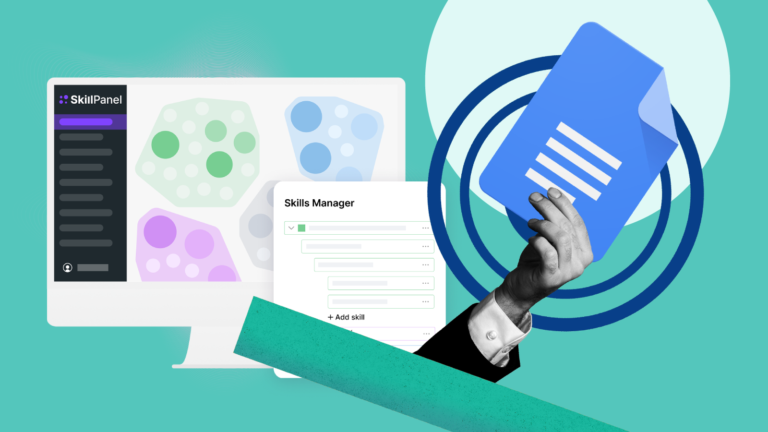
The connection between skills data and training decisions is critical here. SkillPanel’s approach reflects this: by mapping workforce capabilities through a dynamic skills map, HR teams can see exactly where gaps exist before designing a single training session, rather than guessing at what employees need.
Why training and development matters for modern organizations
The business case for training and development in HRM is backed by numbers that are hard to ignore, especially as skills gaps and AI-driven role changes accelerate. Employers who cite skills gaps as their biggest barrier to transformation now sit at 63%, and nearly 39% of workers’ core skills are projected to be outdated by 2030 according to the same research.
Boosting employee performance and productivity
The productivity case for structured training is well documented. Companies with formalized training programs achieve 218% higher income per employee than those without structured development, and eLearning specifically increases revenue for 42% of companies by improving productivity and performance. Online learning alone can improve performance by 15 to 25%, based on the same analysis.
Talent analytics sharpens this further. Organizations using people data to optimize training have achieved the same performance improvements with 40% less training expenditure, and 74% of HR professionals report improved job performance after implementing analytics-driven upskilling. Smarter targeting, not bigger budgets, appears to be what actually moves performance.
Strengthening engagement and retention
Retention is where training and development pays off most visibly. Companies with personalized development programs report 90% retention versus 75% in companies relying on generic training, a roughly 15-point swing that’s hard to replicate through any other HR lever. LinkedIn’s Workplace Learning Report backs this up at scale: 94% of employees would stay longer at a company that invests in their career development.
Gallup’s research adds a sharper detail. Employees who had a meaningful development conversation in the last six months are 2.8 times more likely to be engaged and 3.2 times more likely to plan to stay the following year. A single well-run conversation is enough to move the needle. Career pathing tools extend that effect further, with organizations using them reporting 57% higher retention rates than companies without structured pathing, alongside up to 30% higher engagement scores.
Closing skills gaps and adapting to industry change
Strategic upskilling doesn’t just fill a gap, it changes earning trajectories. SkillPanel’s research on employee upskilling programs ties targeted skill-building directly to revenue, a pattern that holds up under scrutiny: online training yields roughly $30 in productivity for every $1 invested, and every $1 spent on upskilling returns at least $2 in revenue or savings.
Coursera’s research quantifies this at the organizational level. Each 1% increase in L&D spend per employee correlates with a 0.2% increase in business revenue, which translates to $4.70 in revenue per employee for every additional dollar invested in development.
Building a leadership pipeline
Leadership development isn’t optional anymore. Organizations with strong leadership development programs see 80% improvements in business outcomes, 59% retention gains, and 25% better overall business performance when programs are well aligned. One documented leadership initiative saw salaried turnover drop by 80% and hourly turnover fall by 25% within a year.
Deloitte, Heidrick & Struggles, and McLean’s 2025-2026 analysis frames the stakes bluntly, stating that “succession will move from an HR priority to an enterprise risk” in 2026. Identifying and developing future leaders now affects organizational resilience, not just talent depth.
Types of training in human resource management
Understanding the types of human resource training available helps HR teams match the right approach to the right problem. The types of training in HRM generally fall into six categories, each solving a distinct organizational need.
Onboarding and orientation training
Onboarding sets the tone for an employee’s entire tenure. Structured, formal onboarding leads to roughly 50% higher retention and 62% greater productivity compared with informal approaches, while other research puts strong onboarding’s retention improvement even higher, at 82%, with productivity gains exceeding 70%. On-the-job training remains the dominant format here, with 65% of new employees receiving hands-on training as part of onboarding.
The catch is that most onboarding still skews toward paperwork rather than capability building. Research shows 52% of onboarding programs focus mainly on compliance and administrative tasks, and 54% of companies don’t measure onboarding effectiveness at all, a real opportunity cost given how much value strong onboarding can unlock.
Technical and job-specific skills training
This category covers the hard skills employees need to do their actual jobs: software proficiency, equipment operation, industry-specific processes. It’s usually the most straightforward type of training to justify, since the link between skill and output is direct and easy to measure.
Soft skills and behavioral training
Communication, teamwork, and problem-solving increasingly separate high performers from average ones, especially as roles become more collaborative and cross-functional. Soft skills training is harder to measure than technical training, but its absence shows up quickly in team friction, poor feedback loops, and stalled projects.
Compliance and regulatory training
Compliance training protects the organization as much as it protects employees. The 2025 Training Industry Report found organizations allocate the largest share of their training budgets to mandatory compliance training, tied with management and supervisory training at 13% each. Legal exposure clearly drives a large portion of L&D spending decisions.
Leadership and management development
Leadership development programs prepare current and future managers to handle team dynamics, strategic decisions, and organizational change. Given the retention and performance gains already outlined above, this category increasingly gets prioritized ahead of purely technical training in many organizations’ 2026 planning.
Diversity, equity, and inclusion training
DEI training builds the skills employees need to work respectfully and effectively across differences, with a direct bearing on collaboration and retention. One large-scale training implementation, covering more than 20,000 employees, achieved 97% satisfaction with required training and reported increased perceptions of inclusion, which correlated with improved retention outcomes.
The learning process in training and development
Designing a training program without understanding how adults actually learn is a fast way to waste a budget. The learning process in training and development draws heavily on adult learning theory, which emphasizes relevance, immediate application, and active participation over passive content consumption.
Adult learning principles that drive retention
Adults retain information best when it connects directly to their current role and when they can apply it right away. Training built on real scenarios, interactive practice, and immediate feedback consistently outperforms lecture-style formats, part of why personalized digital learning has been shown to raise knowledge retention rates from 8-10% to 25-60%.
How employees move from awareness to mastery
Skill development moves through stages: first exposure to a concept, guided practice, then independent mastery. Programs that skip the middle stages, jumping straight from awareness to an expectation of mastery, tend to see poor adoption. Building in checkpoints, feedback, and repeated practice at each stage is what actually moves someone from “aware of a skill” to “reliably using it.”
The training and development process: Step-by-step
A structured training development process keeps programs anchored to business needs instead of drifting into generic content nobody applies. The process for training and development generally follows five steps, and skipping any one of them tends to show up later as poor adoption or unclear ROI.
Step 1: Conduct a training needs analysis
Everything starts with identifying where the real gaps are. SkillPanel’s own methodology for this combines organizational data, manager input, and employee self-assessment to pinpoint the gap between current capability and business need, then ties those gaps directly to business priorities. A related approach, the training matrix process, involves reviewing job descriptions and performance data, gathering manager and employee input, and using that combined picture to build individualized learning paths with measurable objectives.
For deeper gap analysis, a structured workflow works best: document the current state with real data, define a measurable target state, quantify the gap, identify root causes, and build an action plan with clear owners and deadlines.
Step 2: Set clear learning objectives
Objectives need to be measurable, not aspirational. “Improve communication skills” is a wish, not an objective. “Reduce escalated customer complaints by 20% through improved de-escalation training” is something you can actually evaluate. This step is where training and development plans succeed or fail long before delivery even starts.
Step 3: Design the program and choose methods
Program design should reflect both the objective and the audience. A competency matrix approach helps here: define the purpose and target roles, identify core competencies, set observable proficiency levels, then translate gaps into action plans such as learning paths, stretch assignments, or role redesign. For broader competency frameworks, starting with strategic objectives, gathering input through structured interviews, and using performance data to identify which competencies predict success gives the design phase a solid evidence base rather than guesswork.
Step 4: Deliver the training
Delivery format matters as much as content. A mix of formats, workshops, e-learning modules, hands-on practice, tends to outperform any single format used alone, particularly because different employees absorb material differently depending on role and learning style.
Step 5: Evaluate results and measure ROI
This is the step most organizations underinvest in. SkillPanel’s guidance on training ROI recommends setting clear measurable objectives up front, using pre- and post-training assessments, tracking KPIs tied to actual outcomes, and running employee surveys for satisfaction and feedback, with an emphasis on business outcomes rather than completion rates alone.
Training and development methods compared
There’s no universal best method of training and development. The right choice depends on the skill being taught, the urgency of the need, and how much hands-on practice the role demands. Training and development methods generally split into three broad categories.
On-the-job methods (coaching, mentoring, job rotation, shadowing)
On-the-job methods remain the most heavily used approach in corporate training. ATD’s State of the Industry data shows coaching is used by roughly 72% of organizations and mentoring by about 67%, both outpacing many off-the-job and asynchronous digital formats. Analysis of this data suggests organizations are leaning into these methods because they let employees apply new skills in context, building confidence in ways that classroom-only or LMS-only training struggles to match.
Job rotation is less common but disproportionately effective where it’s used. SHRM’s 2025 Talent Trends research found only 11% of organizations offer formal job rotation programs, yet 92% of those organizations rate it as somewhat or very effective at easing talent shortages. The same research frames formal mentorship as a strategic accelerator: it speeds up skill development, boosts satisfaction, and reduces voluntary turnover, particularly among mid-career and high-potential employees.
Off-the-job methods (workshops, simulations, case studies)
Off-the-job training removes workplace distractions and allows for deeper, more focused learning, particularly for complex material that benefits from uninterrupted attention. Traditional in-person classes still see usage above 60% according to recent ATD-based synthesis, and live online classes sit close behind at roughly the same level. These formats haven’t been displaced by digital alternatives, just supplemented by them.
Digital and blended learning (e-learning, LMS, microlearning)
Digital and blended approaches offer flexibility that traditional formats can’t match, particularly for distributed or hybrid teams. Asynchronous e-learning usage has actually dropped to about 40% in recent data, while hybrid learning, blending digital content with human interaction, has climbed to 54% adoption. Pure self-paced digital learning alone isn’t cutting it; it works best paired with some form of live coaching or peer interaction.
Choosing the right method for your workforce
The strongest approach rarely relies on a single method. Analysis of 2025 workplace learning trends suggests learning is most effective when it’s tightly connected to career development, managerial coaching, and internal mobility, rather than delivered only as a catalog of standalone courses.
Professional development for employees beyond formal training
Professional development for employees extends well past scheduled training sessions. Professional development programs increasingly rely on structured, ongoing frameworks that treat growth as continuous rather than event-based, which is where individual development plans, stretch assignments, and succession planning come in.
Individual development plans
Individual development plans work best as structured roadmaps, not vague aspirations. SkillPanel’s development plan framework outlines a process that starts with structured self-assessment, identifies a prioritized set of gaps, breaks goals into sequenced activities with milestones, and defines two to three KPIs per goal, with measurement focused on outcomes like internal mobility, promotion rates, and proficiency change. A sample IDP for a software engineer moving toward a technical lead role might include shadowing senior architects, systems design training, and gradual ownership of architectural decisions.
Personalized development planning tends to start with discovery, translating broad career goals into three to five critical capabilities, then blending formal learning with experiential and social learning. Effective plans set measurable milestones with check-ins every two to four weeks and quarterly reviews, rather than a single annual conversation.
Stretch assignments and job enrichment
Stretch assignments push employees into challenging territory: cross-functional projects, higher-visibility work, or problems outside their usual scope. SkillPanel’s guidance explicitly recommends matching development needs to opportunities like stretch assignments, coaching, or peer learning as core parts of a growth plan, not optional extras. Job enrichment works alongside this by expanding decision-making authority within an existing role, which often boosts engagement without requiring a formal promotion.
Succession planning and career pathing
Succession planning and career pathing increasingly overlap with day-to-day development work rather than sitting as a separate annual exercise. SkillPanel’s succession planning research notes that individualized development plans are typically the final step in succession planning, incorporating training, mentoring, and stretch assignments to prepare candidates for future roles.
The real-world results back up the investment. PwC’s internal skills marketplace was used by 75% of U.S. employees, with about 25% securing a new role, project, or stretch assignment through it. Unilever’s platform supported over 1 million internal experiences for more than 100,000 employees, reaching an internal fill rate near 80% for some roles, while Schneider Electric hit a 70% internal fill rate for management positions and Novartis reported a double-digit increase in employees moving into new roles through its skills platform.
Career pathing tools are also getting smarter about how they connect people to opportunities. AI-powered platforms can now recommend microlearning, stretch assignments, and mentoring connections based on an employee’s existing skill gaps and desired trajectory, turning what used to be a manual, manager-dependent process into something more consistent and scalable.
Building a training and development program: Best practices
Best practices for training and development aren’t complicated in theory, but they’re easy to get wrong in execution. Training and development best practices tend to cluster around five areas that consistently separate effective programs from ones that quietly fail to move the needle.
Align programs with business goals
Training that doesn’t connect to a specific business objective rarely survives budget scrutiny for long. Mapping programs to three to five core strategic priorities, and defining success metrics up front, gives leadership a clear reason to keep funding the initiative. SkillPanel’s platform supports this directly by letting HR and talent teams link every goal to a specific business objective, rather than tracking development activity in isolation from strategy.
Secure leadership buy-in and budget
Executive support tends to rise sharply when development is framed as a lever for strategic priorities like innovation or digital transformation, rather than as a generic training catalog. Involving senior leaders as co-designers, sometimes described as “leaders as teachers,” strengthens buy-in further and signals that development is a genuine organizational priority, not something HR handles alone in the background.
Personalize learning for different roles and generations
Effective personalization starts with competency frameworks and gap analyses, not generational stereotypes. Rather than assuming rigid preferences by age group, the stronger approach builds individual development plans that adapt to each person’s role, context, and preferred learning mode, whether that’s one-on-one coaching, peer learning, or self-paced microlearning. This pays off measurably: organizations using personalized learning pathways report 40-60% reductions in study time while improving completion and engagement. Salesforce saw a 44% increase in employee engagement after rolling out personalized learning through its myTrailhead platform.
Use technology to scale and track learning
Technology’s biggest value in 2026 lies in enabling personalization at scale without losing the human coaching element that drives actual behavior change. AI-enabled tools can automate diagnostics, surface insights, and deliver targeted microlearning nudges, freeing up managers and coaches to focus on deeper reflection and accountability rather than administrative tracking. SkillPanel’s platform reflects this balance directly, combining self-assessments, peer reviews, manager input, and technical evaluations into a single skills picture, with integration into existing learning providers so training requests and progress tracking happen in one place rather than across scattered spreadsheets.
The payoff shows up in named deployments already underway. Mettler Toledo’s China operations built a Digital Learning Hub that used skills data to target coding, simulation, and CAD training for frontline operators, cutting voluntary turnover by 80% and opening accelerated promotion paths for workers who picked up the targeted skills. Western Digital’s Thailand facility took a similar skills-first approach with its Digital Leadership Essential Programme, an effort that saw frontline skills training coverage grow by 49% and pushed engagement scores up 21%. Siemens went further, using skills intelligence to identify employees who could be redeployed internally rather than hired externally, a shift that got new facilities to full productivity 40% faster than sites staffed mainly through external hiring.
The scale of AI adoption in L&D backs up how central this has become. Research shows 87% of L&D teams are already using AI in some form, and looking ahead, 72% expect more personalized learning experiences to be the biggest gain AI delivers, ahead of wider reach or improved engagement.
Measure impact with the right metrics
Metrics need to track business outcomes, not just activity. There’s a documented industry shift away from measuring hours of formal training toward outcomes like employee satisfaction, retention, and productivity. SkillPanel’s own workforce development research points HR teams toward tracking productivity, quality, customer satisfaction, innovation pipeline strength, and revenue per employee as the metrics that actually connect training investment to business performance.
Common challenges in training and development
No training and development process runs without friction. Understanding where programs typically break down helps HR teams plan around the obstacles instead of getting blindsided by them mid-implementation.
Budget and resource constraints
Budget pressure is real even where learning is still being funded. SHRM’s 2025 benchmarking data reports a median L&D budget of 15% of total HR budget, with an average closer to 20%, and external training consuming a median 25% of L&D expenses. TalentLMS’s 2026 benchmark echoes this, noting budget constraints remain among the top three L&D challenges, with most organizations now spending between $1,000 and $3,000 per employee.
Low employee engagement in training
Time, not interest, is often the real barrier. TalentLMS’s 2026 report identifies time as the single biggest obstacle to learning, with 50% of HR managers saying high workloads leave little room for training even when it’s clearly needed. Generic training catalogs make this worse, since they can absorb budget while producing low completion rates and minimal actual skill gain.
Measuring long-term impact
Most organizations simply aren’t tracking the data that would tell them whether training works long-term. SHRM’s 2025 benchmarking data shows only 20% of organizations track quality of hire, a useful proxy for whether development spending actually improves workforce outcomes over time.
Legal and compliance risks
Compliance training carries real financial weight in most training budgets. As already noted, compliance training ties with management and supervisory training as the largest single allocation in most training budgets, at roughly 13% each. HR and L&D teams are clearly expected to manage regulatory risk through structured programs rather than informal policy reminders.
Where AI-driven personalization can fall short
AI-driven personalization and skills mapping carry real limitations worth acknowledging before leaning on them too heavily. Research on adaptive learning systems finds that heavy reliance on AI hints and recommendation engines can weaken self-regulated learning, with frequent generative AI use also linked to a measurable dip in critical thinking as learners offload cognitive effort to the tool. Engagement metrics can mislead too: platforms often mistake clicks and log-ins for real understanding, a pattern documented in learning analytics research showing employees can satisfy algorithmic requirements without engaging meaningfully with the material, essentially recreating checkbox compliance training in digital form. Skills-mapping data has its own blind spots, too. Reviews of AI-based personalization systems point to poor or imbalanced datasets and unexplained recommendation logic, meaning a skills map built on incomplete or biased inputs can misdirect training investment rather than correct it. None of this argues against AI-enabled L&D, but it does argue for keeping manager coaching and human judgment in the loop rather than letting algorithms run unsupervised.
Trends shaping training and development in HRM
The direction of travel for training and development in HRM in 2026 is fairly clear: more AI, more personalization, and a harder pivot toward skills over job titles.
AI-powered personalized learning
AI adoption in L&D has moved well past the experimentation phase. Deloitte’s Human Capital data shows 34% of companies have already implemented AI in their training programs, with another 32% planning to do so within two years. LinkedIn Learning research shows AI-personalized learning increases course completion rates by 20 to 35%, with AI-driven training programs associated with roughly a 20% productivity increase.
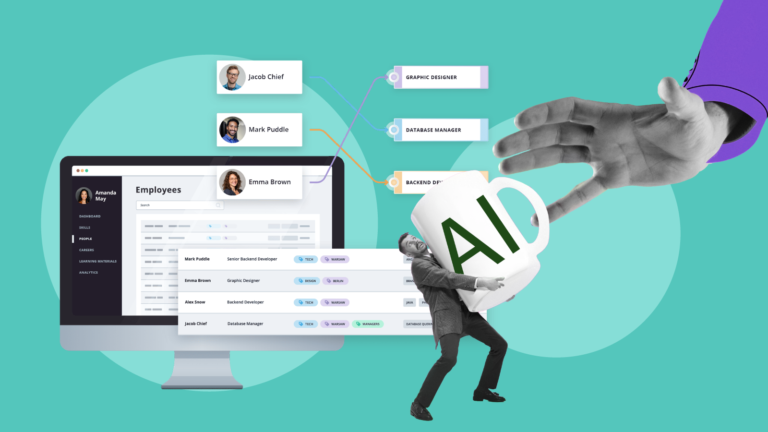
The real-world results back this up. HSBC’s AI-driven call center training raised call quality scores from 88% to 98%, with projected annual coaching cost savings near £1 million. Rolls-Royce’s GPT-powered technical training chatbot reduced formal training hours by 20% and increased managers’ visibility into skill gaps by the same margin. SkillPanel’s own platform reflects this shift as well, using AI-driven skill inference across resumes, project work, and learning records to build real-time skill profiles and recommend targeted development activities, shifting skills-based development into something continuous rather than periodic.
Skills-based talent development
Skills, not job titles, are becoming the organizing unit for talent decisions. LinkedIn data shows skills-based hiring has grown 90% from 2020 to 2024, and LinkedIn Learning’s workplace skills data now identifies AI/ML, data analysis, and digital fluency as the top three skills gaps organizations are trying to close. As one HR leader put it in HR Dive’s coverage, organizations are recognizing that “they can’t hire their way out of this challenge, that everyone needs to learn together in the face of new technology and ways of working,” which is exactly why upskilling has become a strategic priority rather than a defensive one.
SkillPanel’s approach to this trend centers on its skills library and predictive gap analysis, which let organizations map current capabilities against future needs before a hiring decision, or a training investment, gets made.
Hybrid and on-demand learning models
Flexibility has become the default expectation, not a perk. Hybrid learning now sits at 54% adoption according to recent ATD-based data. Workers increasingly expect to blend digital content with live coaching rather than choosing one over the other. This connects to broader AI adoption trends in HR generally, where AI use across HR functions jumped from 26% to 43% of organizations in a single year, with learning and development standing out as one of the top three use cases inside HR.
Building your training and development plan: Next steps
Getting training and development in HRM right in 2026 means treating it as much as a data problem as a people problem. The organizations seeing the strongest returns, whether that’s 90% retention through personalized plans or millions saved through AI-driven coaching, all start from the same place: a clear, accurate picture of what skills their people already have and where the real gaps sit.
That’s precisely the foundation SkillPanel is built to provide. By mapping workforce capabilities through a combination of self-assessments, manager input, and technical evaluations, SkillPanel gives HR teams the visibility needed to design training that actually targets the right gaps, track its impact against real business metrics, and connect individual development plans to internal mobility and succession planning rather than treating them as separate initiatives. Starting with a clear skills picture, rather than a generic training calendar, turns training and development from a cost center into a measurable driver of business growth.