A high attrition rate causes problems in the tech industry.
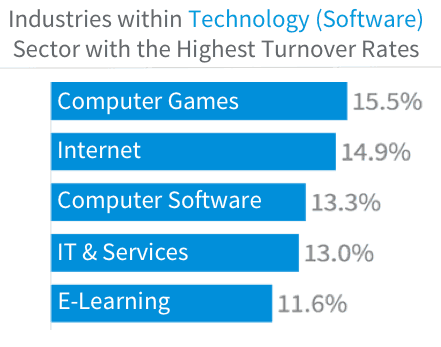
The tech industry turnover rate stands at 13.2% and is higher than in any other business sector. Even companies who have mastered recruitment and onboarding to perfection still struggle with talent retention. Is a high attrition rate a given and something that HR departments should accept?
Definitely not – in this article, we’re going to share with you the main reasons why tech employees leave their jobs, and what tech employers can do to decrease employee turnover rate.
What is attrition rate?
Before we dive deeper into the subject of employee turnover in tech, it’s worth explaining how to calculate the attrition rate, so we’re all on the same page.
Calculating your attrition rate
Attrition is a reduction in the size of your workforce resulting from employees leaving the organization or retiring. You can calculate it by dividing the number of full-time employees who have left per month by the average number of employees, and multiply it by 100.
And it doesn’t spare anyone… not even “the big guys”
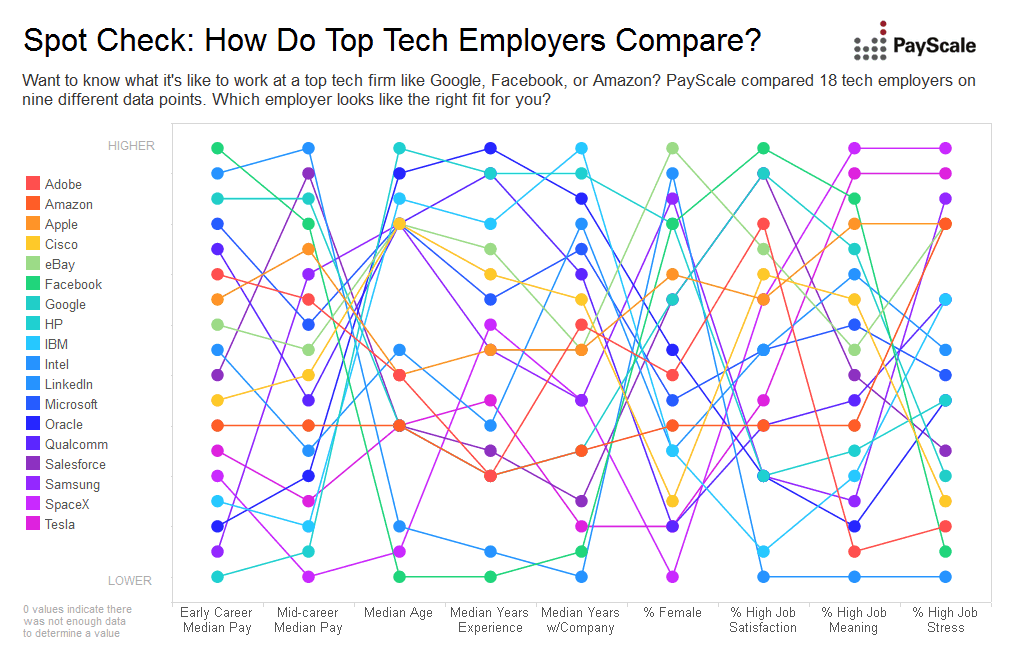
No tech business is immune to turnover, irrespective of their size or reputation.
Uber – on average, their employees stay with the company just 1.8 years, despite the generous benefits package and fancy office space that Uber offers
According to PayScale, “We see that companies with the shortest typical employee tenure are also the ones that are hiring most aggressively.”
Lack of strategy for reducing your attrition rate will have serious business consequences
If you don’t address high employee turnover, it will have a negative impact on your business. Think about:
Revenue loss – losing an employee can cost you dearly – literally. Especially if your top performer leaves. Experts on turnover and retention estimate that it costs 150% of the employee’s base salary to replace them.
Productivity loss – on average it takes 43 days to hire a software developer, that’s nearly a month and a half of productivity loss and it doesn’t even account for onboarding. This can cost you as much as $33,251.
Creating bottlenecks – when an employee leaves, they take all their knowledge with them, and you can’t put a price tag on that. This knowledge gap must be filled – on average it takes one to two months to bring knowledge workers up to speed. Unavoidably, this will create some bottlenecks unless you ask your best employees to take over some of the tasks and work at excess capacity. Unfortunately, this might lead to…
Lower employee morale – nobody likes to be overworked, this might have a bad impact on employee motivation. Also, if the departing employee was close to people who stayed with the company, they might become emotional or even resentful and consider quitting.
Low employee morale cannot be ignored as it can escalate the problem: one employee resignation can lead to another, and another…
Ever heard of the snowball effect?
Like-minded people tend to follow one another – they reinforce each other’s viewpoints. According to Robert Cialdini, we frequently base our decisions on other people’s actions., We treat it as social proof which constitutes a shortcut to decide how to act. The more employees leave your company, the more will follow.
What are the reasons for the high attrition rate in tech?
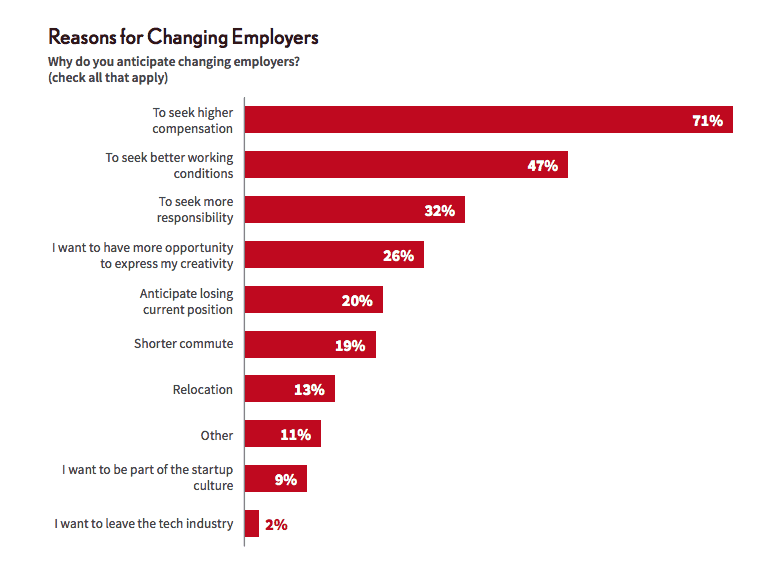
High attrition rate and reasons why tech employees leave their jobs are:
Seeking higher compensation (71%),
Looking for better working conditions (47%)
Searching more responsibility (32%)
Seeking more opportunities to express creativity (26%).
The above-mentioned reasons for the high attrition rate in tech can be split into two main categories: having the right skill set to perform the job and having the right culture-fit.
What can you do to reduce employee attrition?
To hire developers, employers have to use the right strategies and tools to ensure people have the right skills and fit their organizational culture.
Verifying tech skills:
Here are a few ideas you can use to check if your candidates are skilled enough to perform the job you’re hiring them for:
Automated in-stack coding tests
While they’re not the final yes or no to hiring a developer, they’re a great preliminary testing tool, which will help you decide whom to invite to further in-person interviews. You can choose custom tests to maximize hiring precision. At SkillPanel, we’re strong advocates of using coding tests that resemble real work as they give both employers and employees a glimpse of real work. Automated in-stack coding tests are not only a massive time saver for HR, but they can also prevent them from making costly mistakes. If you end up hiring employees who are overqualified for the job, they’ll most probably leave searching for more interesting challenges. Hiring an under-qualified employee is equally harmful, as they will make more work for existing team members which will eventually lead to high attrition.
Hold technical interviews with suitable candidates
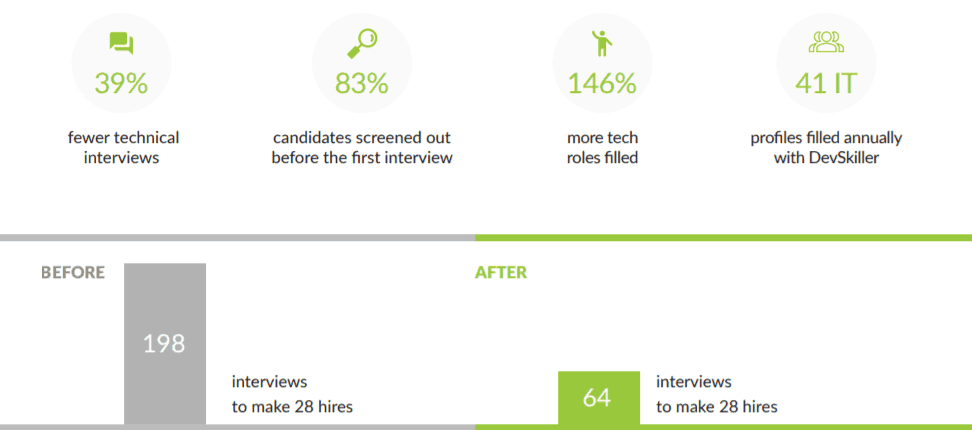
Conducting technical interviews with your chosen candidates either on-site or remotely is a good tactic for hiring the right talent and as a consequence reducing the attrition rate in tech. Just make sure that all tech interviews are held with technical people. SkillPanel can help you quickly eliminate candidates whose skills look better on paper than in real life, enabling you to focus your efforts on the right people. Check how we helped ImpactTech reduce the number of tech interviews from 198 to just 64 to make 28 hires.
You can also consider pair programming…
Some companies go even further and use pair programming as part of their hiring process, where a programmer works alongside the candidate on the same task. Not only does it allow the recruiter to verify the candidate’s tech skills, but also check their social skills, and see what it feels like to work with them.
Assessing the soft skills and culture-fit
Making sure that your new hires fit well within your organization is another important step to reducing the high attrition rate in tech.
Use pre-employment assessment tools Psychometric tests are powerful pre-assessment tools as they measure candidates’ mental capabilities as well as their behavioral style. All to verify whether their character and their cognitive abilities are suitable to effectively perform the job they’re applying for. There are various tests you can select from, the most common ones are numerical reasoning, verbal reasoning, diagrammatic reasoning tests, situational judgment tests, and personality tests. Below is an example of a verbal reasoning test.Source: SHLDirect
Psychometric tests improve the effectiveness of recruitment as they uncover skills that cannot be evaluated during a face-to-face interview.
Ask candidates to spend some time in the office It’s beneficial for both your company and your future hires. It gives the candidates and the employees the opportunity to meet in person, check if they get along, and ask questions. Recruiters will be able to observe how the candidates behave and act, which should help them decide whether their chosen candidate fits the company culture or not.
Use situational judgment tests Using videos as part of your recruitment process will let your candidates get a better feel of what it would be like working for you, all-the-while enabling you to see how they respond to “real-life”, on-the-job situations.
Ask the right questions in the interview By right we mean culture-specific questions, as they will help you assess the culture fit. Here are a few questions which you can consider using – just bear in mind that the questions should reflect YOUR company culture specifically.
Describe the work environment or culture in which you are most productive and happy.
What are the characteristics exhibited by the best boss you have ever had—or wish that you have had?
What are the positive aspects of your current job and work environment, or the last position you held before coming to this interview?
Find out what really matters to them Try to find out what matters to them most. You can obtain this information by asking outside the box question to make the answer more genuine. Google, known for their thorough interviewing process, asks: “If you could be remembered for one sentence, what would it be?” – very powerful and creative, don’t you reckon?
Find out how they want to grow and the type of career they can have at your company Lack of growth opportunities is one of the reasons why tech employees leave their jobs. A good hiring practice is to verify their expectations at the very beginning. Check where they want to take their career – if they’re overly ambitious, and you’re certain you won’t be able to meet their expectations then maybe you’re better off hiring someone else as they will most probably end up leaving you.Alternatively, you can try to come up with a good career path to ensure your top talent has room to grow – this should have a positive impact on reducing your attrition rate.
Have soft skill interviews with HR Last but not least, don’t forget about assessing your candidates’ soft skills i.e. communication, decision-making, collaboration, teamwork, etc. They’re crucial for checking their culture-fit and constitute a good indicator of their future job performance.
Final thoughts
The high attrition rate in tech is a problem that all businesses battle with. The high employee turnover rate can and should be tackled prior to getting new hires.
Implementing the right mechanisms for tech skills screening such as automated in-stack coding tests, tech interviews, as well as verifying the culture fit is the best strategy for managing attrition.
Most development plans fail for a simple reason: they read like a shopping list of courses instead of a path to a better role. The strongest examples of individual development plan IDP documents tie each action to a career goal, show how progress will be measured, and spell out who supports whom. This guide walks through realistic scenarios, including one fully worked plan, goal formats you can copy, a template, and the habits that keep a plan alive after the first meeting.
The stakes are real. Gallup found that only 30% of U.S. employees strongly agreed in 2024 that someone at work encouraged their development, down from 36% in 2020. LinkedIn's Workplace Learning Report 2024 found that organizations with strong learning cultures had higher retention, more internal mobility, and healthier management pipelines. Individual career plans were one practice in the mature programs behind those results, and only about 40% of organizations had such programs. The finding is an association, not proof that IDPs alone cause these outcomes, but it shows where a good plan fits.
Article
| Reading time:
Development areas for leaders: 12 key skills to grow
Leadership is not a title you earn once. It is a set of capabilities you keep sharpening as your responsibilities, technology, and business conditions change. The most effective leaders treat development areas for leaders as a working agenda: a short list of skills they practice, get feedback on, and revisit.
This guide covers how to find your priority skills, 12 development areas worth your attention, how priorities shift by leadership level, and how to turn them into a plan you can track. A note on sourcing: SkillPanel is a skills intelligence platform, and the customer examples below come from its published material. Most vendor-published case studies, including the other program examples here, offer useful outcome data but limited independent verification.
Article
| Reading time:
Career performance goals: 25 examples
Most people write their goals the night before a deadline, and it shows. "Improve communication" or "be more proactive" sounds fine until a review asks what actually changed. Strong career performance goals fix that problem. They name a result, a starting point, a deadline, and the evidence that will prove it.
This guide explains what career performance goals are, how to write ones that survive a review, and how to track them. It includes 25 original examples and a worked scenario you can adapt for 2027. Treat the examples as templates, not benchmarks. Swap in targets that fit your own baseline, workload, and priorities. SkillPanel, the publisher of this guide, sells skills-intelligence software, so we flag where our product comes up.
Article
| Reading time:
How to train new hires: 7 proven steps
Most teams know how to hire. Far fewer know how to turn a signed offer into a confident, productive colleague. If you want to know how to train new hires well, start by treating training as a planned process with owners, milestones, and measurable outcomes, not a first-week event. This guide walks through seven steps you can adapt to any role, plus the mistakes that quietly undermine good intentions. A note on transparency: SkillPanel, the skills platform mentioned in several steps, is our own product, and we say where it helps and where it isn't needed.
Article
| Reading time:
Employee individual development plan examples
Most development plans fail for a simple reason: the document looks fine, but nobody knows how to turn a vague ambition into a concrete action. Good employee individual development plan examples close that gap. They show how a goal such as "become a stronger communicator" becomes a practiced behavior, with an owner, a deadline, and evidence of progress.
This guide gives you nine role-based examples with sample SMART goals, a copy-ready template, a five-step build process, and an HR rollout approach. It also covers the mistakes that stall plans, the measures that show whether they work, and when an IDP is not the right tool. SkillPanel is a skills intelligence vendor, so we flag where our own data is involved.