A high attrition rate causes problems in the tech industry.
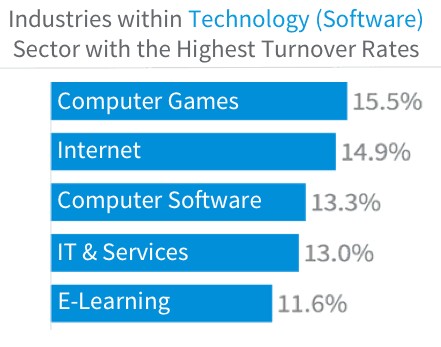
The tech industry turnover rate stands at 13.2% and is higher than in any other business sector. Even companies who have mastered recruitment and onboarding to perfection still struggle with talent retention. Is a high attrition rate a given and something that HR departments should accept?
Definitely not – in this article, we’re going to share with you the main reasons why tech employees leave their jobs, and what tech employers can do to decrease employee turnover rate.
What is attrition rate?
Before we dive deeper into the subject of employee turnover in tech, it’s worth explaining how to calculate the attrition rate, so we’re all on the same page.
Calculating your attrition rate
Attrition is a reduction in the size of your workforce resulting from employees leaving the organization or retiring. You can calculate it by dividing the number of full-time employees who have left per month by the average number of employees, and multiply it by 100.
And it doesn’t spare anyone… not even “the big guys”
No tech business is immune to turnover, irrespective of their size or reputation.
Uber – on average, their employees stay with the company just 1.8 years, despite the generous benefits package and fancy office space that Uber offers
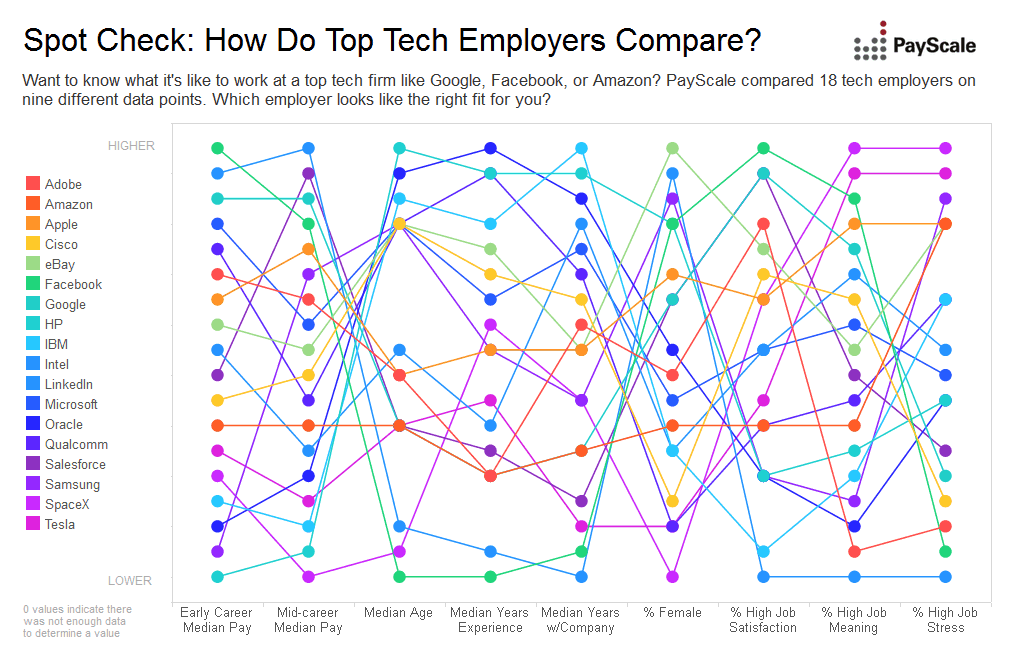
According to PayScale, “We see that companies with the shortest typical employee tenure are also the ones that are hiring most aggressively.”
Lack of strategy for reducing your attrition rate will have serious business consequences
If you don’t address high employee turnover, it will have a negative impact on your business. Think about:
Revenue loss – losing an employee can cost you dearly – literally. Especially if your top performer leaves. Experts on turnover and retention estimate that it costs 150% of the employee’s base salary to replace them.
Productivity loss – on average it takes 43 days to hire a software developer, that’s nearly a month and a half of productivity loss and it doesn’t even account for onboarding. This can cost you as much as $33,251.
Creating bottlenecks – when an employee leaves, they take all their knowledge with them, and you can’t put a price tag on that. This knowledge gap must be filled – on average it takes one to two months to bring knowledge workers up to speed. Unavoidably, this will create some bottlenecks unless you ask your best employees to take over some of the tasks and work at excess capacity. Unfortunately, this might lead to…
Lower employee morale – nobody likes to be overworked, this might have a bad impact on employee motivation. Also, if the departing employee was close to people who stayed with the company, they might become emotional or even resentful and consider quitting.
Low employee morale cannot be ignored as it can escalate the problem: one employee resignation can lead to another, and another…
Ever heard of the snowball effect?
Like-minded people tend to follow one another – they reinforce each other’s viewpoints. According to Robert Cialdini, we frequently base our decisions on other people’s actions., We treat it as social proof which constitutes a shortcut to decide how to act. The more employees leave your company, the more will follow.
What are the reasons for the high attrition rate in tech?
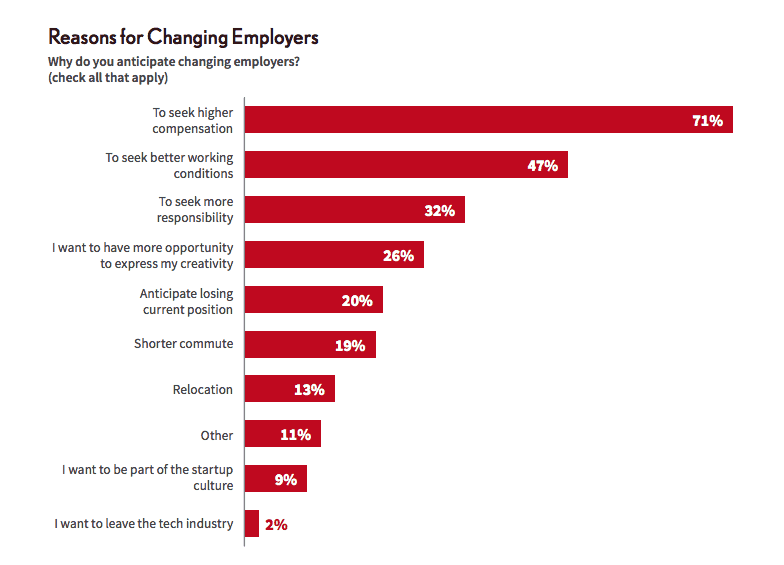
High attrition rate and reasons why tech employees leave their jobs are:
Seeking higher compensation (71%),
Looking for better working conditions (47%)
Searching more responsibility (32%)
Seeking more opportunities to express creativity (26%).
The above-mentioned reasons for the high attrition rate in tech can be split into two main categories: having the right skill set to perform the job and having the right culture-fit.
What can you do to reduce employee attrition?
To hire developers, employers have to use the right strategies and tools to ensure people have the right skills and fit their organizational culture.
Verifying tech skills:
Here are a few ideas you can use to check if your candidates are skilled enough to perform the job you’re hiring them for:
Automated in-stack coding tests
While they’re not the final yes or no to hiring a developer, they’re a great preliminary testing tool, which will help you decide whom to invite to further in-person interviews. You can choose custom tests to maximize hiring precision. At SkillPanel, we’re strong advocates of using coding tests that resemble real work as they give both employers and employees a glimpse of real work. Automated in-stack coding tests are not only a massive time saver for HR, but they can also prevent them from making costly mistakes. If you end up hiring employees who are overqualified for the job, they’ll most probably leave searching for more interesting challenges. Hiring an under-qualified employee is equally harmful, as they will make more work for existing team members which will eventually lead to high attrition.
Hold technical interviews with suitable candidates
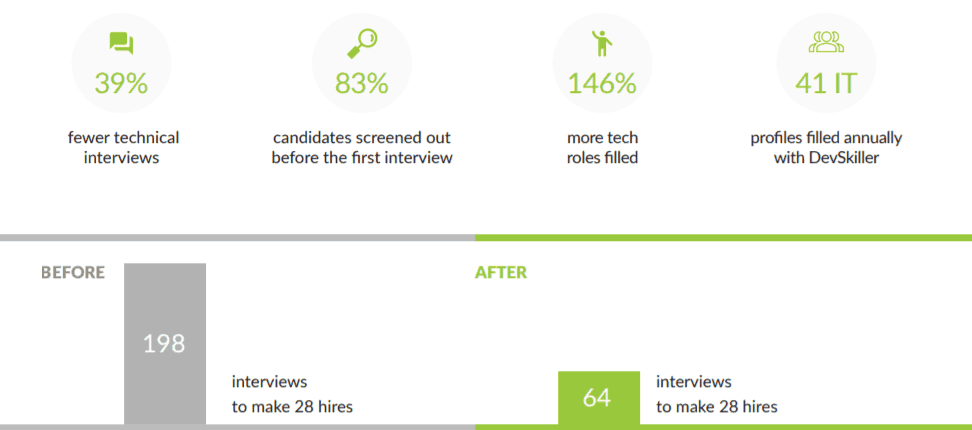
Conducting technical interviews with your chosen candidates either on-site or remotely is a good tactic for hiring the right talent and as a consequence reducing the attrition rate in tech. Just make sure that all tech interviews are held with technical people. SkillPanel can help you quickly eliminate candidates whose skills look better on paper than in real life, enabling you to focus your efforts on the right people. Check how we helped ImpactTech reduce the number of tech interviews from 198 to just 64 to make 28 hires.
You can also consider pair programming…
Some companies go even further and use pair programming as part of their hiring process, where a programmer works alongside the candidate on the same task. Not only does it allow the recruiter to verify the candidate’s tech skills, but also check their social skills, and see what it feels like to work with them.
Assessing the soft skills and culture-fit
Making sure that your new hires fit well within your organization is another important step to reducing the high attrition rate in tech.
Use pre-employment assessment tools Psychometric tests are powerful pre-assessment tools as they measure candidates’ mental capabilities as well as their behavioral style. All to verify whether their character and their cognitive abilities are suitable to effectively perform the job they’re applying for. There are various tests you can select from, the most common ones are numerical reasoning, verbal reasoning, diagrammatic reasoning tests, situational judgment tests, and personality tests. Below is an example of a verbal reasoning test.Source: SHLDirect
Psychometric tests improve the effectiveness of recruitment as they uncover skills that cannot be evaluated during a face-to-face interview.
Ask candidates to spend some time in the office It’s beneficial for both your company and your future hires. It gives the candidates and the employees the opportunity to meet in person, check if they get along, and ask questions. Recruiters will be able to observe how the candidates behave and act, which should help them decide whether their chosen candidate fits the company culture or not.
Use situational judgment tests Using videos as part of your recruitment process will let your candidates get a better feel of what it would be like working for you, all-the-while enabling you to see how they respond to “real-life”, on-the-job situations.
Ask the right questions in the interview By right we mean culture-specific questions, as they will help you assess the culture fit. Here are a few questions which you can consider using – just bear in mind that the questions should reflect YOUR company culture specifically.
Describe the work environment or culture in which you are most productive and happy.
What are the characteristics exhibited by the best boss you have ever had—or wish that you have had?
What are the positive aspects of your current job and work environment, or the last position you held before coming to this interview?
Find out what really matters to them Try to find out what matters to them most. You can obtain this information by asking outside the box question to make the answer more genuine. Google, known for their thorough interviewing process, asks: “If you could be remembered for one sentence, what would it be?” – very powerful and creative, don’t you reckon?
Find out how they want to grow and the type of career they can have at your company Lack of growth opportunities is one of the reasons why tech employees leave their jobs. A good hiring practice is to verify their expectations at the very beginning. Check where they want to take their career – if they’re overly ambitious, and you’re certain you won’t be able to meet their expectations then maybe you’re better off hiring someone else as they will most probably end up leaving you.Alternatively, you can try to come up with a good career path to ensure your top talent has room to grow – this should have a positive impact on reducing your attrition rate.
Have soft skill interviews with HR Last but not least, don’t forget about assessing your candidates’ soft skills i.e. communication, decision-making, collaboration, teamwork, etc. They’re crucial for checking their culture-fit and constitute a good indicator of their future job performance.
Final thoughts
The high attrition rate in tech is a problem that all businesses battle with. The high employee turnover rate can and should be tackled prior to getting new hires.
Implementing the right mechanisms for tech skills screening such as automated in-stack coding tests, tech interviews, as well as verifying the culture fit is the best strategy for managing attrition.
Picture your life five years from now. If the picture is blurry, you're not alone. Most people carry a vague sense of "doing better" without a concrete target to aim for, and that fuzziness is exactly why so many ambitions never leave the daydream stage. This guide breaks down 45 future goals examples across six areas of life, along with the frameworks and tools that turn wishful thinking into a plan you can actually follow through on in 2026.
Talent management
| Reading time:
Internal mobility: A guide to getting it right
This guide was produced by SkillPanel's content team. SkillPanel builds internal mobility and skills intelligence software, and we reference our own platform where it's genuinely relevant to the topic. Every statistic and claim below is sourced and linked so you can evaluate the research independently of our product.
Nearly a third of Fortune 500 recruiting capacity is shifting inward in 2026, and the companies that get ahead of this shift will spend less on hiring, retain more talent, and close skills gaps faster than competitors stuck in old habits. Internal mobility has moved from a nice-to-have HR initiative to a core business lever, and this guide breaks down exactly how to build a program that works, along with where it can go wrong.
Article
| Reading time:
Succession planning template: Free guide
This guide draws on primary research from SHRM, Korn Ferry, the Center for Creative Leadership, Deloitte, i4cp, and AIHR, cross-referenced with named organizational case studies and SkillPanel's own product documentation. It was compiled and reviewed by SkillPanel's HR content team against the latest 2025-2026 succession planning research cited throughout.
A leadership vacancy rarely announces itself on a convenient schedule. One day a VP resigns, a plant manager takes an unexpected medical leave, or a founder decides it's time to step back, and suddenly the organization is scrambling. A succession planning template exists to prevent that scramble. It turns an abstract worry about "what if someone leaves" into a concrete, documented plan that HR leaders, executives, and managers can actually execute.
This guide walks through what a strong succession planning template should contain, how to fill one out step by step, and when spreadsheets stop being enough. You'll also find a free downloadable template, several succession plan examples, and a look at where succession planning is heading in 2026.
AI
| Reading time:
AI upskilling programs: Boost your team’s skills fast
This guide was shaped by SkillPanel's workforce strategy team, combining lessons from client rollouts with independent research from McKinsey, WEF, Gartner-adjacent industry coverage, and academic labor studies. Where we reference our own platform or case studies, we say so directly.
Half of executives now say a lack of skills is the single biggest barrier standing between their company and effective AI adoption. That's not a minor training gap. It's a structural problem that's already slowing deployment timelines and eating into ROI. If your organization is still treating AI training as an optional workshop rather than a core capability strategy, the competitive distance between you and AI-ready companies is growing every quarter.
Talent management
| Reading time:
Reskilling for AI: A guide to future-proof skills
Every industry is grappling with the same question right now: how do you keep a workforce relevant when the tools they use are changing faster than any training calendar can track? Reskilling for AI has moved from a nice-to-have HR initiative to a survival requirement, and the numbers back that up. The Future of Jobs Report 2025 from the World Economic Forum estimates that 39% of workers' core skills will change or become outdated between 2025 and 2030. That is not a distant forecast. It is happening in performance reviews, hiring pipelines, and team meetings today.
This guide breaks down what reskilling for AI actually means heading into 2026, why it has become a board-level priority, and how organizations and individuals alike can build the skills that will hold up as AI keeps reshaping work. This piece draws on third-party research from WEF, McKinsey, Gartner, and HBR alongside SkillPanel's own workforce data; where our platform's findings are cited, we've flagged it clearly so readers can weigh the source accordingly.