Competency assessment: What it is, how it works, and why gut instinct isn’t enough anymore
| Reading time:


Knowing what your workforce can do, and where the gaps are, is one of the most strategic advantages an organization can build. Yet most companies still rely on annual performance reviews, gut-feel hiring decisions, and one-size-fits-all training programs that fail to address what employees actually need. That disconnect is costly. According to the WEF Future of Jobs Report 2025, 85% of employers plan to prioritize upskilling their workforce because of rapidly evolving skill demands, with 39% of core skills expected to change by 2030.
Competency assessment is how forward-thinking organizations close that gap. Rather than guessing at workforce readiness, a structured competency evaluation gives leaders precise, evidence-based insight into what their people can actually do, and what they need to grow. This article breaks down what competency assessments are, why they matter, and how to build a program that delivers real results.
What is a competency assessment?
A competency assessment is a structured evaluation that measures an individual’s demonstrated ability to apply knowledge, skills, and behaviors in real-world work contexts. The key word here is “demonstrated.” Unlike traditional academic or theoretical exams, competency-based assessment focuses on actual performance against clearly defined standards rather than what someone knows in isolation.
When organizations conduct a competency assessment, they are essentially answering a fundamental question: does this person have what it takes to perform effectively in this role? That question applies whether you’re evaluating a new hire, reviewing an existing employee, planning a promotion, or identifying development needs across a department.
The assessment of competencies draws on multiple inputs, from behavioral interviews and skills tests to peer feedback and work simulations. What makes it powerful is the combination of rigor and relevance. Each evaluation is anchored to specific, observable behaviors tied to real job requirements rather than abstract traits or credentials.
Competency assessment vs. skills assessment: Key differences
It’s easy to conflate competency assessments with skills assessments, but understanding the distinction helps organizations choose the right tool for the job. A skills assessment typically targets specific technical abilities in isolation, such as proficiency in a programming language, data analysis technique, or software platform. A competency assessment is broader. It evaluates the full range of attributes required for effective performance in a role, including both hard technical skills and the behavioral, interpersonal, and cognitive dimensions that shape how someone works.
Think of it this way: a skills assessment tells you whether someone can write Python code. A competency assessment tells you whether that same person can apply that skill under pressure, collaborate across teams, communicate their approach, and adapt when requirements change. For workforce planning and talent development, competency-based assessments provide a more complete, actionable picture.
Core components of a competency assessment
An effective competency assessment rests on several interconnected components. First, organizations must define clearly articulated competencies that are directly aligned with organizational goals and specific role requirements. These are not generic descriptors but observable behaviors with defined proficiency levels, from beginner through expert.
Second, a robust assessment draws on multiple methods rather than a single data source. Behavioral interviews, practical skills tests, 360-degree feedback, and scenario-based simulations each capture different dimensions of performance. Third, a well-designed competency evaluation includes a structured feedback mechanism that translates results into actionable development guidance rather than just a score. Finally, the most effective programs build in a continuous improvement cycle, regularly updating competencies and assessment criteria to reflect evolving business needs and industry standards.
Why competency assessments matter for workforce development
Skills gaps are no longer just an operational inconvenience. According to the WEF Future of Jobs Report 2025, 63% of employers identify skills gaps as the single biggest barrier to business transformation between 2025 and 2030. Meanwhile, 74% of employers globally struggle to find qualified talent due to these gaps, locking millions out of opportunities despite persistent hiring demand.
Competency assessments are one of the most direct ways to tackle this challenge. They bring structure and clarity to what can otherwise feel like a vague, subjective process, giving HR leaders and line managers the data they need to act with confidence.
Identifying skills gaps across teams and roles
One of the primary functions of a competency assessment is gap analysis. By systematically evaluating employee competencies against role-specific benchmarks, organizations can see exactly where performance falls short, and why. This is fundamentally different from observing that a team “isn’t performing well.” It pinpoints whether the gap lies in technical skills, behavioral patterns, cognitive ability, or something else entirely.
This precision matters because it shapes the intervention. A team struggling with analytical thinking needs different support than one lacking leadership communication skills. Regular competency analysis across teams also surfaces emerging skill needs before they become critical, giving organizations lead time to respond. With analytical thinking ranked as the top core skill by 70% of employers in the WEF’s 2025 report, followed by resilience, agility, and social influence, knowing where your workforce stands on these dimensions is no longer optional.
Informing training, hiring, and succession planning
Competency assessments serve as the connective tissue between workforce data and talent strategy. When used in hiring, they help organizations move beyond credentials and job titles to evaluate whether candidates can genuinely perform the work. A 2023 SHRM survey of 1,688 HR professionals found that 78% reported improved quality of hires from using pre-employment assessments, with an additional 23% reporting improved diversity of hires as a direct outcome. This shift, from measuring what people know to what they can actually do, makes a measurable difference in hiring precision.
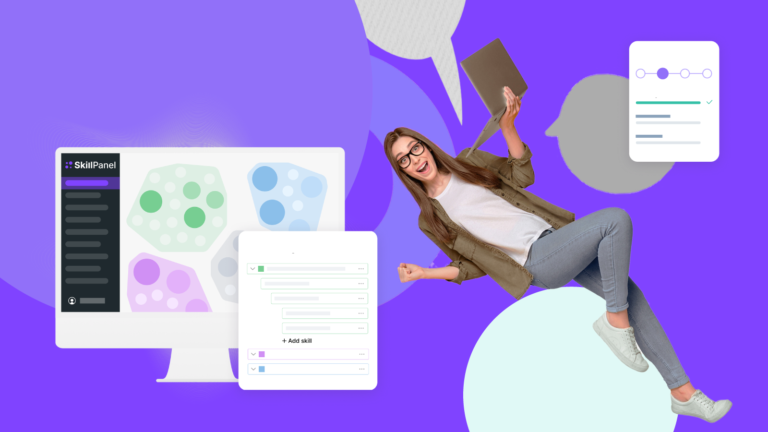
In the context of succession planning, competency evaluations identify which employees are genuinely ready for advancement and which need targeted development before stepping into critical roles. SkillPanel’s platform supports this through dynamic skills mapping, allowing organizations to track readiness across roles over time. Training programs also become significantly more effective when they are built on competency data rather than assumptions, ensuring that learning investments address real gaps rather than perceived ones.
Supporting employee career development and retention
Employees are more likely to stay with organizations that invest in their growth in meaningful ways. Competency assessments create the foundation for personalized career development plans that are grounded in objective data. When an individual can see precisely where they stand against a competency framework and what development looks like at the next level, it creates clarity and motivation.
Transparent competency-based career paths replace vague promotion criteria with observable, achievable benchmarks. This not only improves engagement but also supports retention by making career progression feel fair and attainable. The data also allows managers to have more productive development conversations, focusing on specific behaviors and skills rather than general impressions.
Types of competencies assessed
Competency assessments are not one-dimensional. Depending on the role, organization, and purpose of the evaluation, different categories of competencies come into play. Understanding what each category covers helps organizations build more precise and relevant assessment programs.
Core competencies
Core competencies are the foundational capabilities expected of every employee, regardless of their role or seniority level. These include communication, problem-solving, adaptability, and ethical decision-making. They reflect the behaviors and values that define how an organization operates and ensure a coherent, productive culture across teams.
Core competencies often align with organizational mission and values. For example, a company that prioritizes innovation may define core competencies around creative thinking and comfort with ambiguity, while one focused on client service might emphasize empathy and responsiveness. Assessing these competencies helps ensure that every hire and every promotion reflects who the organization wants to be.
Functional or technical competencies
Functional competencies are role-specific. They encompass the technical skills and specialized knowledge required to carry out particular job responsibilities effectively. For an engineer, this might include proficiency in coding languages, cloud architecture, or cybersecurity protocols. For a finance professional, it could involve financial modeling, regulatory knowledge, or data analysis methodologies.
SkillPanel’s platform maps these functional and technical competencies across more than 3,000 role-specific competencies, enabling organizations to conduct precise evaluations tailored to particular job functions. This granularity is especially valuable in technical roles, such as engineering competencies, where general descriptions of “technical skill” are not sufficient for accurate assessment or meaningful development planning.
Leadership and behavioral competencies
Leadership and behavioral competencies capture the interpersonal and personal attributes that determine how someone leads, collaborates, and communicates. Emotional intelligence, conflict resolution, decision-making under pressure, and the ability to influence without authority are all examples of behavioral competencies that significantly impact team and organizational performance.
The SHRM Body of Applied Skills and Knowledge (BASK), updated through 2024 to 2025 research, provides a well-recognized framework for these competencies in HR contexts, organizing them into three clusters: Leadership (including leadership and navigation, ethical practice, and inclusion and diversity), Interpersonal (relationship management and communication), and Business (covering business acumen, critical evaluation, consultation, and global and cultural effectiveness). Notably, SHRM added an Inclusive Mindset competency in its 2024 to 2025 update, reflecting evolving expectations around equitable leadership.
A behavioral competencies test is particularly effective when evaluated through 360-degree feedback and structured behavioral interviews, which capture how these attributes show up in real interactions rather than self-reported perceptions.
Common competency assessment methods
No single method captures the full picture of an individual’s competencies. The most effective programs combine multiple approaches, each designed to illuminate a different aspect of performance and capability.
Behavioral interviews
Behavioral interviews are built on the premise that past behavior predicts future performance. Using the STAR method (Situation, Task, Action, Result), interviewers ask candidates or employees to describe specific situations where they demonstrated a particular competency. This approach surfaces concrete evidence of how someone has actually applied skills and behaviors, making it one of the most reliable tools for evaluating soft skills and complex competencies that are difficult to test directly.
When used as part of an employee competency assessment, behavioral interviews also create a dialogue. They give employees the opportunity to share context around their performance, which can add nuance that a test score alone cannot capture.
Skills tests and competency assessment tests
Skills tests measure technical competencies through direct demonstration. Rather than asking someone whether they can perform a task, these assessments have them actually do it. SkillPanel’s RealLifeTesting™ methodology applies this principle rigorously, placing candidates and employees in realistic work scenarios to evaluate practical problem-solving rather than theoretical knowledge. The platform offers access to over 5,000 assessment tasks, spanning technical areas like coding, cloud computing, cybersecurity, and data science.
For roles where technical precision matters, a well-designed competency assessment test provides objective, comparable data that is difficult to argue with. Combined with behavioral evaluation, these tests give organizations a well-rounded picture of capability across both the technical and human dimensions of performance.
360-degree feedback
The 360-degree feedback method collects performance input from multiple perspectives: direct managers, peers, direct reports, and sometimes even clients. This approach is especially valuable for assessing leadership and behavioral competencies, where how others experience someone’s behavior is just as important as how that person perceives their own performance.
The value of 360-degree feedback lies in its breadth. Different stakeholders observe different aspects of an individual’s performance, and bringing those perspectives together produces a richer, more balanced picture. When structured around a clear competency framework, 360-degree feedback moves beyond vague impressions to deliver specific, actionable insight.
Self-assessments
Self-assessments invite employees to evaluate their own skills and competencies, reflecting on what they do well and where they see room to grow. While self-perception and observed performance don’t always align, the process itself is valuable. It builds self-awareness, encourages ownership of development, and gives managers useful data about how an employee understands their own role and capabilities.
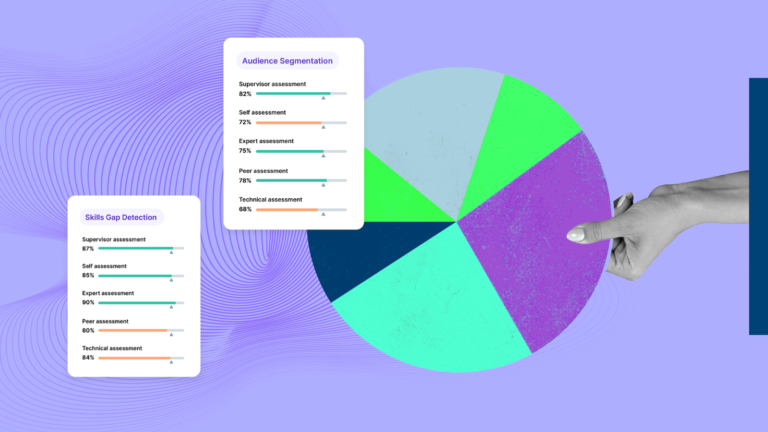
In SkillPanel’s multi-source assessment model, self-assessments are combined with manager input, peer reviews, and technical evaluations. This triangulation helps identify meaningful gaps between how individuals see themselves and how their performance reads to others, which can be one of the most informative signals in any competency evaluation.
Observation and project-based assessments
Observation-based assessments involve directly watching employees perform their work, capturing competencies as they appear in real time. This method is particularly effective for roles where process and behavior are as important as outcomes. Project-based assessments take a similar approach but structure the evaluation around a specific task or challenge, allowing assessors to evaluate problem-solving, collaboration, and technical execution in a controlled context.
SkillPanel recommends using extended work simulations that mirror real tasks, paired with rubrics tied directly to competency indicators. This approach produces some of the most reliable performance data because it evaluates what people can do in conditions that closely replicate actual work demands.
Assessment centers
Assessment centers bring multiple evaluation methods together in a structured environment, typically used for high-stakes decisions like senior hiring or promotion. A typical assessment center might include a mix of role-plays, group exercises, case studies, presentations, and structured interviews, all designed to observe competencies in action across a range of scenarios.
Because assessment centers are resource-intensive, they are generally reserved for roles where the cost of a poor decision is significant. However, when well-designed, they offer some of the highest validity of any assessment approach, combining the rigor of skills tests with the contextual richness of behavioral observation.
How to conduct a competency assessment: Step-by-step
Running an effective competency assessment program is not just about choosing the right tools. It requires a deliberate process that connects assessment design to organizational strategy, ensures fairness, and translates results into action. Here is how to conduct a competency assessment in a way that actually drives change.
Step 1: Define role-specific competencies and success criteria
Before any assessment can begin, you need to know exactly what you are measuring. Start by identifying the competencies required for each role, drawing on job descriptions, strategic objectives, and input from managers and subject matter experts. Define each competency in terms of observable behaviors, not abstract traits. Instead of “good communicator,” specify what effective communication looks like at each proficiency level.
This step is also where you establish what “good” looks like. Setting clear success criteria grounded in actual role requirements gives employees a fair benchmark and ensures that results can be compared meaningfully across teams and time periods. The tighter the alignment between assessed competencies and real job demands, the more actionable the outputs become.
Step 2: Choose the right assessment method for your goals
Different competency types call for different methods. Technical competencies are best evaluated through skills tests and work simulations. Behavioral competencies require structured interviews, 360-degree feedback, or observation. Leadership and cognitive competencies may warrant a combination of situational judgment tests, self-assessments, and multi-rater input.
Resist the temptation to default to a single method. The most accurate picture of an employee’s competencies comes from combining at least two or three approaches that complement each other. Your method choices should also reflect the purpose of the assessment, whether it is for hiring, development, performance review, or succession planning.
Step 3: Select or build your competency assessment tool
Organizations can choose from existing competency assessment tools or build customized instruments tailored to their specific frameworks. Platforms like SkillPanel offer pre-built assessment libraries, customizable question types, and clear scoring systems with graphical proficiency representations, enabling organizations to move quickly without sacrificing rigor. SkillPanel also integrates with existing HR technology stacks, which means assessment data flows directly into the systems where talent decisions are made.
Whether you use a platform or build internally, the tool should support objective, consistent evaluation and generate outputs that are easy to interpret and act on.
Step 4: Communicate the process to employees
How you introduce a competency assessment program significantly affects how employees engage with it. Transparency builds trust. Clearly explain the purpose of the assessment, how results will be used, who will see them, and how they connect to development planning and career progression. Frame the process as an opportunity for growth, not a judgment.
Proactive communication about purpose, process, and outcomes should address common concerns upfront: Will this affect my current role? How will my manager use these results? What happens next? When employees understand the “why” before they engage with the assessment itself, the quality of data you collect improves considerably, especially in self-assessment and 360-degree feedback components where honest reflection is essential.
Step 5: Administer the assessment and gather data
With the groundwork in place, administration should feel straightforward. Ensure that all participants have equal access to instructions, tools, and time. Consistency in how assessments are delivered is critical for fairness and data integrity. For large-scale programs, SkillPanel’s automation capabilities can reduce administration time by up to 60%, freeing HR teams to focus on analysis and development planning rather than logistics.
Collect data systematically and store it in a format that supports analysis. This is where integrating your competency assessment tool with your HRIS or learning management system pays dividends, allowing you to connect competency data with performance records, training history, and role information.
Step 6: Analyze results and identify gaps
Once data is collected, the real work begins. Analyze results at both the individual and team level. At the individual level, identify where performance falls short of defined proficiency benchmarks. At the team or organizational level, look for patterns: are gaps concentrated in particular competency clusters, departments, or roles?
SkillPanel’s predictive gap analysis capabilities are particularly valuable here, surfacing not just current gaps but also likely future gaps based on workforce trends. This competency analysis transforms raw assessment data into strategic insight, connecting workforce capability to business readiness.
Step 7: Build targeted development and action plans
Assessment without action is just data collection. The final step is translating results into specific, personalized development plans that outline what each individual needs to do, what resources are available, and by when. These plans should be collaborative, developed in conversation with the employee rather than handed down from above.
At the organizational level, aggregate gap data should inform L&D priorities, hiring plans, and succession pipelines. When competency assessment results feed directly into these decisions, the program becomes a genuine strategic asset rather than an HR formality.
Competency assessment examples by use case
Understanding competency assessment in the abstract is one thing. Seeing how it applies across different real-world scenarios makes the value concrete. Here are three competency assessment examples that illustrate how the same underlying methodology adapts to different business needs.
Competency assessment for hiring and onboarding
In the hiring process, competency assessments help organizations move beyond resume screening to evaluate whether candidates can actually do the job. According to 2023 SHRM research, 56% of employers already use pre-employment assessments to measure applicants’ knowledge, skills, and abilities, and the business case for doing so is clear. Given that executive hires cost nearly 7 times more than non-executive hires according to SHRM’s 2025 benchmarking reports, the ROI of selecting the right candidate the first time is significant at senior levels.
A competency assessment example here might involve a candidate for a data analyst role completing a work simulation that tests analytical thinking, tool proficiency, and the ability to communicate findings clearly. SkillPanel’s RealLifeTesting™ methodology is purpose-built for this scenario, placing candidates in realistic work contexts that predict on-the-job performance far more reliably than standard interviews. During onboarding, assessment results from the hiring process can then inform tailored induction programs, ensuring new hires receive targeted support from day one rather than generic orientation content.
Employee competency assessment for performance reviews
When integrated into performance reviews, a competency assessment provides structure and objectivity that traditional review formats often lack. Rather than relying on manager impressions or a list of accomplishments, the competency review evaluates performance against specific behavioral and technical standards relevant to the role.
An example here might involve an engineer being evaluated against functional competencies like systems design and code quality, alongside behavioral competencies like cross-functional collaboration and problem-solving. Results are compared to the previous review cycle, revealing growth and identifying areas that still need attention. This approach makes performance conversations more productive, grounded in evidence rather than opinion.
Leadership competency assessment
Assessing leadership competencies requires tools that can capture how someone influences, communicates, and makes decisions in complex situations. A leadership competency assessment typically combines 360-degree feedback with behavioral interviews and situational judgment tests. The Deloitte 2026 Global Human Capital Trends survey reinforces that organizations taking a human-centric, development-focused approach to leadership are more likely to realize returns on their people investments.
One real-world illustration of this comes from the Crestcom Business Productivity Accelerator program, which delivered structured leadership competency development across more than 250 organizations. Aggregate outcomes from the program included $2.8 million in new or retained revenue, $1.9 million in verified cost savings, over 68,000 productivity hours recovered through improved workflow design, and approximately a 45% improvement in customer satisfaction. While these outcomes span multiple organizations rather than a single company, they reflect a consistent pattern: structured, competency-grounded leadership development produces measurable business results when programs are rigorously designed and tied to specific behavioral outcomes.
For succession planning, leadership competency assessments identify which high-potential employees have the behavioral and cognitive foundations to grow into senior roles, and which gaps need to be addressed before that transition can happen successfully. This turns succession planning from a speculative exercise into a data-driven talent pipeline strategy.
How to use a competency assessment template effectively
A competency assessment template provides the structural backbone for consistent, fair evaluation across roles, teams, and time periods. Used well, it ensures that every assessor is measuring the same things in the same way, which is essential for generating data you can trust.
SkillPanel offers competency assessments templates that include standardized formats with customizable question types, covering multiple-choice questions, short answer responses, practical demonstrations, and scenario-based queries. Clear scoring systems with graphical representations of proficiency levels make it easy for managers and HR professionals to interpret results without specialized analytics expertise. A well-designed printable competency assessment template can also support in-person evaluation scenarios where digital tools may not be available.
To use a competency assessment template effectively, start by mapping competencies to specific roles before applying the template. Define proficiency levels with concrete behavioral indicators at each stage, beginner through expert, so that scoring is consistent regardless of who conducts the evaluation. Incorporate question categories that are directly relevant to the audience, whether that means job-specific technical scenarios for an engineering team or communication-focused questions for a client-facing role.
Templates should also evolve. Periodically reviewing and updating your competency assessments template to reflect changes in role requirements, industry standards, or organizational strategy ensures that the tool remains accurate and relevant. SHRM recommends updating frameworks using validated research, such as its annual BASK practice analyses, which are publicly available and regularly incorporate emerging trends like inclusive leadership and global cultural effectiveness.
Measuring the effectiveness of your competency assessment program
Investing in competency assessment infrastructure only makes sense if you can demonstrate that it is working. Measuring program effectiveness requires tracking outcomes across multiple dimensions of workforce performance and business impact.
At the most foundational level, monitor whether assessment results correlate with actual job performance over time. If employees who score highly in specific competencies consistently outperform peers in related metrics, that is a strong signal that your assessment tool has predictive validity. SkillPanel’s analytics capabilities support this kind of longitudinal tracking, connecting assessment data with performance records and business outcomes across roles and departments.
Beyond individual performance, evaluate program effectiveness by tracking training completion and engagement rates, time-to-productivity for new hires, internal mobility rates, retention among high performers, and skills gap closure over successive assessment cycles. These metrics tell a story about whether the program is generating real value or simply producing data that sits unused.
When assessment results don’t align with job performance
One challenge that experienced practitioners encounter, and that surface-level guides tend to skip, is what to do when assessment scores don’t predict performance as expected. An employee who scores highly on a leadership competency profile may still underperform in a new management role. A high technical score in a hiring assessment doesn’t guarantee a smooth first six months. These misalignments are real and deserve a systematic response rather than a shrug.
When scores and performance diverge, the first question to ask is whether the competency framework itself still accurately reflects the demands of the role. Job requirements shift, and a framework built two years ago may no longer capture what effective performance actually looks like today. The second question concerns assessor consistency: are managers scoring the same behaviors differently across teams, introducing noise that erodes predictive accuracy? Calibration sessions, where assessors compare ratings and discuss scoring rationale, help reduce this kind of drift. Finally, consider whether the role itself is well-defined. Vague job expectations make it nearly impossible for any assessment to predict success reliably. If the definition of “good performance” varies by manager, assessment results will appear inconsistent even when the tool is working correctly. Treating misalignment as diagnostic feedback rather than a program failure leads to a sharper, more credible framework over time.
Fairness is another dimension that deserves ongoing attention. Regularly auditing your assessment tools for potential bias, reviewing whether certain demographic groups systematically score differently in ways that cannot be explained by actual performance differences, is both an ethical requirement and a legal safeguard.
Key takeaways: Building a competency assessment strategy that works
A well-designed competency assessment strategy transforms workforce management from reactive to proactive. It replaces guesswork with evidence, aligns individual development with organizational goals, and creates the data infrastructure needed to make smarter decisions across the full talent lifecycle, from hiring and onboarding to performance, promotion, and succession.
The foundations of an effective strategy are clear and measurable competencies tied to real role requirements, a mix of assessment methods that capture both technical and behavioral dimensions, and a process that is transparent, consistently administered, and connected to meaningful development action. Equally important is the commitment to treating assessment as an ongoing discipline rather than a one-time event.Platforms like SkillPanel support this kind of sustained, systematic approach by providing dynamic skills mapping, predictive gap analysis, multi-source assessment capabilities, and deep integration with existing HR and learning systems. Whether you are conducting an employee competency assessment for the first time or scaling a mature program across a global workforce, the same principles apply: define clearly, measure rigorously, act promptly, and review continuously. That is how organizations build the workforce intelligence they need to grow with confidence.