
Most HR teams still run their skills tracking off spreadsheets and annual surveys that go stale within weeks. That approach doesn’t hold up in 2026, when AI adoption is reshaping job requirements faster than most organizations can document them. Building an AI workforce skills inventory isn’t a nice-to-have anymore. It’s the difference between knowing what your people can actually do and guessing based on outdated job titles.
This guide walks through what a modern skills inventory looks like, why it matters right now, and exactly how to build one that keeps pace with your business.
What is an AI workforce skills inventory (and why it’s different today)
A skills inventory is a detailed record of the skills, qualifications, and experience held across your workforce. But the version organizations need today looks nothing like the static spreadsheets of the past. An AI workforce skills inventory pulls in real-time data to reflect what employees can do right now, not what they could do during last year’s performance review cycle.
That distinction matters because job requirements are shifting quickly. Roles that didn’t involve AI tools two years ago now require at least working familiarity with them. A skills inventory built for 2026 has to capture that movement as it happens, not months after the fact.
How AI skills inventories differ from traditional skills matrices
Traditional skills matrices rely on manual updates and periodic assessments. Someone fills out a form, a manager signs off, and the data sits untouched until the next review cycle. By the time you look at it again, half the information is outdated.
AI-driven inventories work differently. They use machine learning and data analytics to continuously assess and update skills information, so organizations can respond to changing business needs without waiting for the next scheduled audit. This automation cuts down on administrative overhead while improving accuracy, since the system is constantly cross-referencing new data rather than relying on a single snapshot in time.
That said, a full AI-driven inventory isn’t the right starting point for every organization. A small team of a dozen people can often get by with a well-maintained matrix and a manager who genuinely knows everyone’s strengths. The continuous, automated approach earns its cost once headcount, role complexity, or the pace of change makes manual tracking unreliable.
What data an AI skills inventory captures
A well-built inventory captures far more than job titles and years of experience. It tracks specific skills, proficiency levels, certifications, and relevant work history, then layers in feedback from performance reviews, self-assessments, and peer evaluations. That multi-source approach gives a much fuller picture than any single input could provide on its own.
When you combine these data points, you can identify skill gaps with precision, track how employee development progresses over time, and align training investments directly with business priorities instead of guessing where the need is greatest.
Why your organization needs an AI workforce skills inventory now
Organizations that wait too long to map their workforce capabilities risk falling behind competitors who already know exactly where their talent strengths and shortfalls lie. As AI tools work their way into more roles, the gap between what companies need and what their people are documented as knowing tends to widen quietly, often unnoticed until a project stalls for lack of the right skills in the room.
An AI-driven talent inventory surfaces hidden capabilities within your existing team and speeds up decision-making around hiring and development, it keeps your workforce planning grounded in real data rather than assumption.
Closing the AI skills gap before it widens
A skills inventory helps by pinpointing exactly where shortages exist, whether that’s in prompt engineering, data literacy, or AI-assisted workflow design. Once you know where the gaps sit, targeted training programs become far more effective. Instead of rolling out generic upskilling initiatives across the entire company, you can direct resources toward the specific teams and individuals who need them most, closing the gap before it becomes a competitive liability.
Uncovering hidden talent and internal mobility opportunities
Every organization has employees whose capabilities go underused simply because nobody has visibility into what they know. An AI skills inventory changes that by giving a clear view of employee skills and capabilities across the entire workforce, not just what’s listed on a resume or job description.
This visibility fuels internal mobility. When you can see that someone in operations has quietly developed strong data analysis skills, you can move them into a role where that skill actually gets used. That kind of matching improves engagement and retention while making better use of resources you already have on payroll.
Making faster, data-driven workforce decisions
HR leaders spend too much time making decisions based on incomplete information. Real-time access to detailed skills data changes that. Instead of relying on gut instinct or outdated records, teams can quickly assess who’s qualified for a new project, who needs training, and where hiring gaps genuinely exist. This shift toward data-driven decision-making also reduces the risk of misallocating training budgets or making hiring decisions that don’t actually address the underlying gap.
What holds companies back from building one
Plenty of organizations still haven’t built a working skills inventory. The most common obstacle is simply a lack of awareness about what these systems can do and how much value they generate once implemented. Beyond that, resistance to change within traditional HR practices can slow adoption, especially in organizations used to annual review cycles rather than continuous tracking.
Integration challenges also play a role. Connecting a new skills inventory tool with existing HR systems takes planning, and some teams underestimate the work involved. Rollouts can also stall on softer issues: employees who are reluctant to self-assess honestly for fear the data will be used against them, or genuine data privacy concerns about who sees what. None of these are reasons to avoid building an inventory, but they’re worth planning for rather than discovering midway through a rollout.
How to build your AI workforce skills inventory: 7 steps
Building an effective inventory isn’t complicated, but it does require a clear sequence of steps. Skipping ahead, like choosing software before defining what skills matter most, tends to create rework later. Here’s how the process should unfold from start to finish.
1. define the AI and business-critical skills to track
Before anything else, you need to know what you’re actually measuring. This means working with stakeholders across departments to identify which skills matter most for current operations and where the business is heading. Skipping this step leads to inventories that track the wrong things entirely.
2. choose a skills inventory tool with AI-powered inference
The right skills inventory software makes or breaks the entire initiative. Look for a skills inventory tool that automates data collection, analysis, and reporting so the inventory stays current without constant manual intervention. Platforms like SkillPanel are built for this, using a broad skills library and AI-powered inference to keep data accurate as roles and requirements evolve. That said, the right tool depends on scale: a growing team may only need a lightweight matrix before a full platform makes sense.
3. collect and validate employee skills data
Accurate data comes from multiple sources, not just a single self-assessment form. Combining self-assessments, peer reviews, and performance evaluations gives a much more reliable view of what employees can actually do, rather than what they believe they can do.
4. assess proficiency levels using AI-enabled methods
Knowing that someone has a skill isn’t enough; you need to know how well they perform it. AI-enabled assessment methods, including automated testing and simulations, provide objective measures of proficiency instead of relying on self-reported confidence levels that can skew inaccurate.
5. centralize skills data into a single source of truth
Scattered data across departments creates blind spots. Centralizing everything into one repository ensures every stakeholder, from HR to department leads, works from the same information. That consistency improves both decision-making and cross-department collaboration.
6. map skills gaps against business and AI readiness goals
Regularly comparing your skills data against business objectives shows you exactly how to identify skill gaps before they become urgent problems, giving you time to plan training or hiring proactively instead of reactively.
7. keep the inventory continuously updated
A skills inventory that isn’t updated regularly quickly becomes just another outdated spreadsheet. Building processes for continuous updates, rather than annual refreshes, keeps the data relevant and ensures the inventory remains a tool people actually trust and use.
Turning your skills inventory into action
Building the inventory is only half the job. The real value comes from putting that data to work across training, mobility, and recruiting decisions.
Targeted AI workforce training and upskilling
Once you know where the gaps are, AI workforce training becomes far more precise. Rather than generic company-wide courses, you can design programs that target the specific skills your data shows are missing, which makes every training dollar work harder.
Talent mobility, succession, and career pathing
A skills inventory also supports succession planning by highlighting who’s ready for expanded responsibility and where potential career paths exist. This transparency encourages employees to pursue growth within the company rather than looking elsewhere for opportunity.
Smarter recruiting and workforce planning
With clear visibility into existing capabilities, recruiting becomes more strategic. Teams can identify when a gap is better solved by internal development versus external hiring, reducing unnecessary recruitment costs and making fuller use of the talent already on staff.
AI workforce skills inventory in practice: A sample framework
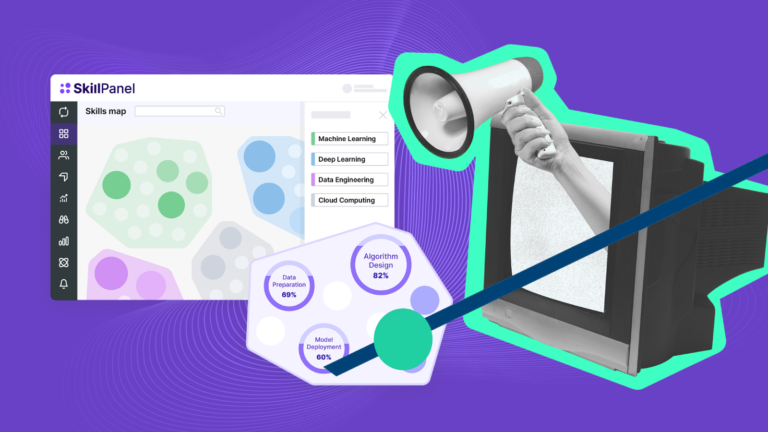
A practical skills inventory example typically follows a structured framework: define the skills that matter, validate data through multiple input sources, then assess proficiency and map results against business goals. Consider how this plays out for a mid-size company rolling out AI tools across operations: mapping the inventory first reveals which teams already have working AI fluency and which don’t, so the training budget goes toward the groups with the widest gap rather than being split evenly across departments that may not need it. Organizations using platforms such as SkillPanel often build this kind of framework around a skills map paired with predictive gap analysis, allowing HR teams to spot where gaps are likely to emerge next as business priorities shift, not just where they sit today. Personalized development plans then translate that analysis into concrete next steps for individual employees, closing the loop between insight and action.
Best practices for a reliable, future-ready skills inventory
Keeping an inventory reliable over time requires discipline. Clear, consistent definitions of each skill prevent confusion across departments, while regular updates keep the data trustworthy rather than aspirational. Encouraging a culture of continuous learning also helps, since employees are more likely to engage honestly with self-assessments when development feels like an ongoing conversation rather than a one-time evaluation.
Automating as much of the process as possible through the right technology also matters. Manual tracking simply can’t keep pace with how quickly skills requirements evolve, which is part of why more organizations are shifting toward integrated platforms that combine assessment, analytics, and development planning in one place. SkillPanel, for instance, connects HRIS, payroll, and learning systems to deliver real-time insight into workforce capabilities without disrupting existing workflows. The payoff is a workforce where skills data actually drives decisions instead of sitting untouched in a shared drive.
Frequently asked questions
What’s the difference between a skills inventory and a skills matrix?
A skills inventory is a detailed database of employee skills and qualifications, while a skills matrix typically provides a visual representation of skills across teams or departments. Think of the inventory as the detailed data source and the matrix as one possible way to visualize a slice of that data.
How often should you update an AI workforce skills inventory?
An AI workforce skills inventory should be updated regularly, ideally on a continuous basis, to reflect changes in employee skills and organizational needs. Waiting for annual cycles defeats the purpose of having real-time data in the first place.
Can you build a skills inventory without AI tools?
It’s possible to create a skills inventory examples-style spreadsheet without AI tools, but doing so sacrifices efficiency and accuracy. Using the right technology significantly improves both the speed of data collection and the reliability of the resulting analysis.
Who should own the skills inventory process?
The skills inventory process is typically owned by HR or talent management teams, but collaboration with department leaders and employees is essential for ensuring accuracy and relevance. Skills data only stays useful when the people closest to the work help keep it current.