Career development planning: The guide that puts you in control of where you’re headed
| Reading time:


Most people don’t plan to stagnate in their careers. It just happens. Without a clear roadmap, professional growth becomes reactive rather than intentional, shaped by circumstance instead of choice. Career development planning changes that equation entirely by helping individuals accomplish both short-term and long-term objectives for future success.
A structured approach to career growth planning gives you agency over your professional trajectory and complete control over your professional growth. It closes the gap between where you are and where you want to be, one deliberate step at a time. And given where the workforce stands today, that agency matters more than ever. Global employee engagement fell to 20% in 2025, the lowest point since 2020, costing an estimated $10 trillion annually in lost productivity. One of the core drivers behind that decline? Insufficient support for employee development, highlighting the critical role of the company in supporting career development.
This guide walks you through every stage of the career development process, outlining the career planning process as a structured workflow—from honest self-assessment to building an action plan for career development that you’ll actually stick to. Whether you’re just starting to think about your future career plans or refining an existing path, these career plan steps will give you the clarity and momentum to grow.
Why career development planning is the difference between drifting and growing
Career development planning isn’t about having everything figured out. It’s about having a framework that keeps you moving forward even when things are uncertain. Without one, most professionals find themselves responding to opportunities as they arise rather than creating them, which is a fundamentally different posture.
The data reflects just how widespread this gap is. 51% of U.S. employees were actively looking for new jobs or watching for opportunities in Q4 2025, the highest turnover intent since 2015, largely linked to lacking developmental support. And 34% of employees who voluntarily quit cited insufficient challenge or career stagnation as the primary reason. Among tech professionals, that number jumps to 52%. Many organizations are moving beyond traditional annual reviews by adopting continuous feedback and modern career management tools, which help align employee growth with business needs more effectively.
These aren’t isolated cases. They reflect what happens when professional growth and development goes unplanned. And for organizations, the cost of inaction is steep. Building a culture where people have genuine career development pathways leads to 57% higher retention in strong learning cultures and saves organizations an average of $8,053 per employee annually through productivity and turnover reductions. In fact, higher retention rates can result when employers invest in professional development, with 94% of employees indicating they would stay longer.
What the research also reveals is how plans go wrong even when people try. Only one in five employees report that their manager actively supports career mapping, and just 15% see clear organizational guidance. Without that scaffolding, self-directed development tends to follow personal interest rather than business need, widening skill gaps in exactly the areas organizations most urgently need filled. A separate body of practitioner research from AllenComm’s 2025 leadership analysis found that plans also fail when training is disconnected from live business priorities, and when post-learning environments don’t reinforce new behaviors. The implication is clear: a career plan needs both individual ownership and organizational support to stick.
The good news? A thoughtful career plan doesn’t need to be complicated. It just needs to exist.
What a career development plan actually is (and isn’t)
At its core, career development planning is a personalized roadmap that documents your career aspirations and the concrete steps required to reach them, with goal setting as a fundamental component. But it’s important to clarify what it isn’t: a career development plan is not a list of vague ambitions or a one-time document you file away after writing it.
An effective individual career development plan is a living document. It evolves with your experiences, responds to industry shifts, and gets updated as you grow. It captures both your short-term and long-term goals, defines the skills and experiences you need to acquire, and identifies the resources that will help you bridge the gap. Through self-assessment and envisioning your future, you create a clear picture of your career aspirations. Think of it as a navigation system rather than a rigid blueprint.
What is career development in practice? It’s the ongoing process of acquiring new skills, expanding your responsibilities, building relationships, and aligning your professional contributions with your personal values and ambitions. The plan is the structure that makes that process intentional rather than accidental.
The real benefits of having a plan
The benefits of developing a career plan go well beyond simply knowing what job you want next. A structured approach to career progression planning touches nearly every dimension of professional life.
When you have a defined career path, every decision becomes easier. You know which opportunities to pursue and which to pass on. You can evaluate a promotion, a lateral move, or a new project through the lens of your broader goals rather than reacting emotionally or impulsively. That clarity reduces noise and keeps your energy focused on what actually moves the needle. Career development planning also contributes to job satisfaction by helping you align your roles with your personal strengths and preferences, leading to greater engagement and performance.
Professionals who plan their development also acquire targeted skills faster than those who learn reactively. By identifying specific competencies required for your next role, you can direct your learning investments precisely. Achieving smaller milestones along the way builds greater confidence, self-trust, and resilience. This matters especially now, when 44% of core skills are expected to change within five years and employers report that half the workforce will need reskilling due to technology adoption. And while a career plan doesn’t eliminate uncertainty, it builds the mental scaffolding to handle it. Resilience, flexibility, and agility have risen 17 percentage points in employer priority since 2023, and developing those qualities starts with having a stable foundation to build from.
Proactively building credentials and expanding your network as part of your career development planning also enhances your employability, making you more competitive for promotions or career changes.
Step 1: Assess where you are right now
Honest self-assessment is the starting point of any effective career development process. You can’t map a route without knowing your current location. This step often gets rushed or skipped, but it’s foundational. Taking time for self-assessment provides a better understanding of your current skills and the requirements needed for growth. Everything else in your plan depends on an accurate understanding of where you stand today.
Feedback from others is also crucial—especially honest feedback from mentors and peers who can offer genuine, constructive insights into your strengths and areas for improvement.
A useful tool at this stage is a SWOT analysis, which helps you evaluate your Strengths, Weaknesses, Opportunities, and Threats, giving you a clear snapshot of your current capabilities and future potential for career development.
How to evaluate your current skills, strengths, and gaps
A useful self-assessment combines multiple perspectives. Start with a personal inventory of the skills you use regularly and the ones you feel confident in. Then layer in external feedback from peers, managers, or mentors who can offer a more objective view of your capabilities. This multi-source approach, combining self-reflection with peer input, is exactly the methodology behind platforms like SkillPanel (the platform this article is published on, built specifically to address workforce skill visibility). SkillPanel builds accurate, verified skill profiles for employees across organizations by drawing on the same combination of self-reported and externally validated data.
The goal isn’t to produce a perfect inventory. It’s to identify patterns: where you consistently perform well, where you feel stretched, and where genuine gaps exist relative to the roles you’re targeting. Skill proficiency isn’t binary. Think of it as a spectrum, and aim to understand where you fall across the competencies most relevant to your career goals.
Pay particular attention to the skills employers are prioritizing right now. In your self-assessment, be sure to evaluate key competencies such as analytical thinking, decision making, problem solving, leadership and social influence, and technological literacy. Analytical thinking is the #1 core skill, considered essential by 70% of employers. Leadership and social influence has surged 22 percentage points in employer rankings. Technological literacy, including AI fluency and data analysis, shows the largest net demand increase across industries. Benchmarking yourself against these competencies gives your self-assessment a real-world grounding.
Questions that reveal what’s working and what isn’t
The right questions can surface insights that a simple skills list won’t. As you assess your current situation, consider asking yourself: Which parts of my current role energize me, and which drain me? What skills have I developed in the last 12 months, and where have I stayed stagnant? What feedback do I receive repeatedly, both positive and critical? Which achievements am I most proud of, and what made them possible?
These questions aren’t just reflective exercises. They reveal your authentic strengths, expose the gaps that matter most to your growth, and often point toward the direction you genuinely want to move in, which brings us to the next step.
Step 2: Define where you want to go
Defining your career direction is where career goal planning becomes motivating rather than just methodical. At this stage, it’s important to engage in career exploration and actively explore different industries, organizations, and roles to identify which pathways align with your interests and strengths. This is the step where you connect personal ambition to professional strategy, where your future career plans start taking shape in concrete terms.
When setting long-term goals, consider your dream job, desired salary level, work life balance, and education requirements as part of your vision. Factoring in these elements ensures your career development planning aligns with both your personal values and professional aspirations.
Setting short-term vs. long-term career goals
Both timeframes matter, but they serve different functions. Long-term goals give you a destination, typically spanning a few years—often three to five years out—such as a role, a level of expertise, an industry, or a type of impact you want to have. Short-term goals, usually 6 to 12 months, are your milestones, the immediate steps that build toward the larger vision.
Breaking down long-term career goals into smaller, short-term goals can make the process less overwhelming and more manageable.
Treating them separately helps you avoid two common traps. The first is getting lost in the long horizon and feeling paralyzed by how far away it seems. The second is staying so focused on short-term wins that you drift from your broader direction. The balance between these two views is what makes an individual career plan effective.
How to make your goals specific, measurable, and time-bound
Vague goals don’t drive action. “Get better at leadership” is not a goal you can make progress on. “Complete a leadership communication course by Q2 2026 and lead two cross-functional projects by year-end” is. The SMART framework (Specific, Measurable, Achievable, Relevant, Time-bound) exists because ambiguity is the enemy of follow-through, and it encourages you to break your goals into actionable steps that make progress clear and achievable.
When you know how to create career goals properly, you set targets that pull you forward rather than ones you forget by next month. Prioritize two to three high-impact goals at a time rather than spreading your attention across too many fronts. Focus on the goals that offer the most return given your skills gaps, your company’s current priorities, and your one-to-three-year trajectory.
Choosing a career direction when you’re unsure
Not everyone enters the career development planning process with a clear destination in mind, and that’s fine. Rather than forcing clarity prematurely, treat this phase as structured exploration. Research roles that interest you by reviewing real job postings and analyzing the required competencies for specific job roles. Have conversations with professionals in fields you’re curious about. Use informational interviews and tools like the Myers Briggs Type Indicator (MBTI) to understand what those careers actually feel like day-to-day and to assess personality fit for different job roles, not just how they look from the outside. 72% of workers agree that organizations should do more to connect people with growth opportunities, which means your employer may already have resources and conversations available to help you find your footing.
As you explore, seek hands on experience through volunteering, internships, or shadowing professionals in your areas of interest. These activities help you better understand job roles and build relevant soft skills, making your career development planning more effective.
Step 3: Identify the gap between now and your goal
With your current position assessed and your goals defined, the next stage of career planning is identifying what separates the two. This gap, made up of skills, experiences, and sometimes credentials, becomes the core problem your action plan will solve. Succession planning within companies can help identify and prepare future leaders by systematically addressing these gaps and facilitating internal mobility.
Tools like SkillPanel not only help visualize this gap but also enable employees to track progress and acquire new skills, making the journey toward your target role more structured and achievable.
Skills, experience, and credentials you need to acquire
Start by listing the qualifications that consistently appear in job descriptions for your target roles. Note which ones you already have, which need strengthening, and which are entirely absent from your current profile. Go beyond hard skills. Look for patterns in how target roles describe leadership, collaboration, strategic thinking, or domain expertise.
Credentials deserve a targeted review too. Some roles require specific certifications; others value demonstrated experience far more than formal qualifications. Knowing which pathway matters in your specific field prevents you from investing time in credentials that won’t meaningfully advance your position.
85% of employers plan workforce upskilling programs with a focus on analytical thinking, AI fluency, resilience, and technological literacy. Understanding these priorities helps you align your personal development with what employers actually want, creating a natural overlap between your growth and your marketability.
How to research role requirements and industry benchmarks
Job postings are your most immediate source of role intelligence. Analyze multiple listings for your target position, not just one, to identify recurring themes. Industry reports, professional associations, and LinkedIn profiles of people in your desired roles can further round out your picture. Pay attention not just to what skills are listed, but to how they’re described and weighted.
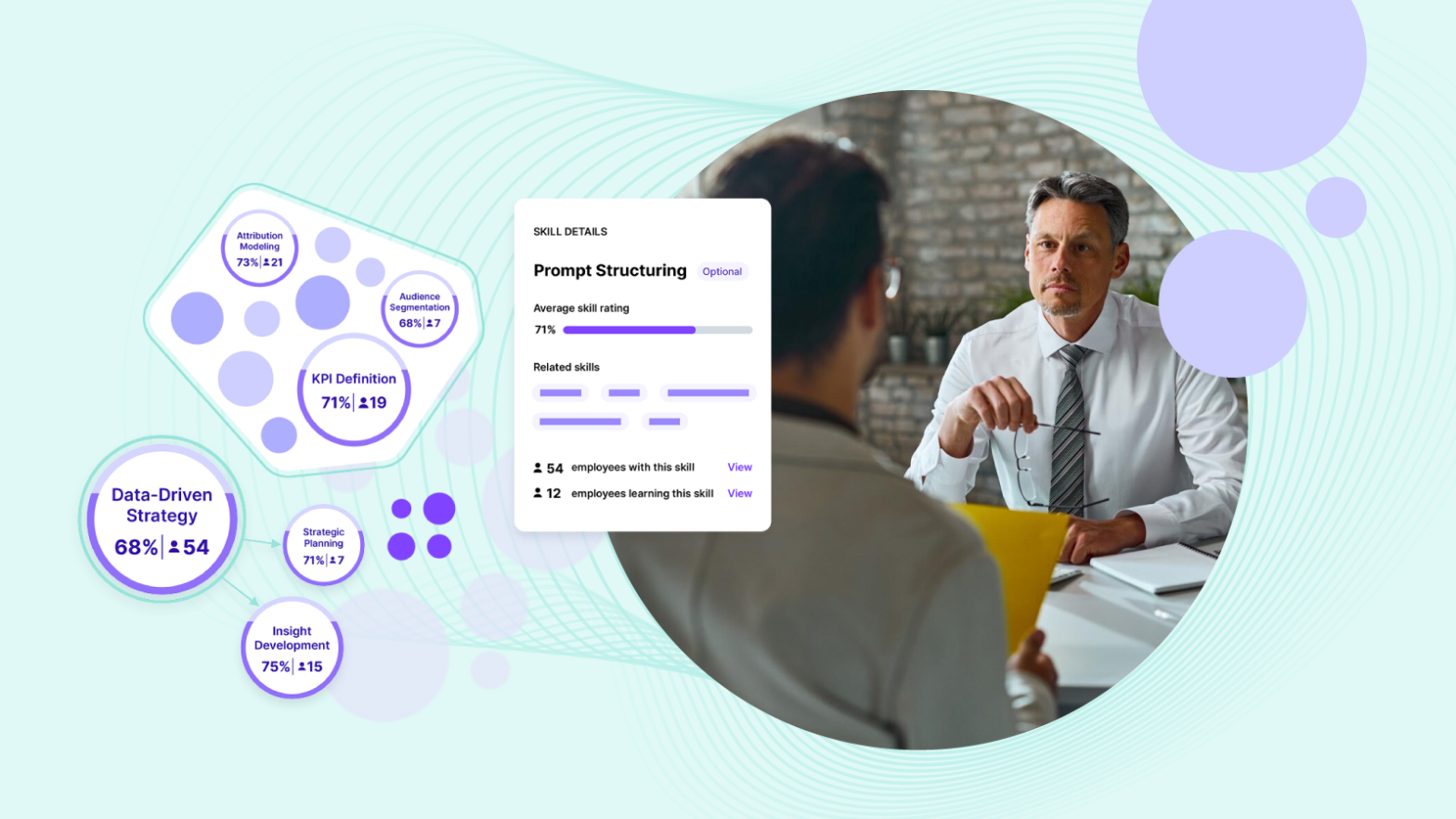
Skills-based approaches to hiring and career development are increasingly prevalent, with 79% of HR managers reporting that their companies use this approach. That means the gap between your current capabilities and your target role is increasingly measurable in concrete competency terms, which is exactly where platforms like SkillPanel excel. SkillPanel’s automated gap analysis compares your current skills against role requirements in real time, flagging not just what’s missing but what’s at risk of becoming obsolete.
Step 4: Build your action plan
Knowing what you need is only half the equation. The other half is building the career development action plan that actually gets you there. An action plan for career development turns abstract goals into a sequence of specific, dated commitments, supporting professional development by providing a structured approach to skill enhancement and growth.
When it comes to learning resources, don’t just think of traditional classes or books. Online learning platforms like Coursera offer affordable, flexible educational resources that employees can access from anywhere, making it easier to enhance skills, increase productivity, and promote career advancement.
Turning goals into concrete milestones and deadlines
Break each goal into smaller milestones that can be achieved within 60 to 90 days. Quarterly reviews are a useful natural cadence, giving you enough time to make meaningful progress while staying close enough to the details to catch when something isn’t working. Each milestone should have a clear, measurable outcome, something you can look at and confirm either happened or didn’t.
This granularity matters because it’s where accountability lives. Large goals feel motivating in the abstract but can become overwhelming without intermediate proof points. Milestones give you wins to build on and early warning signals when a deadline is slipping.
Learning resources: Courses, certifications, mentorship, and on-the-job experience
The most effective development plans draw on multiple types of learning. Leadership training tops organizational development strategies at 71% of companies, followed by mentorship programs at 55% and cross-functional projects at 45%. Each resource type serves a different learning function.
Online courses and certifications build foundational knowledge efficiently. Mentorship accelerates judgment by exposing you to experienced perspectives and practical wisdom. On-the-job experiences, especially stretch assignments or cross-functional projects, develop the applied competencies that formal training often can’t replicate. A well-rounded plan for career development incorporates all three rather than relying on any single source.
Networking as part of your career development strategy
Networking often gets treated as a separate activity from career development, but it’s an integrated part of any strong career path. Relationships accelerate visibility, surface opportunities before they’re publicly posted, and provide real-time intelligence about industry trends and role expectations.
Build your network intentionally rather than transactionally. Seek out conversations with professionals in roles you aspire to. Participate in industry communities where your target peers gather. Engage with your organization’s internal networks too, since companies with strong learning cultures achieve 23% higher internal mobility. Being known internally as someone committed to growth opens doors that performance reviews alone often don’t.
Step 5: Track progress and adapt over time
A career development plan that lives in a drawer isn’t a plan. It’s a document. The difference between the two is a regular practice of review, reflection, and adjustment.
How to review your plan regularly without losing momentum
Quarterly check-ins are the minimum viable review cadence. Set aside 30 minutes every three months to evaluate whether your goals still reflect your priorities, whether your timelines are realistic, and whether the strategies you’re using are producing results. These sessions shouldn’t feel like an audit. Think of them as a calibration, a chance to confirm you’re still pointed in the right direction.
Adding a smaller weekly learning rhythm helps maintain momentum between quarterly reviews. Consistent small actions, such as focused study sessions, a practice task, or a brief reflection on recent learning, build the habits that sustain long-term growth. Define what progress looks like in specific, observable terms so you can recognize it when it happens.
When and how to adjust your goals as circumstances change
Flexibility isn’t a weakness in career planning; it’s a design feature. Industries evolve, companies restructure, personal priorities shift. A career plan that can’t bend will eventually break. The key is distinguishing between adjustments that reflect genuine growth and recalibration versus those that are simply avoidance of difficult work.
When a goal needs updating, treat it the way a navigator treats a route change: acknowledge the new conditions, recalculate the path, and continue moving. Tweaking a timeline, updating a target role, or pivoting toward an adjacent opportunity can all be signs of a maturing career strategy. The 42% of voluntary departures that leavers describe as preventable often trace back to exactly this failure: plans that became irrelevant and were never updated. Research into why development plans stall also points to a subtler pattern, returning from a training program or completing a certification rarely changes behavior unless the day-to-day environment reinforces practice. Building in reflection time and seeking manager check-ins after key learning milestones helps close that gap between completing development activities and actually applying them.
Career development plan example: Real outcomes from structured plans
The most convincing argument for career development planning isn’t a framework. It’s what happens when people actually use one. The following examples, drawn from documented career plan implementations in 2023 to 2025, show what structured planning looks like in practice and what it produces.
From engineer to technical lead: Marcus’s two-year progression
Marcus was a software engineer with seven years of experience who wanted to move into a leadership role but had no formal path for getting there. His plan was specific and phased. In the first six months, he volunteered to lead a project team and began mentoring junior developers, two activities that built visible leadership credibility rather than just technical output. In year one, he completed an Agile certification and a public speaking course, adding the formal and interpersonal credentials his target role required. By year two, he had taken on sustained leadership responsibilities across multiple projects.
The outcome was direct: Marcus advanced to a Technical Lead role within two years. What made the plan work wasn’t the certifications alone. It was the combination of structured skill-building with deliberate, on-the-job application and visibility. Every development activity mapped to a specific gap his target role required, and each milestone built the evidence base his organization needed to see before promoting him.
Career change with a timeline: James’s 18-month transition
James was a military veteran transitioning to civilian project management, a move that required translating years of real operational experience into the terminology and credentials civilian employers recognize. Working with career counselors, he spent the first three months on resume translation and skills mapping. Months four through six focused on enrolling in a PMP certification course and building a civilian professional network. By the end of year one, he had completed his PMP, finished targeted interviews, and supplemented his profile with nonprofit project management volunteering.
The result was a civilian project management role secured within 18 months. James’s plan succeeded because it treated his existing skills as assets to be translated rather than deficits to be filled, and because each milestone was sequenced to build directly on the previous one.
What these examples have in common
Both cases followed the same underlying logic: a clear starting assessment, a defined target, a phased action plan, and consistent review. Neither plan was perfect from the start. Both required adjustment as circumstances evolved. But the structure itself created the accountability and momentum that made progress possible. This kind of planning, whether you’re navigating a promotion, a career change, or a skills pivot, can be built and tracked using tools like SkillPanel, which maps competencies against target roles in real time and generates personalized development recommendations tied to both career goals and business needs.
Common mistakes to avoid when writing your plan
The most common pitfall in writing a career development plan is setting goals that are too vague to act on. “Become a better leader” gives you nothing to work with. A second frequent error is treating the plan as static, writing it once and never returning to it. As life changes, so should the document.
Other mistakes include focusing exclusively on technical skills while neglecting the interpersonal competencies that increasingly drive advancement. Leadership and social influence has surged 22 percentage points in employer priority rankings. Ignoring this dimension means building only half a profile. Finally, many people underestimate how long skill development takes and set timelines that set them up for disappointment. Build in realistic buffers and treat missed deadlines as data, not failures.
Career development tips to accelerate your progress in 2026
Beyond the core planning process, a handful of strategic habits separate people who make steady progress from those who stay stuck. These career development tips address the practical realities of growing professionally in 2026.
Leverage AI tools and digital learning platforms
AI tools and digital learning platforms have become genuine career accelerators. The ability to access personalized learning recommendations, build skill profiles automatically, and benchmark progress against industry standards is no longer limited to large organizations. Individual professionals can use these tools to close gaps faster and make smarter decisions about where to invest learning time.
The strategic value of AI proficiency extends beyond using tools for learning. Employers across sectors are actively seeking AI fluency, with job postings offering salary premiums for professionals who demonstrate it. Curiosity, lifelong learning, and systems thinking are increasingly vital alongside technical capabilities, and platforms that combine both are worth prioritizing. SkillPanel’s AI-powered inference engine, which automatically builds skill profiles from resumes, projects, and learning data, is one example of how organizations are making this kind of continuous development scalable.
Build visibility inside and outside your organization
Skills and accomplishments only create opportunities when the right people know about them. Building professional visibility is a deliberate practice, not a byproduct of doing good work. Internally, this means volunteering for projects with cross-departmental reach, speaking up in strategic conversations, and building relationships with leaders beyond your immediate team.
Externally, it means engaging in professional communities, sharing expertise through industry forums or content, and staying active in your professional network. Managers drive 70% of team-level engagement variance, which means your direct relationships with leadership also shape how your development is perceived and supported. A growth-oriented reputation, built on substance and visibility together, opens doors that strong performance alone rarely does.
Protect your development time against day-to-day demands
Development time is perpetually at risk of being consumed by urgent tasks. Without deliberate protection, the important work of growing your skills consistently loses to the immediate demands of your role. The solution is treating your career development like a meeting you can’t cancel.
Block time in your calendar for learning, practice, and reflection. Treat it with the same respect you’d give a client call or a team deadline. Learners who set career goals engage four times more with learning content, and that engagement gap compounds over time. Organizations with strong learning cultures achieve 57% higher retention rates than those without them. The difference often comes down to whether individuals and their organizations actively protect development time or allow it to erode.
Start your career development plan today
Career growth doesn’t wait for the perfect moment. The professionals who advance most reliably aren’t the ones with the clearest crystal ball about the future. They’re the ones who start planning, commit to reviewing that plan regularly, and adjust when the landscape shifts.
Start with where you are. Assess your skills honestly, name your goals specifically, and build an action plan that connects the two. If you’re supporting a team or an entire organization through this process, platforms like SkillPanel provide the real-time skills intelligence, gap analysis, and personalized development pathways that make career development planning scalable across a workforce.
The career development process is not a linear path to a fixed destination. It’s an ongoing practice of self-awareness, skill-building, and strategic adaptation. The most important step is the one you take today.