

The war for talent has fundamentally changed. External recruitment no longer delivers the competitive advantage it once promised, and forward-thinking organizations are discovering something counterintuitive: their most valuable talent pipeline already exists within their walls. Leadership and management development is now the top HR priority for 2026, displacing recruiting from its traditional position at the top of strategic agendas.
This shift represents more than a tactical adjustment. It signals a complete reimagining of how organizations build capability, deploy talent, and create competitive advantage in an era where external hiring increasingly fails to deliver results. Internal talent development has emerged as the cornerstone of sustainable workforce strategy, driven by economic realities, technological enablers, and a fundamental transformation in what employees expect from their careers.
Why internal talent development dominates 2026’s HR landscape
Three converging forces have pushed internal talent development from a nice-to-have benefit to a business-critical imperative. Organizations that recognize and respond to these dynamics are positioning themselves for sustained competitive advantage, while those clinging to external-first hiring strategies face mounting costs, capability gaps, and retention crises.
The perfect storm: Economic and labor market pressures
Labor markets have tightened dramatically, creating a landscape where traditional recruiting approaches no longer function effectively. Only 41% of U.S. workers agreed that their organizations’ recruiting efforts were effective in 2024, despite more than half of HR professionals rating their own recruiting as effective. This perception gap reveals a fundamental disconnect between recruiting activity and actual hiring outcomes.
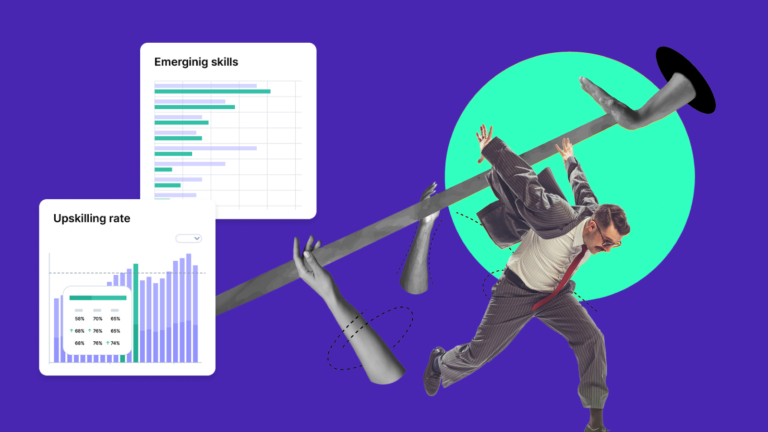
The skills employers need are evolving at unprecedented speed, with job requirements changing roughly 25% since 2015 and expected to double that rate by 2027. External hiring cannot keep pace with this velocity of change.
The rising cost of external hiring
Financial pressures have made external recruitment prohibitively expensive for many organizations. Average cost per hire in the US reached $4,800 in 2026, up from $4,425 in 2021, driven by rising costs for agency fees, job board advertising, and third-party recruiter reliance. External agency fees for a $100,000 salary hire range from $15,000 to $25,000 in competitive markets, representing a significant premium for specialized roles.
These direct costs tell only part of the story. External hires require extensive onboarding, experience longer ramp-up periods, and lack institutional knowledge that internal candidates bring to new roles. US private industry compensation costs rose 3.5% year-over-year to June 2025, fueling baseline hiring expenses as organizations compete for increasingly scarce external talent.
Employee expectations have shifted
Career growth has become the primary driver of retention, with four of the top five factors predicting intent to stay now relating directly to growth opportunities. Employees planning to remain at their organizations are three times more likely to believe they can achieve career goals internally.
94% of employees would stay longer at their company if it invested in their career development, according to LinkedIn’s research. This statistic underscores a simple truth: retention strategy and development strategy are now inseparable.
What internal talent development actually means (and what it doesn’t)
Internal talent development encompasses far more than periodic training events or annual review processes. It represents a fundamental commitment to continuously building employee capabilities through diverse experiences, transparent pathways, and integrated learning systems.
Beyond internal mobility: The full spectrum
Internal talent development operates across multiple dimensions simultaneously. Skills-based competency frameworks break roles into specific technical, business, leadership, and communication capabilities, defining success at different proficiency levels. This granular approach allows organizations to identify precise development needs rather than relying on generic training curricula.
Blended delivery methods match learning approaches to specific skill types. Microlearning formats demonstrate 22% better retention than traditional classroom training, making them particularly effective for technical skills and knowledge updates. On-the-job experiences, mentoring relationships, and cross-functional projects provide contextual learning that accelerates capability building in ways formal training cannot replicate alone.
Continuous learning with personalized journeys has replaced periodic training events as the gold standard for development. Progressive organizations create embedded learning experiences based on individual skill gaps, learning styles, and career aspirations. This personalization increases skill acquisition rates by 31% compared to standardized programs.
How internal development differs from traditional training
Traditional training operates episodically, delivered in discrete events disconnected from daily work. Internal talent development integrates learning into workflow, making capability building a continuous process rather than an occasional activity.
The scope differs fundamentally as well. Traditional training focuses narrowly on job-specific skills needed for current roles. Internal talent development takes a broader view, preparing employees for future positions, building transferable capabilities, and creating organizational agility through workforce versatility.
Measurement approaches diverge significantly. Traditional training tracks completion rates and satisfaction scores, metrics that reveal little about actual impact. Internal talent development focuses on performance outcomes, internal mobility rates, time-to-proficiency for new roles, and retention of high-potential talent.
The business case: Quantifiable benefits of investing internally
Internal talent development delivers measurable returns across multiple dimensions, from direct cost savings to improved organizational agility.
Cost savings: The numbers that matter
Organizations can achieve $8,053 annual savings per employee through career advancement and skills development opportunities, broken down as $6,521 from increased productivity, $916 from decreased turnover, and $616 from lower healthcare costs.
A 1% reduction in employee turnover generates $500,000 in annual savings, according to PayPal’s analysis. Organizations with strong learning cultures see57% higher employee retention, directly reducing turnover costs while preserving institutional knowledge.
Internal mobility candidates convert at 32 times the rate of inbound applicants, compared to 11 times for referrals. This dramatic difference in conversion rates reduces recruiting costs while accelerating time-to-fill for critical positions.
Retention and engagement metrics
Companies with strong internal mobility programs see a 2x increase in employee retention, according to LinkedIn’s research. Employees at organizations with internal mobility programs stay 60% longer than those at organizations without such programs.
Employees with higher internal mobility stay with organizations for an average of 5.4 years compared to 2.9 years in low-mobility organizations. This stark difference demonstrates how internal development directly impacts workforce stability.
Internal mobility grew 30% since 2021, with rates resuming growth after a pandemic-era dip. A 10-year study revealed that top-performing companies filled over 60% of roles internally and achieved a four-fold surge in sales per employee, compared to bottom performers who filled only 35% internally.
Accelerated time-to-productivity
Internal hires reach full productivity significantly faster than external hires, leveraging existing knowledge of organizational culture, processes, and relationships. Organizations using digital competence frameworks report 42% faster time-to-proficiency for employees transitioning to different roles.
Organizations implementing talent marketplaces report 20-day reductions in time-to-fill for internal positions compared to external hires, 30-40% better cycle times for staffing projects, and 25% improved candidate skill-set matching.
Knowledge preservation and institutional continuity
Internal talent development preserves critical institutional knowledge that walks out the door with departing employees. Organizations that prioritize internal advancement create redundancy in critical capabilities, ensuring that key expertise exists across multiple team members rather than residing with single individuals.
Knowledge transfer programs embedded within internal development initiatives capture and distribute specialized expertise throughout the organization. Succession readiness improves dramatically when internal development focuses on building bench strength for critical positions.
When external hiring makes more sense
While internal talent development offers compelling benefits, it’s not always the optimal strategy. Organizations need balanced talent strategies that recognize when external hiring delivers better outcomes.
Strategic transformation and market expansion
External recruitment works best during periods of strategic transformation or market expansion, when organizations need expertise that internal teams cannot quickly develop. New markets often require localized knowledge, regulatory understanding, and industry connections that internal employees may lack.
Building emerging technology capabilities
When introducing new technologies requiring specialized expertise, external hiring proves particularly effective. Organizations adopting artificial intelligence, blockchain, or other emerging technologies may need specialists whose knowledge cannot be rapidly developed internally. Internal reskilling programs typically require months of training, whereas external hires can contribute immediately.
Preventing skills stagnation and fostering innovation
Overreliance on internal hiring can lead to skill stagnation and reduced innovation because teams primarily consisting of people with similar backgrounds may struggle with creative problem-solving. External hires invigorate the workforce with new skills and fresh perspectives, expanding the company’s talent pool and challenging established thinking patterns.
Addressing diversity and inclusion goals
External hiring allows organizations to be more selective from a larger, more diverse talent pool. This capability is particularly relevant for organizations seeking to build more inclusive workforces or access specialized talent pools underrepresented in their current organization.
The optimal approach remains balanced: organizations should treat internal development as the foundation while using external hiring strategically for genuine capability gaps and innovation needs.
Building your internal talent development strategy
Creating effective internal talent development requires deliberate design, clear processes, and sustained commitment.
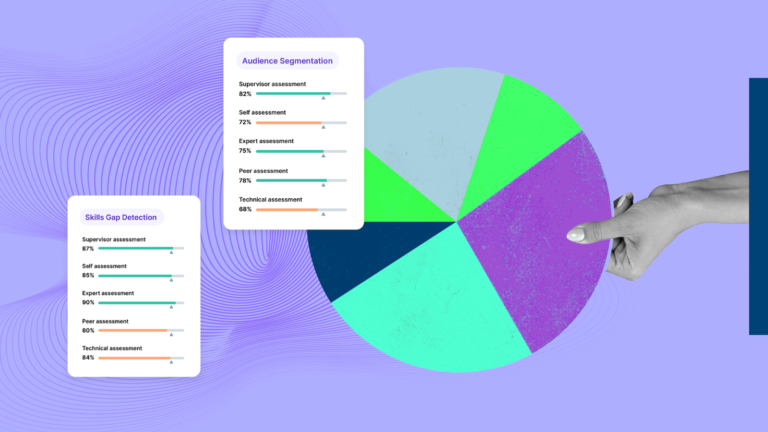
Conducting a skills gap analysis and future-state planning
Effective internal talent development begins with understanding current capabilities and future requirements. Organizations should align skills assessment with strategic goals, defining required skills using competency frameworks, industry standards, and market data.
Collect and analyze multi-source data quantitatively to create accurate capability baselines. Employee proficiency assessments, performance reviews, manager evaluations, and AI-inferred data from HR systems provide comprehensive views of current capabilities.
Prioritize gaps based on strategic impact and urgency. Focus development resources on capabilities that directly enable strategic objectives, support competitive differentiation, or address critical bottlenecks in organizational performance.
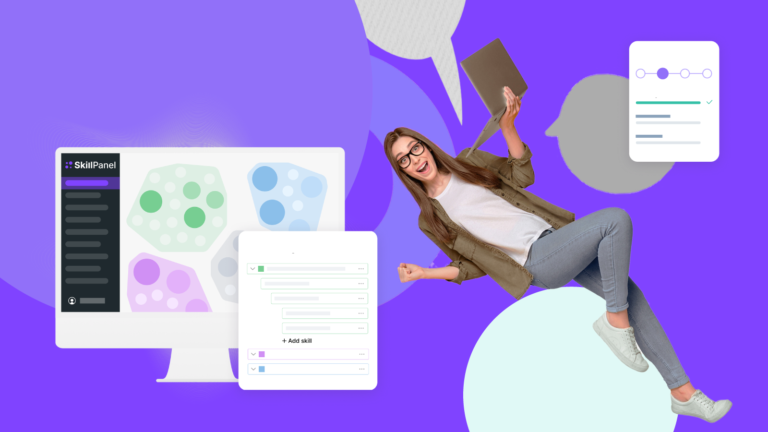
Skills intelligence platforms like SkillPanel pinpoint missing skills systematically, enabling targeted training programs and upskilling suggestions based on existing competencies. Organizations under 500 employees may achieve similar results with structured spreadsheets and regular talent review meetings before investing in enterprise platforms.
Creating transparent career pathways
Employees need clear visibility into advancement possibilities to invest meaningfully in their development. Map multiple advancement trajectories beyond vertical promotion, outlining diverse pathways including lateral moves, project-based assignments, and specialized expert tracks.
Ground advancement in transparent, skills-based competency frameworks that clearly define expectations at each career stage. Document required skills, development milestones, and proficiency benchmarks for different roles and levels.
Create visual aids like organizational charts and career pathway diagrams that help employees understand current positions and growth opportunities. Technology platforms can make these pathways interactive, showing employees how their current skills align with target roles and what gaps they need to close.
Establishing internal mobility as a cultural norm
Internal mobility requires more than process design. It demands cultural transformation where talent sharing across organizational boundaries becomes expected rather than exceptional. Leadership must visibly endorse internal mobility and hold managers accountable for supporting employee moves.
Eliminate structural barriers that impede mobility. Standardize eligibility criteria focusing on performance, skills matching, and business needs rather than tenure or manager discretion.
Over-communicate opportunities internally before considering external candidates. Posting positions internally first demonstrates organizational commitment to existing employees while giving them first access to advancement opportunities.
Designing development programs that actually work
Effective development programs align learning approaches with skill types and individual needs. Skills-based development tracks focus on specific competencies critical for organizational success.
Skills-based development tracks
Organize development around skills clusters rather than traditional functional categories. Technical skills, business capabilities, leadership competencies, and communication abilities each require different learning approaches and timelines.
Create clear progression pathways within each track, defining proficiency levels from foundational to expert. This structure allows employees to advance through increasingly sophisticated skill applications.
Mentorship and knowledge transfer programs
Design mentoring programs featuring regular, focused conversations on skill gaps and development opportunities. Structure mentorship around specific capability building rather than general career discussions. Pairing employees with mentors who possess target skills creates direct learning pathways that complement formal training programs.
Stretch assignments and project-based learning
Implement talent marketplaces and cross-functional projects that enable employees to build skills through real work experiences. Short-term gigs and unfamiliar projects outside comfort zones develop adaptability while providing low-risk opportunities to demonstrate readiness for new roles.
Pilot internal platforms where employees can volunteer for stretch assignments without leaving current roles. These temporary engagements build skills, expand networks, and test interest in different career paths while maintaining productivity in primary responsibilities.
Getting manager buy-in and removing talent hoarding
Manager resistance represents one of the most significant barriers to effective internal talent development. Managers often view losing strong performers as punishment rather than organizational benefit.
Make internal mobility worthwhile for managers by offering compensatory rewards. Frame talent development as a tradeoff where managers gain recognition, resources, or other value for releasing strong performers. Introduce accountability metrics like “Talent Exporter” recognition that rewards managers who facilitate internal moves.
Conduct individual, proactive conversations with managers to surface specific concerns about backfill, succession planning uncertainty, and the effort required to onboard new team members.
Establish leadership-driven cultural change positioning internal mobility as an organizational principle rather than manager discretion. Senior leaders must visibly endorse talent sharing and hold managers accountable for supporting employee development, even when it means losing team members to other parts of the organization.
Technology enablers: Platforms and tools for scale
Technology infrastructure determines whether internal talent development scales beyond pilot programs to enterprise-wide transformation.
Internal talent marketplaces and opportunity platforms
Internal talent marketplace platforms create centralized hubs connecting employees with development opportunities across the organization. These systems surface available roles, projects, and assignments while matching employee skills and aspirations with organizational needs.
AI-driven skills matching enables precision talent deployment by analyzing employee capabilities and matching them to open opportunities. This automation reduces friction in internal mobility processes while improving match quality between employees and positions.
Skills inventories and capability mapping
Maintaining accurate, up-to-date skills inventories provides the foundation for effective talent deployment. Digital skills mapping creates comprehensive views of workforce capabilities, identifying where critical skills concentrate, where gaps exist, and how capabilities distribute across teams and departments.
Platforms like SkillPanel provide skills mapping and visualization capabilities that create data-driven insights for resource allocation and training decisions. Real-time analytics enable monitoring of proficiency levels, career progress, and bench strength planning.
Ai-powered career pathing and recommendations
Artificial intelligence enhances career pathing by analyzing employee skills, performance data, and organizational needs to recommend personalized development pathways. These systems identify optimal next roles based on skill transferability, learning trajectories, and advancement patterns of similar employees.
AI adoption in learning systems is expected to reach 72% of enterprises by 2026, reflecting widespread recognition of AI’s value in personalizing development experiences. Organizations report 57% increases in learning efficiency when tailoring learning paths with AI.
Learning experience platforms (LXPs) integration
The LXP market is projected to reach USD 28,904.64 million by 2032, growing at a 33.79% compound annual growth rate from 2024-2032. This explosive growth reflects enterprise recognition that personalized learning infrastructure drives better development outcomes.
Employee satisfaction with learning platforms increased to 84% in 2025, up from 79% in 2024. 85% of learners report improved retention when using interactive content, demonstrating the effectiveness of contemporary learning approaches.
Integration with existing HR technology stacks ensures minimal workflow disruption while maximizing data flows between systems. Skills intelligence platforms can connect with HRIS, payroll, and learning systems to deliver real-time insights into employee capabilities across roles and departments.
Overcoming common implementation barriers: What actually works
Even well-designed internal talent development strategies encounter predictable obstacles during implementation. Understanding these barriers and preparing mitigation strategies determines whether initiatives achieve their potential or stall in pilot phases.
Addressing low adoption and employee skepticism
Organizations implementing talent marketplaces often face employee skepticism about fairness and effectiveness as a major barrier. The solution involves establishing clear guidelines emphasizing the platform as a development tool rather than just job searching, which helps employees quickly adopt it.
Assign a dedicated Change and Enablement lead to manage the implementation process, with engaging communications and training resources to guide teams through the transition. Without strong change management, even the best-designed programs fail to gain traction.
Navigating technical integration complexity
Integration prerequisites are critical to successful implementation. Organizations typically struggle with connecting multiple systems, including HRIS and ATS integration for employee data flow, Learning Experience Platform connections for skills tracking, single sign-on for seamless access, and data lake connectivity for analytics.
Security and compliance add layers of complexity requiring role-based access control, audit trails, and geographic data residency restrictions. Modern platforms have made this significantly more accessible than in the past, though it remains a substantial undertaking requiring careful planning.
Start with phased pilots in select units to test approaches before enterprise-wide rollout. These controlled experiments identify practical obstacles and effective solutions that inform broader implementation while demonstrating feasibility to skeptical stakeholders.
Solving manager resistance and skills-based evaluation challenges
A global pharmaceutical enterprise faced 65-day average fill times for niche roles and low internal mobility despite high employee engagement. Their solution involved manager training on skills-based evaluations and automated manager prompting systems coupled with existing learning and performance appraisal systems.
An APAC Financial Services organization created skills academies with direct links to marketplace jobs and AI-powered career pathways, addressing urgent reskilling needs for fintech roles during a hiring freeze and regulatory pause. This approach connected learning directly to opportunity, making the value proposition clear to both employees and managers.
Establishing governance structures that work
Without proper governance structures, organizations cannot maintain up-to-date skills profiles or ensure equal access to opportunities. Successful implementations require governance frameworks covering privacy, data protection, bias evaluation, and rules regarding data opportunities and allocation from the outset.
Weak change management and lack of organizational culture supporting internal mobility can result in low adoption and make it impossible to sustain the program. Cross-functional governance committees balance competing priorities, resolve disputes about employee transitions, and ensure talent decisions align with strategic objectives.
Breaking down organizational silos
Departmental boundaries create artificial constraints on talent movement, limiting employee development opportunities and organizational agility. Secure leadership support to break these silos, with top executives endorsing enterprise-wide talent sharing and revising incentives to prioritize organizational outcomes over departmental interests.
Establish cross-functional project teams and rotation programs that normalize working across organizational boundaries. These experiences build relationships and understanding that make future internal moves more natural while developing employee capabilities through diverse experiences.
Balancing business needs with individual growth goals
Tensions inevitably arise between immediate business requirements and individual development aspirations. Establish clear eligibility criteria focusing on performance, skills readiness, and business impact to ensure mobility decisions balance competing needs fairly.
Provide manager training on career conversations and transitions, equipping supervisors to discuss development opportunities constructively while managing business continuity. Use skills-based assessments and talent matching technology to identify win-win opportunities where employee development goals overlap with organizational capability needs.
Measuring success: Metrics that matter
Effective measurement separates genuine internal talent development impact from activity-based metrics that reveal little about actual outcomes.
Internal mobility rate and fill rate
Calculate internal mobility rate as internal moves divided by total employees, multiplied by 100. This metric measures how effectively the organization grows and advances internal talent through promotions and lateral opportunities. Industry benchmarks suggest that top-performing companies fill over 60% of roles internally.
Track internal fill rate for open positions to understand what percentage of hiring needs are met through internal candidates. Rising internal fill rates indicate improving capability to develop and deploy internal talent effectively.
Time-to-fill for internal vs. external hires
Compare time-to-fill for internal versus external hires to quantify the speed advantage of internal development. Internal candidates typically transition in weeks rather than the months required for external recruiting, creating significant agility benefits.
Monitor trends over time to ensure internal hiring processes remain efficient. Increases in internal time-to-fill may signal process friction, manager resistance, or inadequate development preparation that requires attention.
Retention of high-potential employees
Track retention rates specifically for high-potential employees identified through performance and capability assessments. These individuals represent disproportionate value to the organization, making their retention critical for competitive advantage.
Organizations with mature internal development programs should maintain retention rates above 90% for high-potential talent, with turnover below 10% for key positions.
Skills development ROI
Quantify the business impact of development programs by measuring outcomes like increased productivity, improved performance ratings, successful role transitions, and reduced external hiring against total program costs.
Monitor time-to-proficiency improvements for employees participating in development programs. Track skills readiness indicators that predict whether the workforce possesses capabilities needed for current and future strategic requirements.
Real-world success: How companies achieved results
Leading organizations demonstrate that internal talent development delivers measurable business impact when implemented strategically.
Accenture: Systematic opportunity visibility
Accenture exceeded its 40% internal hiring goal, achieving a 46% internal hiring rate in December through leveraging internal talent marketplace platforms with personalized job and learning recommendations. The key to their success wasn’t just implementing technology but integrating peer-to-peer networking and targeted career development content that made internal opportunities visible and accessible.
Their approach addressed a common challenge: employees often don’t know what opportunities exist. By systematically surfacing relevant openings and providing personalized recommendations, Accenture transformed passive job boards into active career development engines. This visibility drove employee engagement with internal opportunities at unprecedented levels.
Cummins: Culture-first implementation
Cummins achieved 37% of hires from internal moves while employees built more than 1,500 career paths in less than 10 months. Their talent marketplace implementation included organization-wide rebranding and ecosystem updates that made internal mobility a cultural priority.
The lesson from Cummins: technology alone doesn’t drive adoption. Their success stemmed from positioning internal mobility as a fundamental organizational value, supported by communications, leadership endorsement, and process changes that made career pathing a natural part of employee experience rather than an optional HR program.
Johnson & Johnson: Building network effects
Johnson & Johnson broadened platform expertise and fostered adoption of talent management solutions with focus on internal sourcing and career development resources. This resulted in a 106% increase to alumni network, 188% increase to emerging talent program, and 72% increase in new CRM profiles created overall.
These metrics demonstrate network effects where strong internal development infrastructure attracts and retains talent beyond current employees. Alumni who experienced quality career development maintain connections with the organization, creating talent pipelines and brand ambassadors that strengthen external recruiting when needed.
33% of companies prioritizing internal talent development are industry leaders, according to Deloitte research. This correlation between internal development focus and competitive positioning suggests that talent strategy creates tangible business differentiation.
Making internal talent development your competitive advantage
Internal talent development has evolved from HR initiative to strategic imperative. Organizations that build robust capability development systems, create transparent career pathways, and leverage technology to scale internal mobility gain decisive advantages in talent acquisition, retention, and deployment.
The shift toward internal development reflects fundamental changes in how work gets done and careers unfold. Skills evolve rapidly, making continuous learning essential for workforce relevance. Employees demand growth opportunities and will leave organizations that fail to provide them. External hiring costs continue rising while delivering diminishing returns in quality and speed.
Forward-thinking organizations recognize these dynamics and respond by investing systematically in internal talent. They implement skills-based frameworks that provide clear visibility into workforce capabilities and development needs. They deploy technology platforms that match employees with opportunities and personalize learning experiences. They measure outcomes rigorously, tracking mobility rates, retention statistics, and productivity metrics that demonstrate return on development investments.
The competitive advantage stems not just from better talent deployment but from fundamentally different organizational capabilities. Companies that develop talent effectively create self-reinforcing cycles where employees stay longer, accumulate deeper institutional knowledge, and contribute more value over their tenure. They respond faster to market changes because their workforce already possesses foundational capabilities that require only incremental skill building rather than wholesale recruitment.
However, success requires acknowledging limitations. Internal development cannot solve every talent need. Organizations must maintain balanced strategies that combine internal development with strategic external hiring for genuine capability gaps, fresh perspectives, and specialized expertise that would take too long to build internally.
Organizations standing at the beginning of their internal talent development journey should start with foundational elements before platform deployment. Define clear Skills-Management frameworks, align strategy with business objectives, and develop comprehensive change management plans. Use phased pilot deployments in receptive divisions rather than attempting enterprise-wide launches that risk overwhelming the organization.
Prioritize platform integration and data quality governance, selecting solutions that connect with existing HR, learning, and collaboration tools to maintain accurate skill profiles automatically. SkillPanel provides this integration capability while delivering comprehensive skills intelligence that transforms workforce visibility.
The path forward is clear. Internal talent development will increasingly separate high-performing organizations from those struggling to compete. The question is not whether to invest in internal development but how quickly organizations can build the capabilities, systems, and culture that make talent development a sustainable competitive advantage.